

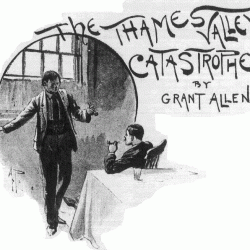
PseudoPod 665: The Thames Valley Catastrophe
Show Notes
 Hey PseudoPod family, is your TO READ pile getting shorter? We have a solution for you. Coming out this week is Monster, She Wrote: The Women Who Pioneered Horror and Speculative Fiction. This is written by our friends Lisa Kroger and Melanie R. Anderson who host the Know Fear Cast along with Matt Saye. I really enjoyed how each chapter begins with an introduction that explains the era and its representative styles. It then follows with a number of exemplars of that era and style in both short and long fiction formats.
And Quirk Books delivers again with the physical copy of this book. The layout is exceptional and O! The illustrations! Each chapter has illustrations in repeating patterns like could inhabit some creepy wallpaper, with subjects related to a number of the particular stories covered there. I loved the pulp panel in particular with Shambleau by C.L. Moore and The Canal by Everil Worrell – which just so happened to run as episode 648 earlier this year. I loved seeing a shout-out to PodCastle and narrator extraordinaire Dave Robison, and we’re looking forward to bringing some of the stories highlighted here to your ears in the not too distant future.
The Thames Valley Catastrophe
by Grant Allen
It can scarcely be necessary for me to mention, I suppose, at this time of day, that I was one of the earliest and fullest observers of the sad series of events which finally brought about the transference of the seat of Government of these islands from London to Manchester. Nor need I allude here to the conspicuous position which my narrative naturally occupies in the Blue-book on the Thames Valley Catastrophe (vol. ii., part vii ), ordered by Parliament in its preliminary Session under the new regime at Birmingham. But I think it also incumbent upon me, for the benefit of posterity, to supplement that necessarily dry and formal statement by a more circumstantial account of my personal adventures during the terrible period.
I am aware, of course, that my poor little story can possess little interest for our contemporaries, wearied out as they are with details of the disaster, and surfeited with tedious scientific discussions as to its origin and nature. But in after years, I venture to believe, when the crowning calamity of the nineteenth century has grown picturesque and, so to speak, ivy-clad, by reason of its remoteness (like the Great Plague or the Great Fire of London with ourselves), the world may possibly desire to hear how this unparalleled convulsion affected the feelings and fortunes of a single family in the middle rank of life, and in a part of London neither squalid nor fashionable.
