

PseudoPod 1007: The Children of the Event
Show Notes
To support us during our year-end campaign, go to escapeartists.net/support-ea
Notes from the author:
As long as I can remember, I’ve been a Godzilla fan. My fate was set at the age of six, when me and a neighborhood boy rented Godzilla vs Monster Zero and Godzilla 1985 from the local video store. As they say, the rest was history.
To this day, I’m not sure why kaiju movies have followed me through my life. Maybe it’s just because they’re cool. Kaiju are big, they break things; they have colorful energy beams—what kid couldn’t fall in love with that? They’re also fantastical, inhabiting a world of sci-fi imagination where aliens and androids are a constant threat. But maybe it’s because, despite their size, they improbably represent something much bigger. War, nuclear annihilation, bureaucracy—the list goes on.
“The Children of the Event” is a kaiju story, but as most in that grand tradition, it’s really about something else. It’s about aging; succumbing to hatred; fearing a world that won’t stop changing no matter how much you wish it wouldn’t. It’s about nervously waiting for the day you cease to be young and bright and full of hope, and become another bitter tool of the establishment.
Godzilla Minus One:
en.wikipedia.org/wiki/Godzilla_Minus_One
The first person to see the wave was a fisherman. Like most of his kind, he was strong, fond of water, and a heavy drinker; he wore rubber boots and a yellow coat slicked with salmon guts. It’s important to stress that there was nothing heroic about this fisherman. He was a normal man. He had friends and family. One bar server remembered that he used to show off on Friday nights, after the day’s catch, impressing local women with his trick shots.?*
Footnote:
* Anonymous interview.
There was nothing that made him more special than all the other men and women who died early that morning, but because he reached for a radio, we know that his name was Jaycee Washington.
To this day, his body remains undiscovered. But it’s his voice, his gasping SOS, that became the soundbite that defined a catastrophe:
“Hello? Hello? This is, uh, Jaycee.”
“Jaycee, this is the coast guard. What’s going on? Over.”
“Something’s in the water. Something’s… [inaudible]”*
Footnote:
* For myself and others, this was history. I remember repeating, “Something’s in the water, something’s in the water,” while watching the news, doing the dishes. These words became a part of us.
The water crashes against the deck and Jaycee is presumably thrown overboard. That alone is enough for a tragedy. A man is dead, lungs filling with icy salt water. But as we know, fate is not so kind. Because after Carbon Angela goes down, the water stills. Then, after an hour, it breaks.
It’s hard to talk about what happened next, because it’s absurdity incarnate. Karin Delle of the Northwest Linguistic Institute posits that’s why we collectively decided to call the creature the Event.
The name stuck. The being, or whatever it was, crawled out of the ocean. Scaly, with black skin and red markings. A crown of curved horns. A maw of dripping fangs. A large distended stomach. Observers calculated it as standing roughly seven hundred feet on its hind legs, and half that on all fours. Its tail was as long as its body and then some. It came to the coast first, scuttling ships and killing men like Jaycee Washington, before climbing onto shore. Most people heard the Event before they saw it. Its deep resonating roar rumbled through the earth, announcing its arrival.
Just as its weight crushed through the docks, sending shards of splintered wood careening through the air, two Coast Guardsmen made the decision to sound the alarm, eleven full minutes after Washington fired off his warning.*
Footnote:
* In the aftermath, this prompted a public debate. Some commentators praised the Guard for their reaction time. Others dismissed it as too little, too late.
The broadcast was hastily put together. Press releases were rushed; news anchors and radio personalities were interrupted mid-sentence with breaking news.
Brian Seneca of WDFQ said, “It was like nothing I’d seen. We’d done emergency announcements before, of course we did. We’re the news. But this carried with it a certain gravity. I could tell it was serious when the information hit us and the producers just looked at each other in disbelief. One of them, Randy, came up to me, dead serious, and said, ‘Read the prompter. It’s not a joke.’ And that was that. I did it. Soon after, we were evacuated.”*
Footnote:
* Seneca went on to mention that the evacuation itself was a surreal affair. “We were hustled out of the building, into a news helicopter, and flown 15 miles up north. We were terrified. The helicopter could only fit so many personnel. They took us first, ‘the talent.’ I never felt so guilty in my life. When we were safe, I watched it fly away. I didn’t realize it was never going to come back.”
The Event destroyed fifteen blocks of newly renovated waterfront property, burying restaurant-goers and the workers that served them in crumbling rubble. It continued its march of destruction for two hours, tearing through commercial and residential neighborhoods alike. Thousands perished during the Event’s initial landfall. Whether by accident or design, however, is an entirely different matter.
One woman, one of several dozen to live in the city center and survive its destruction, said, “…[I]t wasn’t doing much but walking, really. I was shaking. I’m still shaking thinking about it. We were all huddled up under a fallen support beam. I could still see out to the street though. Its claws were yellowish, as big as me, if not bigger. And I couldn’t see much, all I had was a triangle between two slabs of drywall, but I could tell that it was bending over, like it was about to do something. Which terrified me, you know? Because until that moment, I didn’t realize that it had thoughts. It was doing something. I didn’t like that, I didn’t like that at all.”
What the Event was doing in that moment, is an example of dramatic irony on a cosmic scale. The woman, who wished to remain anonymous, was a partial witness to a paradigm shift.*
Footnote:
* Many of those interviewed for this piece wished to remain anonymous, for reasons that will be obvious later.
Many of us, this author included, did not know what the monster was doing in the city. We evacuated early, or lived in the suburbs and quietly quaked, glued to the news. Those who lived in the city had front-row seats to what the rest of us could only imagine.
Helicopter footage showed us what happened in those two fateful hours. The Event crashed through buildings, first knocking them gently with its snout; then, when the tenants in waiting fled, it flattened them completely. This routine was repeated many times. But when the people ran into the streets—and there were a good many—the great beast unhinged its jaw and leaned over them. It becomes obvious, through the footage, that the Event was sucking people whole into its maw. Hundreds of them.
There is one short clip of footage from a supermarket, where the camera is so shaky you can barely see anything but white walls and glass doors. What you can hear, briefly, is one man screaming, “Jesus Christ! It’s eating them!”
Street after street, this continued.
For observers, the horror seemed to last an eternity—and for many of us, the image of the great behemoth, crushing our structures, and vacuuming up our friends and family, would come to define that morning. We sat together in our homes or evacuation sites, hugging each other close. We knew that our lives, or rather, our reality, had changed forever.
At noon, sitting in my one-bedroom apartment, twenty-five minutes east of the city, I heard one of my neighbors in the hallway yell, “It’s gone! It’s gone! The monster left!”
I, and others like myself, wiped the sweat from our brows and gave into our own nervous energy. We left our apartments and walked outside, watching the plumes of smoke rise up into the sky.
An hour later, someone’s teenage daughter pointed at her phone: “Look at this,” she said. Soon, a group of adults gathered around her, to see the video. So many people crowded around her that others were left to ask, “What’s it called? What are we looking at?” and then they too pulled it up on their phones.
We were all watching the same helicopter footage. There it was, the Event, stretched out in the remnants of our city, its posture reminiscent of a cat voiding a hairball. Its back arched, jaws parallel to the earth. It retched. We all watched the video hundreds of times, over and over again.
The Event hacked and hacked and then, a mass of twisted limbs came out of its stomach. We couldn’t make it out clearly from the footage until it zoomed in.*
Footnote:
* An entire article could be written just on how we, humans as a collective, experience trauma on a mass scale through second-hand reporting. Many of us, myself included, never saw the Event, nor felt its presence until hours after it had left. And yet, we still have in us a deep throbbing sense of despair, of loss and terror.
At the end of the video, you can see a large hill of wet humans squirming, separating from each other. The video cuts, a short time jump, and we’re left with a lingering shot. The monster is gone, the Event is over, and on top of the rubble, an army of glowing survivors survey their surroundings.*
Footnote:
* This went on to become an iconic image. The videographer who captured it refuses to be named and has donated the image to the public domain.
It was obvious that the people had changed in some way. We’d seen them on the news, listened to them talk. They described being in the monster’s stomach as something akin to a womb, although they said it smelled of rot and sulfur. By all accounts it was dark, hot, and humid. They floated in a pool of thick saliva and stomach acids, gasping for air. Of the 376 that were swallowed, every one of them claimed that a warm calmness washed over them. When they came out (or were born, as some commenters put it), they glowed a peculiar green. In news segments, I watched them curiously as they struggled to articulate their feelings, as if they were newborn fawns taking their first steps with the English language.
The bias arrived immediately.*
Footnote:
* I myself admit to this, although I’m not proud of it. The first time I saw one on television, I recoiled.
One man, a first responder who attended to the newly born, said, “I had an immediate reaction to them. I couldn’t put my finger on it, but something wasn’t right. They were normal, they looked like us, I thought. But, something inside me felt repelled by them.”
This man, who wished to remain anonymous, captures the popular sentiment against the Children of the Event (who would go on to colloquially be called the Children). Although by all accounts they presented themselves as earnest, eager to help, and curiously humanitarian, their alien gestalt was almost universally off-putting.
The Children reintegrated as best they could. They went back to their families, hugged their loved ones (even when those loved ones cringed at their touch), and the rest of society began discussing the Event with a feverish intensity.
The first matter, of course, was where did the monster come from? The answer was: we did not know. This ambiguity created an ugly back and forth as officials theorized loudly on television. The Event was from the ocean, it was a lost creation from prehistory. Or, it was a product of our invention—a byproduct of environmental waste. Religious officials held an uncomfortable notion that it was the biblical Leviathan. Fringe metaphysicians maintained that it was a God, a spiritual reckoning given shape and form to punish us.
We never received a definite answer. So, naturally, the question “Where did it come from?” became “Where did it go?”
That, too, proved to be unanswerable.*
Footnote:
* Ambiguity tolerance is a part of a country’s cultural makeup and reveals how a culture deals with uncertainty. Ambiguity theorists such as Rosha Hundvirst believe that, while the United States typically is identified as being an ambiguity-tolerant culture, the Event challenged this norm in some way, and since then, neuroticism has become more acute and pervasive. This represents one of the few great cultural shifts we’ve seen happen in real time.
Observably, the Event came from the ocean and returned to it. Nations gathered to sweep the depths, but the Event was never found. It was as if it came to life, then dissolved into unlife. And all it left of itself was tragedy. And, of course, the Children.
My first interaction with one of the Children was at a volunteer event.*
Footnote:
* I did this, in a way, to challenge my own biases.
We gathered to begin the rebuilding process. There was also the hope of rescuing survivors, despite the utter devastation surrounding us.
We were brought together by the destruction of the city and we were determined to do something about it. That’s all anyone could say at their television, for a while. “Somebody has gotta do something!” Collectively, we came to the agreement that this is what somebody ought to do—show up and sift through the wreckage.
It became apparent very early on that there were Children among us. The eerie glow that emanated from them unsettled me deeply. I tried my best not to show my discomfort, because we were there to do a job. We were there to do something.
I was tasked by one of the Children, who was wearing an orange vest and a hard hat, to go with another of his glowing fellows, a man named Carlos.
Carlos was kind and friendly, often giving me advice on how to traverse difficult terrain. He smiled at me gently, helped me when he could.*
Footnote:
* On the day of, it was impossible to read this as anything but pointed condescension.
“Over there,” he said. “There’s more over there.”
Carlos led me to the hollowed-out foundation of an apartment building that he seemed to know intimately, or rather, innately. We dug through rubble. I didn’t talk much, because I didn’t have anything to say, and also I was afraid of maybe saying the wrong thing. As if I would open my mouth too long and I’d have no choice but to ask about what it was like inside of the Event.
Carlos, it seemed, knew the question on my mind. But when he would look up at me, a smile spread thinly on his lips, a twinkle in his emerald eyes, it was like he was daring me to ask. That day, Carlos found twelve corpses amongst the rubble. I found none. When we reported to the organizer though, Carlos made sure to say we found them—a fine gesture, to be sure.
Everyone said it would take years to rebuild the city. We had all started to buckle down, ready for the long haul, while living in fear of the Event returning. It never did, thankfully. But some of us felt like it should.
In actuality, most of the destruction was cleared in weeks thanks to the hard labor of a group of efficient community-minded teams. It came as no surprise to us that they were made entirely of the Children. At bars and at restaurants, in conspiratorial whispers, we told ourselves that it was okay. Of course they’re taking the initiative, no one knows the Event better than them. But even that thought left a cold clump of icy dread sitting in our stomachs.
I made an appointment with Marshall Wallace, the Senior Director of ReBuild—a non-profit organization dedicated to funding the re-development of the city. Wallace was a barrel-chested man who seemed ill-suited for his button-up shirt and slacks. He looked like the sort that found more joy in the solitude of nature, or as a calloused-hand in the trades. Wallace confirmed as much shortly after we met. When he shook my hand, I tried not to recoil, lest his glow penetrate me.
He pointed out a group of construction workers. “I used to do what they’re doing,” he said. “But not anymore.”*
Footnote:
* While upward mobility is often a theme in whispered tales of the Children, it’s important to note it’s not always so. Most of the Children haven’t reported a significant change in salary.
We sat under a tent, a sort of makeshift lunch space. Wallace was gracious and intelligent and looked me in the eyes.
“How do you feel about what people call you?” I asked.
Wallace sighed. “It’s just a name, I guess. I don’t think about it much. Except in the dark.”
“Because of the glow?”
“Right.”
“Have they figured out why that happens?”
Wallace shook his head. “Your guess is as good as mine, bud.”*
Footnote:
* Currently, we have no credible scientific discovery regarding the Children’s glow.
“Some people have said that the Children have changed in some way. Do you agree with that?”
“I don’t know shit about that, bud. I think we all changed. That’s what happens when something like this happens, right? Being in the belly of the beast, so to speak, it gives you perspective. I’d say we’re just like you, doing our best in a difficult time.”
It was because of men and women like Wallace that the rebuilding began at all. While some of us held vigils and made talking points of the catastrophe, the Children acted. And not to be outdone, we followed.
There was pushback, of course. There was a sense that in the wake of the catastrophe, we were moving too fast. That we were not grieving adequately. This grief was for change. Because things were changing.
I first noticed the “Seawatchers” gathered in a long line along the boardwalk. I was on my way to interview a woman who worked in the rebuilding effort. They leaned over the railing, carefully eyeing the soft curvature of the horizon. Some of them locked arms; some of them wept. It was as if they were both mourning and pleading, all at the same time. These Seawatchers were urged internally by a sense of melancholy longing to be swallowed by the Event, to rest in its stomach acids, suspended in bile with their new brothers and sisters.
They could be seen from blocks away, many of them wearing glow stick arrangements to emanate a chemical shade of emerald—a weak substitute for the Children’s natural glow. But, like the Children, they were resented and reviled. “It’s disgusting,” said one anonymous source. “Foul. Just look at them, the way they—I don’t know—grovel.”
I approached the Seawatchers with curious empathy. I too watched the same footage they had; I too felt a deep emotional reaction. We all did. Every one of us lived under the weight of the Event. The Seawatchers though, transubstantiated an invisible slice of the zeitgeist into something concrete—a movement.
They stood there in shifts, at every time of the day. Even in the dark hours of the night, they glowed—albeit artificially. They held each other and looked out to the sea and wished for one more chance to be something special.
It’s funny how even in times of disaster those pesky human needs still roil under the surface. Death screams and rubble can only suppress our desires to be loved and recognized; however, they cannot annihilate them. Standing in the cool breeze, smelling the ocean, I felt what they felt, for a time—that everything we loved was gone, and soon everything would march forward, with or without us.
The Seawatchers, all in all, were a harmless sect. They watched the sea with pensive despair but did little more than loiter. The Children commented on them only when pushed. When it came time to renovate the waterfront and undo the damage from the Event, the Children paused construction. They created a plan to respect the mourning of the Seawatchers and convened with their representatives to find a workaround. The Seawatcher representatives could not hide their glee at shaking hands with the Children. Some wondered if this was the plan all along, to force their attention.
The Seawatchers continued on, as the new waterfront was built under a new architectural vision. They stood in their false glow, totally unaware that a new event was upon them.
I did not consider myself a Seawatcher, but I did spend time with them. They were the only ones who were willing to wear their hearts so plainly on their sleeves. It was exhilarating, in a nihilistic way. The desire to wish the Event back to shore, after so much devastation, was akin to an intrusive thought. It was driving into traffic, jumping off a bridge, playing Russian roulette—pure catharsis.
It was on a cold day in November when tensions reached a fever pitch. At first it was a minor bit of counter protesting. Four people, sans glow, holding picketing signs across the street. One read, “Green Unclean,” while another urged Seawatchers to “Run toward the light.” They laughed and jeered and did little more than tease. But then, slowly, more joined.
It wasn’t until that day in November, six months after the Event, that I felt a more acute friction.
There was no name for the protesters. We just called them people. They were not the Children, they were not Seawatchers. They were just people, like myself. Ostensibly, they had no loyalty or connection to each other, besides the fact that they did not glow and did not want to glow. They came from all walks of life, and many of them brought weapons.
The tide was higher than usual that morning which caused some new chatter. The Seawatchers were prone to assigning value to randomness. They talked amongst themselves. “It’s here,” they said. “There’s something in the water.”*
Footnote:
* This was a rallying cry of sorts for the Seawatchers.
For some reason, they were more elated than usual. The week before, a whale carcass washed ashore, but there was only a murmur of excitement. But on that fateful day, the crowd erupted. Speaking to one expert on crowd dynamics, Dr. Linda Wolk, this explosion in activity could’ve been building for a long time, and it was likely because it had been building, and nothing else. “When people get together in groups, especially for a cause, they want to see results. Eventually, through either fact or fiction, they’ll find them.”
As the tide rolled in, large waves foaming and frothing in collapsing crescents, the Seawatchers cheered. They jumped up and down, screaming. “Yes, thank you! Yes! It’s coming! Take us!”
I watched it come in, bemused, but also energized. I bounced too, throwing my body against them, back and forth, screaming nonsense.
Later, I was told that the people—the regular, plain people—were pacing, agitated. I didn’t see them at all, I couldn’t. I was with the Seawatchers, bellowing my lungs out in the glow of filtered light.
Somewhere down the waterfront, a bullet found its target. We did not hear the gunshot. They found the body and then slowly hushed those around them, craning their necks like meerkats as the unseen rifle kicked and sent another Seawatcher sprawling to the ground, blood rushing from their neck.
Silence overtook us in a wave, spreading whisper to whisper, until it reached myself and beyond. I did not know what had happened; I only knew to be quiet. Many of us, for a moment, thought that the Event had returned, so we turned back toward the ocean to look for a great shape rising from the water.
As another volley of shots arrived, another handful of Seawatchers fell to the ground, dead. Pandemonium struck soon after.
The Seawatchers, once docile and melancholy, turned toward the protesters in rage. The protesters, in turn, ground their teeth and reloaded. They didn’t wait to fire, they kept killing until the rush of the crowd overtook them, until their bodies were trampled under the false glow of angry boots.
I ran, dodging people and bullets, ducking behind outhouses and construction equipment. The city’s pressure cooker of rage exploded all around me, and I ran into a dig site, through the skeletal beginnings of a building I could not recognize. I went up a flight of iron stairs that looped about like the curves in a roller coaster.
At the top, I collapsed, hot breath steaming into my palms. I stared down at the wreckage below me, the violence that overtook the streets.
People were being pounded into paste. It was a squirming mass of wriggling bodies, tearing each other apart. Those who ran stomped away in splashes of blood.
Police cars and ambulances arrived soon after. Men and women exited the vehicles with riot gear and an emerald aura. They used minimal force, I realized. As I watched from my perch, I saw the crowd disperse, the violence mute itself. Once enraged murderers were taken calmly into the backseats of police cars. Green EMTs mended wounds for both people and Seawatchers.
I watched this for hours, a sickness growing inside me.
By the time I left my hiding spot, the streets were clean and quiet.
There was no great violence after, no more events—capital or lowercase. Time marched forward and so did we, as best we could, with the knowledge that our home was not our own. The new world will belong to the Children and their children.
And yes, there were births. The Children reproduced, but only with each other. They bear illuminated children that don’t cry much and hit milestones early; they’re a friendly, insightful bunch. Now, in the city, I can’t help but think the only people I see anymore glow a vivid emerald. They’re eating sandwiches, talking about the news, pushing their brood in new baby carriages. Sometimes, they open the door for me and smile as if they’re holding bile in their cheeks.
There is no more blood in the streets though. There is no more rubble. They don’t live with the memories of before and after.
The city is different. The towers are taller, thinner—like needle points reaching to sew a seam in the sky. They have no windows. Some of them are short and squat, round and metallic. Others curve and loop, serpentine, around the older buildings, threatening to constrict them with their new construction.*
Footnote:
* We didn’t think about how strange these were when they were built. We accepted them. We didn’t even consider that the world that we were building, under the direction of the Children, was a new one.
But now that the Event is long gone, unable to be located the world over, and the city is rebuilt, it seems that that just isn’t enough. The old buildings that survived are now being demolished. Glowing men set the charges and stare solemnly as they crumble. The city is almost done, I hear, but that’s a funny thing to think about. The word “done.” When is a city done?*
Footnote:
* We’ll know when they tell us.
Host Commentary
Here’s what Carson Winter had to say:
As long as I can remember, I’ve been a Godzilla fan. My fate was set at the age of six, when me and a neighborhood boy rented Godzilla vs Monster Zero and Godzilla 1985 from the local video store. As they say, the rest was history.
To this day, I’m not sure why kaiju movies have followed me through my life. Maybe it’s just because they’re cool. Kaiju are big, they break things; they have colorful energy beams—what kid couldn’t fall in love with that? They’re also fantastical, inhabiting a world of sci-fi imagination where aliens and androids are a constant threat. But maybe it’s because, despite their size, they improbably represent something much bigger. War, nuclear annihilation, bureaucracy—the list goes on.
“The Children of the Event” is a kaiju story, but as most in that grand tradition, it’s really about something else. It’s about aging; succumbing to hatred; fearing a world that won’t stop changing no matter how much you wish it wouldn’t. It’s about nervously waiting for the day you cease to be young and bright and full of hope, and become another bitter tool of the establishment.
Carson dances along a very fine line here and does so with a grace and precision that I’ve rarely, if ever, seen managed anywhere else. To the right of that line is the sort of ‘foreigners coming over here, stealing our jobs’ dogwhistle bigoted sewage that governments on both sides of the Atlantic are either kowtowing to or actively spewing themselves. To the left is the sort of very occasionally well meaning small c conservatism that has blighted the lives of everyone born in the UK since the 1970s. Austerity and curtain twitching. Passive aggression and condescension.
In the middle is the honest, compassionate acknowledgement, as Carson says, that aging is terrifying, and difficult. Because it is. And it is. I turned 49 a few weeks ago and while I don’t feel the temptation to turn inwards I definitely feel the expectation of it and see it in the media I work with professionally. Someone, and I wish I could source this, once said the worst crime Star Wars ever committed was to still exist after I was 11 and so much of this terror comes from that sense of time passing. Of time passing you by. Of damage being sustained and sustaining yourself within damage. That’s where this one gets me, in the wreckage of persistent trauma and the whispered voice saying ‘This is all you get. This is all you deserve.’
That voices lies and Carson proves it with a line that stopped me in my tracks:
An army of glowing survivors
There’s a line in The Crow that has the same effect from entirely the opposite direction:
Victims, aren’t we all?
What ties those two statements together for me is the self awareness. For the second it’s awareness of the situation and how little control you have over it. For the first, it’s the awareness that everything that hurts us ends and our agency in all this lies in making sure we don’t end before it does. The way that Carson weaves inconceivable scale and horror around very personal, very real trauma, is…beautiful. And that’s a word I use a lot but I always mean and especially here. Because survivors are never unharmed, never without damage. To be a survivor requires you to have something to survive. And who wants to just survive? Who wants to persevere through hardship? Per Ardua Ad Astra? Hold the Per Ardua and give me a double order of Ad Astra please.
But we survive. We hate it. We don’t want to. But we do. And when you come out the other side, your persistence, your desire to remain the same has made you different. Made you glow with the alien yet somehow familiar light of hard won joy and who you’ve become. That always fades a little but it never quite leaves and you can build such beautiful things with it. As Kat put it when we were talking about this:
The world doesn’t stop, does it? The only time things stop changing for you is when you’re done, and that’s not something to fight for.
Thanks to all. And welcome to the army of glowing survivors.
About the Author
Carson Winter
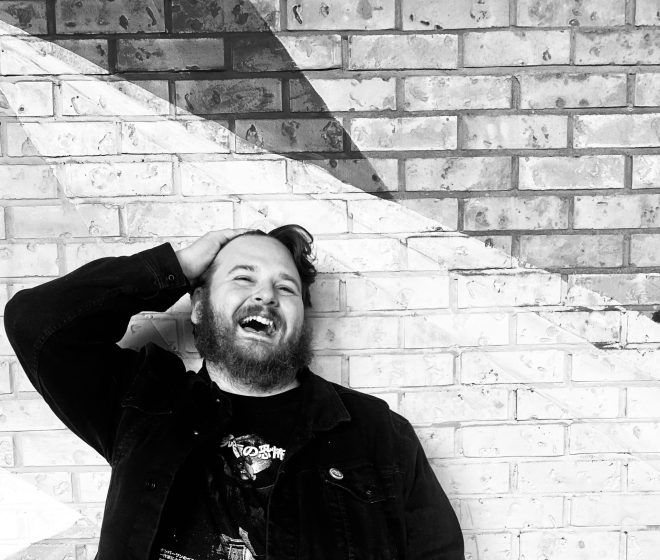
Carson Winter is an award-winning author, punker, and raw nerve. His short fiction has appeared in dozens of publications, including Apex, Vastarien, and Chthonic Matter Quarterly. He is the author of Soft Targets, The Psychographist, and A Spectre is Haunting Greentree. His debut collection, Portraits of Decay, is out now from Salt Heart Press.
About the Narrator
Matt Arnold
Matt Arnold’s podcasts are The UNSONG Audiobook at unsong.libsyn.com, and Fluidity Audiobooks at fluidity.libsyn.com. He narrates fiction and nonfiction which take problems of meaning-making, typically considered spiritual, and turn them into practical problems, which are more tractable. For 20 years, Matt ran Penguicon, a combination science fiction convention and open source software conference. He now runs the annual Fluidity Forum, which can be found at fluidityforum.org. He is a previous staff member for Escape Artists Inc, having shipped the PodDisc archive CDs from 2008 through 2010.”
