

PseudoPod 1058: The Haunted Houses She Calls Her Own
Show Notes
From the author: “The Haunted Houses She Calls Her Own” is of course an homage to Elizabeth Short, better known as the Black Dahlia. Her case has always made me so sad for so many reasons, particularly because it’s still unsolved eighty years later and also because we simply don’t know that much about Elizabeth. In writing this story, I wanted to see her life (and her afterlife) through her eyes, just to spend time in her perspective for a moment, even if it’s only an imagined one.
For anyone who’s read both my collections, this story is in direct conversation with the title piece from And Her Smile Will Untether the Universe. In that tale, a fan is able to keep a murdered actress’s memory alive, which ultimately leads to this moment of final transcendence. In “The Haunted Houses She Calls Her Own,” however, so-called fan devotion becomes a prison for the murdered woman. As part of my writing process, it’s often important to me to go back and revisit the same ideas, only to turn them in different directions and examine how you can invert the same scenario. Life can be so complicated, and something that can be positive in one setting can be so toxic and damaging in another, so I like to interrogate those types of ideas, even if it can be painful and emotionally devastating to do so. “The Haunted Houses She Calls Her Own” definitely was an emotionally draining story to write, but I hope that I honored Elizabeth in at least some small way by creating it.
The Haunted Houses She Calls Her Own
by Gwendolyn Kiste
Her first haunted house isn’t a house at all. It’s no more than a field, a grassy little spot near a Los Angeles housing development, the street shiny and new and filled with promise.
It’s a Wednesday morning, a sunny morning, as bright as the smile she used to give her friends, used to give anybody who would give her a chance. That’s all she ever wanted: a real chance in the world. That’s the one thing she never got.
A young mother with a baby carriage, out for an early stroll, discovers her. When she stumbles upon the crime scene, not knowing yet there’s been a crime at all, the mother thinks the corpse is only a mannequin, something plastic. Something fake.
Then the truth settles over her, heavy as the California swelter, and a single piercing cry shatters the day. From there, it only takes an instant until they’re everywhere. The passersby and the policeman and the press that always follow close behind, their prying eyes never wanting to miss a thing.
She’s a Jane Doe at first, but that doesn’t last long. Her fingerprints are on file, her mugshot more charming than most girls’ screen tests. A few years back, she’d been arrested for underage drinking. Too much fun, the cops said. Nobody would ever accuse her of having too much fun again.
They’ll call her the Black Dahlia, but her real name’s Elizabeth. Betty, to friends. And soon, once the whole world knows about her, knows all the secrets she never told them, she’ll have to wonder if that makes them her friends too.
Like it or not, Betty’s about to have a lot of new friends.
They’ll print her picture, a glamour shot from when she was still alive. You know the one. A faraway look in her eyes, a smile on her lips. A real smile this time, not the one etched into her face, the one she can’t escape.
“Why don’t you smile more, darling? You look so much prettier when you smile.”
But even as they take away her body, Betty doesn’t go with them. She’s still back at the crime scene, an invisible face in the crowd, watching quietly as the reporters gather closer, their hot flashbulbs shattering into a thousand jagged pieces.
Betty wants to stay, she wants to understand, but she doesn’t get to linger here. The fading afternoon air shimmers suddenly, and something pulls at her like fishhooks in her skin, dragging her off through the ether.
That’s because there are other places where she’s expected now.
Her second haunted house is all stone and shadow, tucked away near the Santa Monica Mountains.
They say the property was designed by the son of Frank Lloyd Wright, but Betty doesn’t know for sure, because she never gets to see the whole place. She’s exiled to the damp basement beneath a row of splintered rafters, everything strange and gray.
An echo of footsteps overhead, and Betty crawls back in the dark, hiding from him. The man who murdered her. He’ll come back for her, he’ll do it all again. She never gets a good look at his face, no matter how many times she relives this moment. It’s so impersonal what he does to her. So intimate too.
As she cowers beneath the stairs, the air stinking of black mold and melancholy, Betty thinks how it isn’t fair. There should be no walls, no roof, no doorway to hold her in. She’s a ghost. There should be some freedom in that. But she belongs to the world now, and the world loves a mystery. She’s become a yellowed corpse for yellow journalists. A headline that never gets old.
Yet even after a hundred stories, there are things about her the papers never bother to mention. Little things, all those inconsequential details that define a life.
They don’t ask about her favorite color. (It was blue, she thinks, though she has trouble remembering now. She has trouble remembering so much, as though the ghost she’s become is no more than a stranger to her.)
Or her first kiss. (He was just a silly boy, a nobody, a cipher, but then again, aren’t we all?)
Or how she had asthma growing up, so the doctors recommended she abandon the brutal Massachusetts winters for the Florida sun. (The warmer weather didn’t help as much as she hoped. Nothing ever helped as much as she hoped.)
Or how she liked to play make-believe as a little girl. A few people even claimed she wanted to be an actress someday, because why not? Los Angeles is a city of dreams, a city of angels. (Isn’t it?)
Or maybe she didn’t want to be an actress at all. Maybe that’s just another rumor about her.
One thing for sure: she got famous all right, just not in the way she ever wanted to. Betty’s not the only girl to be murdered in Hollywood—Oh, honey, those come a dime a dozen—but she’s the one the headlines hold onto. The cold case that’s never quite forgotten. The Black Dahlia’s remembered, she’s worth remembering.
Settled back in the gloom of eternity, Betty wonders if being remembered is a blessing or a curse.
Her third haunted house is a hotel, a place she never remembers visiting. But they say she went there, and they say she might have died there too, and it turns out their theories—whoever they are—are the only things that matter. Their theories are what drag her from one place to another, wrenching her through the darkness, a restless phantom at their beck and call.
Before now, Betty was like the rest of us: she assumed ghosts were forever shackled to a single place. But she doesn’t have a solitary haunted house. She has a multitude of them, one for every theory they invent about her. That’s because nobody knows for sure where she died, not even her.
Betty wishes she could remember what came before. She wishes she could remember the last time she was happy.
On the good days, if she closes her eyes, she can almost hear it. The parade on D-Day. The whoops of joy, the acrid stench of car exhaust on the streets of Hollywood, a cavalcade of Chevrolets and Cadillacs going down the boulevard, streamers in the air. If you’ve done your research, you’ll know there’s even allegedly a grainy video of her from that afternoon. In the back of an automobile, she’s with a group of other girls, grinning and celebrating, all the promise of the universe brimming in her heart.
(Betty hasn’t seen the video, and she doesn’t care to. These days, she doubts she would recognize her own face anymore.)
Sometimes, when the headlines wane for a moment and nobody’s looking, Betty can slip away for a little while. Into the endless night, she goes wandering, past the cracked storefront windows and along Hollywood Boulevard, her ethereal fingers tracing the stars on the Walk of Fame, touching the names of the matinee idols from her day. Clark Gable. Lauren Bacall. Veronica Lake.
She pretends they’re still alive. She pretends she is too, a game of make-believe where she’s merely a girl, not a ghost, not a gruesome legend, not this thing they’ve turned her into.
But the make-believe never lasts. Soon, somebody comes up with another theory, and she’s yanked back into the dark, into whatever haunted house has been built for her this time. The world dissecting the case, the man dissecting her. Betty still can’t see his face, but his hands are always the same. Rough yet meticulous. The callous touch of a stranger.
To escape him, she closes her eyes and plays another game in her head. She tries to decide which haunted house she likes best, as though she’s got a choice in it. As though all her silver screen dreams came true, and now she’s a shining star picking a prime piece of real estate in the Hollywood Hills.
But the truth is she’d never choose this city. Not anymore, not after what it’s done to her. All she really wants is to run, as fast as she can.
If only she could remember how.
The haunted houses keep coming for Betty until there are too many to count. A backyard shed. A motel room. An empty doctor’s office. It seems like any old place could become an abattoir, an ideal locale to butcher a young woman.
She wonders if this is how it always goes. Is everywhere just a haunted house in the making?
When she can, she breaks free again and wanders a little further, right up to the city limits, her black pumps quivering against the crumbling sidewalk. Yet every time, it’s always the same. She can’t take the last step. She can’t move on from this place. This city of angels, this city of dreams. The whole town is her haunted house, and it won’t let her go. Nobody will let her go. She’s Hollywood’s favorite ghost, after all.
And what would we do without our favorite things to keep us company?
Betty tries to learn how to live with it. She tries to learn how to live as a ghost. It’s harder than she expects. Life was always harder for her. She never understood how other people made it look so easy.
But she keeps trying anyhow. When the faceless man takes out a bone saw, a kitchen knife, a dull switchblade—it’s different every time because every theory’s got to be different, it’s got to make its own mark—Betty squeezes her eyes closed and pretends she’s merely a magician’s assistant. She pretends it doesn’t hurt.
Sometimes, she almost convinces herself it’s true.
The years dissolve around her until one day, something twists inside the place Betty’s heart used to be, and she realizes it’s too late. Even if they solved the mystery, even if they knew who did it beyond a shadow of a doubt, it wouldn’t matter now. It’s been too many decades, and the man responsible is long dead.
(And let’s face it: it was a man who did it. We don’t need DNA or fingerprints to know that. Some stories can only end one way.)
Tonight, the streets are empty, the palmettos drooping in the Los Angeles heat, and Betty goes walking again. Back to the lonely crime scene, that spot where they discovered her. It doesn’t look like much. Just a verdant lawn, a generic patch of grass. There’s nothing to mark that it was hers. Her first haunted house. She gazes down at it, wishing she could feel connected to this place. She wishes she could feel anything.
(Is a ghost even supposed to feel, she wonders?)
She wishes other people could feel for her too, even though she’s already figured out they don’t. The audience pretends to care, pretends to mourn her, but what everyone really wants is a good show.
Betty knows that now. She knows that while the man who murdered her cut her in two, the world is determined to cut her up into even smaller bits than that. Maybe that’s the only way it can go. Because honestly, can you ever honor the dead, ever really do them justice? Or is everybody just a story to sell?
(Should we be talking about her now? Should we even speak her name? Or should we just leave a girl to her coffin and call it a day?)
But you can’t help yourself, can you? You’ve been watching her for so long. We all have. The whole world’s never been able to take their eyes off her. She was nobody until she was somebody, the grotesque inverse of the starlet she longed to become. Her greatest role was to play herself, to play dead.
(Does that mean we’re all her murderers now? Are we accomplices to what’s become of her?)
Even though it’s too late to make a difference, you still want retribution, you want answers. You forget you weren’t the one forced to carry the burden. You’re only a spectator, someone who’s defined Betty through her ending. As if that’s the only moment of her entire life that ever really mattered.
(Why is it you feel more kinship to dead girls than living ones? And what do you think that says about you?)
The air around you shimmers, and something’s suddenly pulling at you, like fishhooks in your skin. You want to escape it, but you close your eyes instead, and when you open them again, everything’s changed. You’re the girl in the picture now. You’re the one in the basement, the one bisected in the field. No more than a bloodless mannequin, a butchered doll for the world to pick over like vultures.
(Is this what you wanted? A vicarious thrill? A chance to know what it feels like to die? Betty could have told you it’s not worth the curiosity, but would you ever bother to listen to her? Will you listen even now?)
You try to run, but the haunted houses follow you everywhere you go, the air thick with mildew and heartache, the endless hallways as unforgiving as the dead.
This is what she felt, what she’s always felt. Trapped in a place she doesn’t know. Trapped by you.
But don’t worry. You won’t be imprisoned forever like her. Betty would never allow that. Remember: you’re the monster. We all are. But not her. She’s something different now. Something fragile as porcelain yet stronger than infinity.
The walls start to tremble, the plaster shattering like broken bone. You’re not the one doing this. It’s her. She’s finally devised an escape route.
A final sprint, and you break away from the haunted houses, but you’re not alone. Betty comes along for the ride. She won’t be your ghost in a peepshow any longer. You can still pick over the remains of the case if you’d like, but she won’t be there to reenact it for you.
Instead, she seeps into you, and with your body cracking from the inside out, you never realized a ghost could be so heavy.
You know my name. You know my face. I’m the girl in the picture. The girl who never gets to stop smiling, never gets to rest, no matter how hard I try, no matter how loud I scream.
(You never heard me until it was too late. Everyone is always too late.)
You’ve been watching me for years, and I’ve been watching you too. You think you know me. People keep making that mistake. But I’m more than the scars on my face, more than the knife in my flesh, more than all the rumors and the theories and the late-night sleuthing you could ever do in a lifetime.
I see you now. I see you all. Don’t try to turn away. This is the moment you’ve been waiting for, the grand finale.
With the last of the haunted houses crumbling around us, I shake off your body and set you free. I’ll offer you a second chance. (It’s the one thing I can give you that I never got.) Besides, I don’t need you anymore. You’ve taken me as far as you can. The rest is up to me.
The night fading away, I reach the city limits, and with a final breath, I take that last step, Hollywood finally disappearing behind me. All the empty dreams I ever had disappearing with it.
At last, the sun cracks through the California sky, and as the breeze whispers in my long dark hair, I look back once and smile—a real smile, my own smile, my body no longer belonging to you or him or anyone else. For the first time, I’m on my own, and still grinning, I turn and vanish into the morning, running as fast as I can, running like a child, until the ghost of me is gone.
Until I’m everywhere.
Host Commentary
If you’re not from the States, you might not be aware of the Black Dahlia murder. I certainly wasn’t. In January 1947, a woman named Elizabeth Short was found murdered in the Leimert Park neighborhood of Los Angeles, California. Her case became highly publicized owing to the gruesome nature of the crime, which included the mutilation and bisection of her corpse. Maybe worse than the Ripper murders. And for reasons unclear, this became known as the Black Dahlia murder, possibly as a handy media tag.
The murder is unsolved to this day and has made a lasting impression in the States. It has generated speculation, theories, books, films, TV shows in both fiction and non-fiction.
That’s a little bit of background. Gwendolyn has this to say about the story:
“The Haunted Houses She Calls Her Own” is of course an homage to Elizabeth Short, better known as the Black Dahlia. Her case has always made me so sad for so many reasons, particularly because it’s still unsolved eighty years later and also because we simply don’t know that much about Elizabeth. In writing this story, I wanted to see her life (and her afterlife) through her eyes, just to spend time in her perspective for a moment, even if it’s only an imagined one.
For anyone who’s read both my collections, this story is in direct conversation with the title piece from And Her Smile Will Untether the Universe. In that tale, a fan is able to keep a murdered actress’s memory alive, which ultimately leads to this moment of final transcendence. In “The Haunted Houses She Calls Her Own,” however, so-called fan devotion becomes a prison for the murdered woman. As part of my writing process, it’s often important to me to go back and revisit the same ideas, only to turn them in different directions and examine how you can invert the same scenario. Life can be so complicated, and something that can be positive in one setting can be so toxic and damaging in another, so I like to interrogate those types of ideas, even if it can be painful and emotionally devastating to do so. “The Haunted Houses She Calls Her Own” definitely was an emotionally draining story to write, but I hope that I honored Elizabeth in at least some small way by creating it.
About the Author
Gwendolyn Kiste
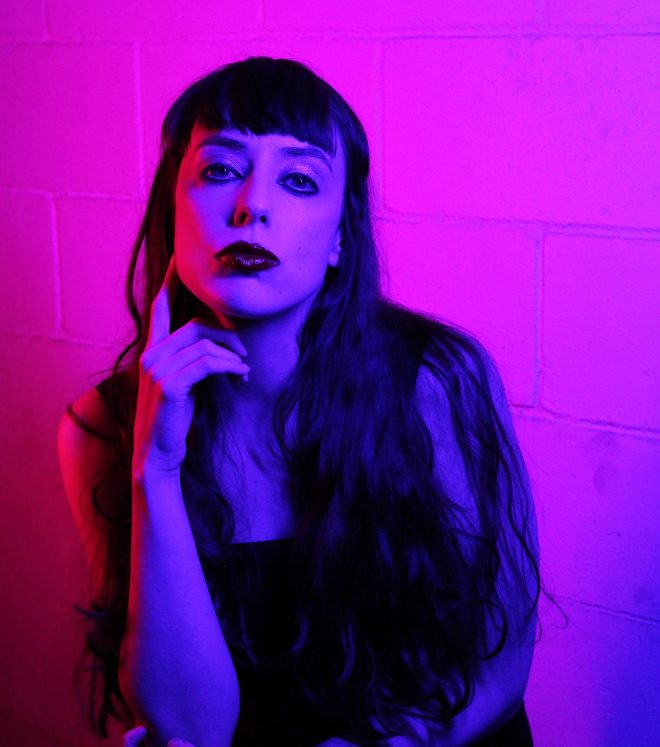
Gwendolyn Kiste is the three-time Bram Stoker Award-winning author of The Rust Maidens, Reluctant Immortals, Boneset & Feathers, Pretty Marys All in a Row, and The Haunting of Velkwood. Her short fiction and nonfiction have appeared in outlets including Lit Hub, Nightmare, Best American Science Fiction and Fantasy, Vastarien, Tor Nightfire, Titan Books, and The Dark. She’s a Lambda Literary Award winner, and her fiction has also received the This Is Horror award for Novel of the Year as well as nominations for the Premios Kelvin and Ignotus awards. Originally from Ohio, she now resides on an abandoned horse farm outside of Pittsburgh with her husband, their excitable calico cat, and not nearly enough ghosts. Find her online at gwendolynkiste.com
About the Narrator
Kitty Sarkozy

Kitty Sarkozy is a speculative fiction writer, actor and robot girlfriend. She is an alumnus of Superstars Writing Seminar, and a member of the Apex Writers Group and the Horror Writers Association. Several large cats allow her to live with them in Marietta, Georgia, and she enjoys tending the extensive gardens, where she hides the bodies. For a list of her publications, acting credits, or to engage her services on your next project go to kittysarkozy.com.
