

PseudoPod 1057: Trench Foot
Show Notes
The Short Timers by Gustav Hasford
https://en.wikipedia.org/wiki/The_Short-Timers
Full Metal Jacket, which was based on The Short Timers
https://en.wikipedia.org/wiki/Full_Metal_Jacket
BSG: The photo in the pilot ready room
https://scifi.stackexchange.com/questions/122184/what-is-the-picture-that-the-pilots-touch-in-bsg
Lake Mungo (ENORMOUS spoilers here. If you haven’t seen it, watch it first)
Trench Foot
By Phil Keeling
You’d think that more of us would have wondered where the foot came from.
You’d think that, unless, of course, you were living in the trenches. No matter how dreamy of a kid you’d started your life as, a few days praying for survival in the mud and rat shit of the trenches was enough to make a single human foot jutting from the earthen walls seem commonplace, even charming. Men got to rubbing the limb for good luck during particularly bad raids, and some even took to trimming the damn thing’s yellowing nails, taking meticulous care with them as if the foot belonged to an invalid relative. Heavily knuckled, with dark patches of fuzz that lined the toes, the foot was pale, cold, and unmoving, just like the muddy walls that seemed to birth it. It had little to no arch: not the foot of a soldier. Which is perhaps why we accepted it so readily among our compatriots: none of us felt like soldiers, either.
It was a common enough welcoming tradition: find the latest recruits, clean and mudless just out of Boulogne or St. Nazaire, show them around, trick them out of confectionaries and cigarettes, and then show them the foot. After a few weeks, however many were still alive would then be in charge of showing the fleshy relic to the next bunch of poor bastards. And so on, and so on.
We’d have called it the “ouroboros of the foot” or something clever like that if we were any better than stupid boys with guns, which of course we weren’t. The point is, anyone who might have been there long enough to remember the first day it was sighted had either been killed or transferred long ago. It wasn’t just that we didn’t know where the foot had come from originally: we couldn’t remember a time before the foot. We didn’t ask many questions about it after the initial shock wore off. We learned to stoop under it as we passed, otherwise running the risk of taking a mouthful of toes to the face. But other than standard precautions like that one, we didn’t find ourselves to be all that curious.
That’s why Henri’s attitude really began to get under our skin.
He was a little man, or at very least it was easy enough to think of him as such. The truth, I think, is that we saw him as smaller than most of us because he was from the latest batch of new recruits. If we’d actually taken the time to really pay attention, I think we would have been surprised at how close he was in height to most of us. But he remained “the little guy” to many of us, a nickname that we made no attempt to hide, and he, to his credit, didn’t throw a fit over. Maybe he knew that it would only have accentuated what we perceived as his delicate immaturity. His eyes were bright and innocent, his occasional tufts of facial hair soft and wispy, as if they’d never been touched by a razor. It wasn’t Henri’s fault, poor little guy. He was just unlucky to be the latest kid brother in a muddy trench filled with frightened, cruel older siblings. He wouldn’t be that way forever: all he needed to do was wait for the next batch of recruits. It was something we all dealt with at some point or another.
Outside of his perceived diminutiveness, he started out like any other member of the company. Fresh off the trains, given his bunk and assignment, and stupefied by the grim horror of the realities of this “great war” that we’d all been sold on. And as if that wasn’t enough, then there was this limb sticking out of the semi-hardened mud of the trenches. He did like so many others before: disbelief, eventually to the point of assuming the older soldiers were playing a joke on him. Some speculation on where the foot could have come from. Occam’s razor: obviously this was just the remains of some unlucky son of a bitch who died in the mud and then was rediscovered: a modern archaeological dig. Then came a false sense of aloofness. The notion that he wasn’t going to allow us to make him look foolish with such a child’s game. Sure, that’s a foot. But why would I concern myself with it when we’re playing war out here? And eventually, acceptance. Yes, that’s a foot. Damndest thing I ever saw. Now who’s got a spare cigarette?
And that would have been the end of it. Should have been the end of it. Only Henri never made his way to that all too important moment of acceptance. Even after the first few days of serious back and forth, with the mud mixing with blood and the constant, whistling sound of hot tin spitting past your ears. Sometimes even during the worst of it. You’d catch his eye while reloading a magazine, and hear him shouting something like, “Say, you suppose it could be some sort of pickled body? The way those Egyptians do it?” And someone would say, “Say, little guy: do us a favor and stick your head over the side. Let us know if it’s gone quiet.”
Henri wouldn’t get mad, though. He’d just shake his head and mutter other theories to himself, like a newly converted heathen who’s sad to see himself among blasphemers and pagans.
This went on for weeks, with most of us doing our best to ignore Henri and even the foot itself. Some made a game out of it: if they could all pretend that the foot wasn’t there, perhaps Henri would begin to feel a bit mad, as if the whole thing was just a figment of his imagination. But somehow that made him double down on the whole situation, even going so far as to rap the fleshy thing with his hands, like a bizarre moment of applause.
“How can you ignore that?” he asked over and over, slapping the foot for emphasis. “It’s impossible to ignore.”
The pranksters largely quit their games not long after that incident. He was right, after all: the foot was impossible to ignore. Things only got worse from there.
We caught him early one morning, tearing away at the muddy embankments with an entrenching spade, pulling great hunks of mud and rootwork out with every gasping grunt and swing.
“It wants to be released!” he kept insisting as we pulled him away. “It’s my duty to free him from this prison!”
Our stated position was that we didn’t want this kid with a shovel to compromise the structure of our trenches because of some mad mission. But if we were being honest with ourselves, I think we didn’t want to see any more of the foot than was already exposed. For some, it was because it seemed disrespectful: the foot had already been through so much, like the rest of us. Why strip the limb of what little dignity it already had? But I think for most of us, it was out of a need to preserve our own precious ignorance. We didn’t want to know how far beyond the foot went. It was enough for us to see it every day and do our best to cope with gallow’s humor and teasing the new recruits. We laughed at their shock and ignorance to mask our own. Acceptance of the thing wasn’t the same as understanding it.
And nobody was going to force us past that line into no man’s land.
It was during a week of relative quiet that some of us saw the foot move. It was just a few of us, half asleep and chewing on food that came out of unlabelled cans (no one knew exactly what it was). We weren’t talking at that point, just letting the rest of the time go by like a fly through a porch swing: hopefully another tiny, insignificant day that would pass through our ears without incident, without purpose. The foot was there, every bit a part of our group, as it always had been. It might as well have been smoking a cigarette and complaining about the state of the platoon’s wine stores. When the toes wiggled, it was barely an event. Honestly, it was something that we didn’t even think to bring up until later that evening, when Henri had returned to that section of the trenches and begun his usual inspection of the limb.
“It moved?” he asked us, his eyes practically bulging out of their sockets.
“The toes,” someone explained (it might have been me). “Just a little wiggle of the toes, as if someone had given them a tickle.”
In response to this, Henri began to tickle the foot. Gently at first, but with an increasing vigor that seemed to turn slowly into fury. We pulled him away for the second time that month, this time around worried he might actually cut into the poor thing’s heel with his dirty, unclipped nails.
We thought at first that this would be the end of it: at least those of us who dragged Henri away did. But whatever the little guy had lacked in his vision for the holy relic of the foot originally disappeared now that we’d seen it move. It was like someone who was already a religious fanatic actually witnessing the beauty of an angel or seeing the face of god. His spirit was already fervent for this thing: he was already so full of questions. But now, others showed up alongside him.
This shouldn’t have bothered the rest of the platoon as much as it did, but we had no idea how possessive we’d become about the foot. And at the same time, we were angry at these new converts and their divine interpretation.
It’s not a big goddamn deal, we’d say. It’s just a foot. We’ve all got them. Who cares? And anyway, it’s our foot, so hands off!
But they just kept coming. The words of Henri spread like zealot’s blood through the trenches, bringing pilgrims and tourists from camps as far as a mile away. They lit candles and left gifts for the foot. In a matter of days, the thing was surrounded by wilted flowers, mud encrusted photos, and lovingly hand-rolled cigarettes. The pile would gather and gather, to the point that we started to wonder how we’d be able to move around it from one stretch of the trench to the other. And then there’d be another shelling from the other side of no man’s land, and the muddy earth would shake loose, covering the gifts in the debris of war, while refusing to expose any more or less of the foot than was already obvious.
And just like the novelty of the relic itself, the whole thing got to a point where we just didn’t notice anymore. Henri and his little religious gang would come to visit and take great pains to wash and dry the foot before the day ended.
“We can’t have you going to bed with dirty feet, can we?” Asked one man. The bars on his arm identified him as a Captain, and I did my best to ignore that. That’s how it feels during a war: the whole goddamn world has lost its mind and you do your best to just pretend that you didn’t notice or that it all makes sense. Superior officers washing a disembodied foot; our foot, no less. Fine. It wasn’t like we didn’t understand. Most of us had families or girls back home to write to: people that created the light at the end of our private tunnels. As far as any of us could tell, Henri and a bunch of the foot lovers didn’t have anyone. Say what you want, but fighting and dying in the mud between cigarettes and tea could make any religious totem look good. And I have to admit, there was something about the foot that slowly started to take on a new glow.
Maybe it was all the candles.
When the food started to run out, that thing looked mighty different, though.
Rats were in the rations, they were in the wine. They’d been in everything, of course, and we’d grown used to shaking our bread and discarded clothes free of droppings, scattering them across the floor, where they’d rehydrate and be consumed by the mud underfoot. Nibbles and bites could be found on anything organic, and it became clear that a fraction of every meal would act as a sacrifice to the vermin that shared our hallways. But as the screaming winter winds began to blow across the battlefield and into the runnelled earth, the rats became more voracious, stealing more than what we’d grown comfortable with being their fair share, and making themselves practically invisible in the meantime. We would have eaten the rodent thieves if we could find them, but they knew the earth better than we did, and only ever came close enough for us to hear their mocking chatter. Crackers and coffee were scarce, let alone any sort of meat. It was only a matter of time before someone recommended the foot for butchering. It caused all kinds of arguing, of course. Some of the men claimed that the foot wouldn’t have enough meat to bother. Some of them argued that there wouldn’t be enough to go around; that it would lower morale and cause fighting. No one argued against the actual butchery, however.
Until Henri arrived, that is.
When he realized what we meant to do, he began to scream; to curse all of us. His eyes flashed and his blood went scalding like the surface of an engine block, and in the cold of the winter mist, the heat of his anger fell off of him in sheets of steam. He bellowed about blasphemy and cruelty and retribution. He told us that we were going to mar something important: a black eye in the skull of a long-dead saint. One man, a big, rangy Norman, knocked Henri out of the way, and got in close to the foot, drawing an arm-length bayonet that had been sharpened to a razor polish. I think he imagined himself slicing the foot up in sheets, like thin strips of jambon. I can’t pretend that I didn’t salivate at the thought. The Norman even managed to put the blade against the skin of the extremity, close enough to shave a toe knuckle. Henri screamed something: I was never sure what, because my focus was on the foot.
And its toes wiggled.
Like a flourish; like a playful wave to a friend or an involuntary reaction to being tickled. And suddenly no one had anything else to say. We watched in silence as Henri, his eyes wide with reverence, crawled on his hands and knees to the trench wall, where he stretched himself up the mud barrier like a cat, and pressed his lips against the ball of the foot. There was a furore in his eyes, as if this tiny action had changed everything for the young recruit. There was no noise: not even a cricket to cut through the cold evening air. I don’t know if the silence lasted a minute or an hour, but when the single shot from the other side of No Man’s Land cut through the evening air, it was like we had been doused in ice water. It was like during downtime in the trenches: the briefest punctuation of violence rudely interrupting meals, naps, cigarette breaks. It was nothing that phased anyone who had been in the mud for more than a week or so. It almost got to the point that it made you feel safe: guns are still being fired, the world is going exactly in the direction we’ve grown accustomed to.
But in that moment, something in Henri shifted. I can’t know for sure, but I think the random shot, fired by a random soldier, seemed blasphemous. To him, it was as if that bullet had echoed through a church instead of a battlefield. When he unslung his rifle and climbed over the edges of the trenches, I’d love to say we were surprised. But to be honest, it seemed like the most natural thing in the world. No one said anything: not even to comment on his bare feet.
Of course, none of us followed him.
The evening mist swallowed Henri as he charged across No Man’s Land. He made it a good deal in before someone on the other side brought him down. He made it far enough that we couldn’t see him for the fog. We didn’t know he had it in him.
We’d never see the foot move again, but after that night, a hush fell over the trenches and the battlefield itself, as if even the enemy knew that something profound had happened. It weighed on us like the mud and morning fog. I’m not sure that everyone saw it as some sort of divine signal, but the number of lit candles and offerings left beneath the limb only increased. And as I cleaned my rifle for the thousandth time in the mud and blood and rat shit, I knew I couldn’t blame anyone for putting their faith in any sort of relic: even a perfectly preserved foot set in the mud. Sometimes I even imagined the rats kneeling in reverence in its shadow: after all, it was the only scrap of meat in the whole labyrinth of the trenches that they dared not to nibble on. Three full days of silence felt like a blissful eternity in those days. You almost felt safe; some of the men even became so brazen as to become bored.
But no peace lasts forever. Because it turned out that the enemy hadn’t, in fact, joined us in a reverent moment of religious ceasefire for any reason other than to acquire and position a detachment of mortars.
The first swarm of shells shattered the wood and mud of our trench walls like a hammer against a mirror. The effect was similar on the men who were struck, and shredded pieces of meat and uniform spun through the air, streaking the survivors in violent streaks of vermillion. The wooden barriers and the ground shook, sending up dirt and limbs and the smells of brass and shit. Earthen walls that had seemed so solid before collapsed like hills of sand at high tide. It rattled the teeth in our jaws and most of us were too busy trying not to notice that the dark soil that held the foot in place had crumbled.
I suppose somewhere in all of our minds that we knew there was a body attached to that thing. But we hadn’t given it a lot of thought, the same way you don’t fully consider the idea of the wine and the wafer being body and blood. Call me crazy, but I’m not sure we’d learn anything if the mysteries of the universe just got laid out for us to see. I think we’d make excuses and ignore it, the way we all did that morning as our tunnels disintegrated and our bodies died. The way we all ran past the foot and its attached body like maybe we didn’t want to know what was attached. Maybe we didn’t want to see the face. Nothing could live up to the foot, right? I don’t know for sure. The only thing I’m certain of is that we never saw the limb, those trenches, or many of our friends ever again. But when it was my turn to run like the devil was chasing me, I tried to slow down. When that foot, that leg–Christ, it had a leg–revealed itself, I didn’t forget my natural instinct to hide. But I strained my neck to see something more. And for a split second I swear the body had Henri’s face, and it was staring at me, though not in an accusatory way. He stared as if I was viewing something forbidden: a glimpse behind the veil.
And maybe I was, because next thing I knew I was in a triage tent. I assume the shell that took my eye and my arm was the same one that forever buried the foot and the body attached to it. I didn’t bother asking if anyone else had seen it. I was already starting to force myself to forget the whole damn thing. That’s where I start to think that I failed: not talking about it to others. It didn’t matter that nothing about it made sense or that I was a shell-shocked poilu everyone expected to hear nonsense from.
In the years that followed I learned to write with my other hand and fitted myself for a false eye. And things started to slow down in a way that terrifies the young and comforts the old. I could look for something else in life: something that wasn’t encased in brass and filled with black powder. But there were nights that I still woke up thinking about Henri’s face and that foot. And I feel guilty, like he needed me to tell his story. Like I was some half-blind Saul of Tarsus. And I sit down at my desk and write little memoirs like this and wonder about taking it to the masses. I could join the ranks of street-walking madmen who squealed like pigs about the end of the world and absolution. But worse than that, proselytize about a deity who doesn’t even have a full body. But I still consider it every few weeks or so–I give the idea some of my time. More than most would, anyway. I think of the foot surrounded by gifts and candles and tokens like the severed limb of a saint. And I think of Henri and the mad look in his eyes as he attempted to dig the foot out of the dirt. And I quiet my mind for another month.
Host Commentary
It almost got to the point that it made you feel safe: guns are still being fired, the world is going exactly in the direction we’ve grown accustomed to.
As this year’s Parade talks about, we’ve spent a lot of time this week doing involuntary familial archaeology. Your sense of time shifts, and your sense of place goes with it. You eat because it’s time to eat. You sleep because the day’s finished. You have a handhold on something enormous and the temptation is there to keep going until it’s landed, until it’s at the top of the hill, until you can rest. But adrenaline is a liar, just like depression. You need to rest, because if you don’t, you don’t just skew your sense of normal, you lose it.
I had a whole other essay written for this one about the astounding dangers and moral and ethical cowardice of the ‘I’m Just Asking Questions’ mindset that manly men who know a lot about jujitsu get paid to espouse over at Spotify. It was funny, several really solid jokes and a lot of anger at watching a profession and medium I adore being hijacked by terrified, cowardly little men who think contrarianism is compassion and compassion is a finite resource.
But it didn’t do anything. It cosplayed as a rational discussion of this story and the motifs behind it when in truth I’d just read a story about a famous science fiction author saying something even more cowardly and stupid than his last outburst and it’s US mid-terms day and sometimes we’re all frightened enough to want to punch up. Or punch down, if we’re very frightened and very broken.
Or as bad, cling onto something. The persistent sense of escalated, fake normalcy the soldiers cling to is a trauma response and it’s one that makes sense in a landscape made of nothing but physical and actual trauma. Sorry Charlie from The Short-Timers springs to mind, as does the ambiguous photo of a marine above the ready room door that every pilot on the Galactica touches on their way out. Everything looks like a life raft if everything else has sunk, and if there are no atheists in a fox hole there’s certainly plenty of schisms to go around.
That’s the horror for me here, that sense of shattering. Henri started as the only rational one and was punished for it. Henri finished as the most irrational one and was punished for it. If you’ve ever seen cult classic Lake Mungo I got echoes of that here too, the idea that when a traumatic event like war happens the shelling doesn’t just damage the soldiers and the land it damages everything. Time. Reality. Compasses madly spinning as the walls come down and the only thing to be done is run until you can’t or until you can stop. Even then, the final lines here are one of the best metaphors for PTSD I’ve ever encountered. With work, you can be fine. But the work never stops even when you really don’t want to do it.
Stunning, witty, terrifying. Great job everyone.
About the Author
Phil Keeling

Phil Keeling is a writer and playwright. He is the author of the novella Juice, published by Psychotoxin Press in 2023. His first collection of short stories, Be Not Afraid, is slated for publication in 2026 by Baynam Books Press. His short stories and essays have been published by a number of periodicals and anthologies, including Uncharted Magazine, Coffin Bell, Cleaver Magazine, The Pinch, and many others. His plays have been featured in theaters all over the United States, including The Barter Theater, The Pittsburgh New Works Festival, and the 13th Street Repertory Company. He is the co-host of Pixel Lit: the best (read: only) podcast dedicated to video game novelizations. He lives somewhere in the woods with his wife and son.
Social Media Links: PhilMakesMonsters on Instagram and BlueSky
About the Narrator
Matt Dovey
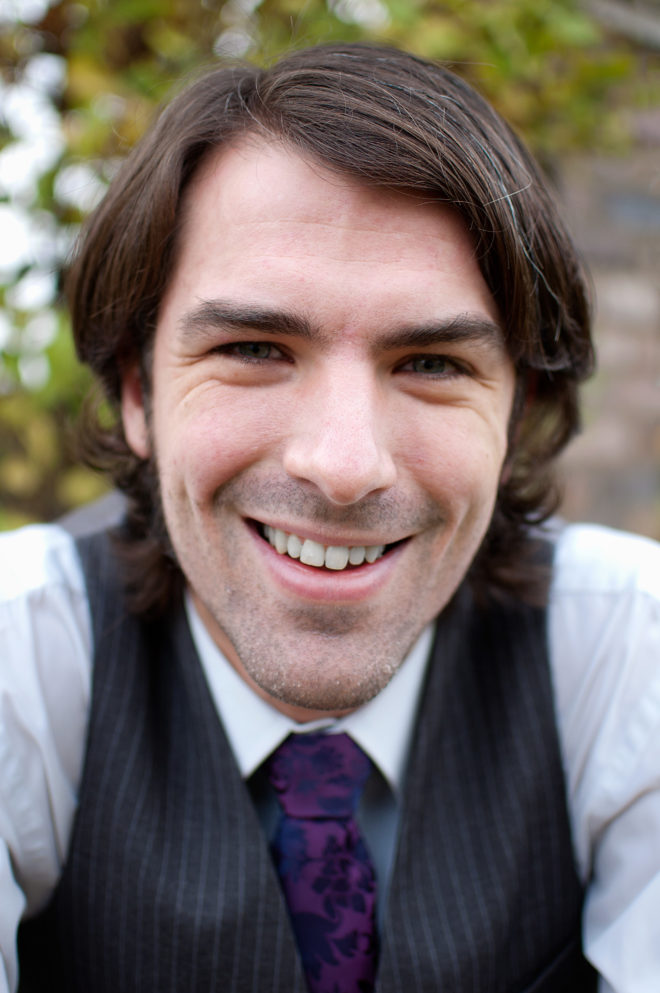
Matt Dovey is very tall, and very British, and although his surname rhymes with “Dopey” all other similarities to the dwarf are only coincidence. He’d hoped for a more exciting mid-life crisis than “late autism and ADHD diagnoses”, but turns out you don’t get to choose. The scar on his arm is from an accident at the factory as a young ‘un.* He lives in a quiet market town in rural England with his wife, three children, and varying quantities of cats and/or dogs, and has been the host of PodCastle since 2022. He has fiction out and forthcoming all over the place: keep up with it at mattdovey.com, because he’s mostly sworn off social media. Mostly.
(*Or so he claims. The Castle dragon told the Tower tentacles a different story…)
