

PseudoPod 1051: The Ghost of a Flea
Show Notes
- The Ghost of a Flea (miniature painting by William Blake)
- Inside No. 9 Stage/Fright
- Quote Investigator: There Are Things Known, and Things Unknown, and In Between Are the Doors
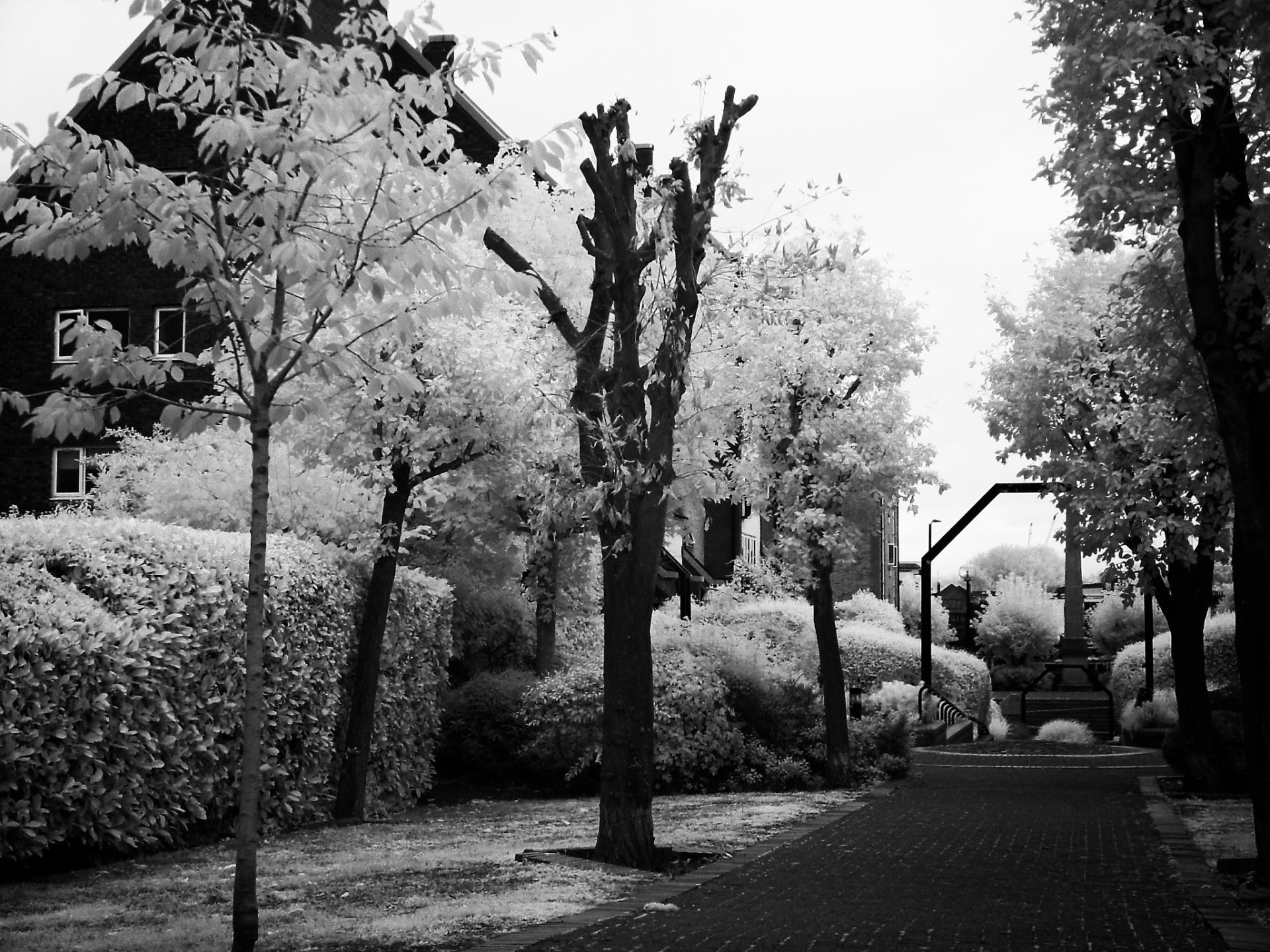
‘Courtyard’ by Tol, taken using a 2002 Sony DSC-F717 bridge camera.
The Ghost of a Flea
By Orrin Grey
“Of course, I haven’t exactly conducted a survey,” Robert was saying, “but I get the impression that people used to see ghosts a lot more often than they do these days. Doesn’t it seem like the opposite ought to be true? After all, with each passing year, the number of dead must steadily increase, so by now the spirit world should be quite crowded. It seems that seeing ghosts ought to be a daily occurrence.”
There were a million potential responses, the majority of which presupposed that the people of past ages weren’t actually seeing ghosts most – if not all – of the times they thought they were. One could blame superstition or religious fervor. One could point to a simple lack of understanding when it came to a variety of scientific principles, from optics to hallucinations. One could even suggest that belief in ghosts was more widespread then, meaning that people were more likely to assign the name “ghost” to something they couldn’t explain, whereas today we might call it something else.
However, Robert had already grown tiresome by that afternoon. He and Luke had been alone together in the dark, wood-paneled rooms at the top of Parmenter Hall for the whole winter break, and by this time even the sex had grown stale and each was starting to get on the other’s nerves. So, instead of any of the responses he might otherwise have given, Luke replied, “Who says it isn’t?”
“What do you mean?” Robert had been pacing the wood floor, while Luke reclined on the green cushions of the ratty sofa in front of the windows. Now, Robert wheeled on him, taken off-guard by the unexpected response.
“Who says we don’t see ghosts every day, and just don’t know that we’re seeing them?” Luke asked, not looking up from the periodical he was idly paging through, but not actually reading. “How do you know what a ghost looks like? Should it be dressed in a sheet? Should it be nothing but bones? Should it be rattling chains? Maybe every third person in a crowd is a ghost. If you don’t know them, you’d never know. And that’s assuming that ghosts look like people at all, but why should they? Whatever a ghost is – soul, spirit, mental energy, merely a recording – why should it look like the vessel that previously held it? For all we know,” and here, Luke pointed to a dark tree standing outside on the snowy quad, “that could be a ghost.”
Robert, his mouth still open, followed the line of Luke’s pointing finger to the dark tree outside. It was small, not more than six or seven feet tall, and it grew near the grape arbor which was now home only to dead vines that the groundskeeper had not yet trimmed back. Like the other trees on the quad, the dark one had no leaves, only nude branches as black as the bark of its trunk. Had that small tree always been there? Of course, it must have been but, at this moment, Robert couldn’t recall ever having seen it before.
He sank heavily into a red velvet chair. “I hadn’t ever thought of that,” he said, an unusual admission of intellectual vulnerability that made Luke immediately feel regretful of his earlier annoyance.
To be honest, Luke hadn’t ever thought of it before, either. It had simply tumbled out of his mouth, an expression of his irritation at what he, in his less charitable moments, saw as his companion’s pomposity.
“There’s a painting by Blake,” Robert was saying, his voice quiet now, almost breathless. “I saw it at the Tate, when I was studying abroad. It’s tiny, no bigger than this,” he held up his hands, thumbs and forefingers at right angles to form a rectangle no larger than a book. “There’s a figure in it. Manlike, but not a man. Muscular and monstrous. Repugnant, yet somehow also erotic in its strength. Have you ever met a person and thought that they would hurt you, but you also sort of wanted them to? It gives that feeling, I think. Blake called it ‘The Ghost of a Flea.’”
“I know this story,” Luke chimed in, setting his magazine aside and rising from the couch. He walked across the room and began digging through the books that were piled alongside his desk. Where Robert was studying letters, Luke was pursuing painting, and the stack was mostly books of art and treatises on various painters, sculptors, et al.
“John Varley was a painter and occultist, founding member of the Old Watercolour Society at the Royal Academy,” Luke said as he rifled through the tumbling pile. “He was also someone who wanted desperately to see a ghost, but never had – at least, not so far as he knew. Blake, on the other hand, claimed to have seen spirits since he was a child. The two struck up a friendship and eventually they came up with a sort of game they played together at Varley’s home. Varley would try to conjure up a spirit – usually some famous figure from history – and Blake would draw what he saw. They published a book…”
Here, Luke pulled a bound folio volume from the stack, titled The Visionary Heads of Blake and Varley. “This isn’t it, of course. Varley’s original book was called ‘Zodiacal Physiognomy,’ or something to that effect. But this has a bunch of the original sketches. Most were like this – black chalk and pencil drawings of heads, usually either straight on or in profile. But the flea was one of them.”
Luke flipped through the book until he found what he was looking for, a drawing that appeared, at a glance, to be of a man’s head in profile. The figure reminded Luke more of a snake than a flea, though he had to admit that he didn’t actually have a very clear idea of what a flea’s head looked like. It had oddly smooth features, its nose flat against the slope of its forehead, and its tongue was like that of a reptile. Below its chin was a second drawing, of the creature’s jaws open, sharp fangs bared, and on the page beside it a quote, apparently from Varley himself:
“I felt convinced by his mode of proceeding, that he had a real image before him, for he left off, and began on another part of the paper, to make a separate drawing of the mouth of the Flea, which the spirit having opened, he was prevented from proceeding with the first sketch, till he had closed it.”
On the facing page was a black-and-white reproduction of the painting that Robert had seen at the Tate. In it, a nude, muscular figure with back-swept, horn-like ears, a forked tongue, and a visible spine strode between thick curtains against a starry background. It carried a bowl in its hand from which it lapped blood. Luke handed the book to Robert, who stared at the image, letting his fingertips rest on the page.
“According to Blake,” the text accompanying the illustration read, “the Flea Ghost spoke to him, telling him, among other things, that fleas were ‘inhabited by the souls of such men as were by nature blood thirsty to excess.’ Blake would later describe this painting as depicting a ‘monstrous’ creature, with a ‘face worthy of a murderer.’”
That night, the sex wasn’t stale. It was hot and fierce and by the time they were spent both had bruised indentations in the shape of the other’s teeth on their wrists, their collarbones, their shoulders, the insides of their thighs. Afterward, they lay together, tangled in the bedclothes, and Luke was sure that Robert was asleep when he heard him ask, “Did you ever see anything that you thought was a ghost?”
“Once, when I was a boy,” Luke said, after a long silence during which Robert wondered if he had fallen asleep, “I saw something I didn’t understand. Something that scared me.
“On my grandmother’s property there was a pond, near enough to the property line that the fence ran to its banks, so that the far side was technically not ours to visit. The back lawn ran down to the pond on our side, but on the other shore, the ground rose up sharply, and the rise was crowned with dark trees that always seemed like the beginning of an adventure, though I never went and explored them.
“It was afternoon, and I was throwing rocks into the pond, I don’t know why. Children, I think, do things for no reason. As we get older, we probably still do, but we make up reasons for them after the fact. Anyway, I remember the sky was very overcast, and the surface of the pond, when untroubled by my stones, was like a mirror.
“The thing I saw was on the other side. Most days, I can tell myself that it was far away, a distortion of my perception caused by light and reflection, but I’m not sure I ever entirely believe it.
“It started out as a shadow. A dark spot in the grass at the water’s edge. Then it seemed to grow, to elongate. As if a person had been lying in the grass but was now standing up. Except that the shape was somehow wrong to be a person. The head was set too low between the shoulders, the shoulders flowed too smoothly into the arms.
“Whatever it was, it looked like it was wearing old-fashioned finery. A black topcoat with buttons and tails. Its skin was dark, too. Gray or green or black, like something that had crawled up from the pond itself. A frog or a toad, but with the proportions of a man, arms long and gangly, sticking out of the ends of the sleeves, and it seemed to keep growing and growing as I watched. Getting taller, but also thinner, as though it was being stretched by some unseen hand.
“I stared, the stone I was holding fell from my hand, and as it struck the ground, the thing looked straight at me and I ran. I was afraid of that pond from then on. I never went back. I was even afraid of water, for a little while, which was something of an inconvenience as my parents decided to vacation at the beach the following summer.”
Robert had been idly trailing the tips of his fingers along the fine, pale hairs of Luke’s chest as he told his story and, when its telling was finished, he leaned in to kiss the memory away.
Later in the night, Luke woke from a bad dream that he couldn’t remember. The room was dark, save for the light that came in through the uncurtained windows, yet he had the unmistakable impression that there was something in the room with them. He knew that it wasn’t Robert, for he could feel Robert’s body still pressed partly against his in the bed that wasn’t truly big enough for the both of them.
He tried to rise, to change his vantage point and perhaps see what had disturbed him, but found that he couldn’t move. He couldn’t so much as stir a finger. Only his gray eyes still seemed alive, and they only able to dart back and forth in the darkness, scanning it for whatever his senses could detect but not quite make out.
Each shape in the darkened room seemed to take on terrible new significance. The ratty couch like a great creeping centipede, the desks traps for shadows to hide. Then, he saw it, in a dark corner near his easel. A different blackness against the night. A shape at first like a mound of clothes, and Luke tried to tell himself that it was simply his smock, draped suggestively, until it began to move.
Its outline was layered, as though it were made up of plates or loose pieces of leather, fitted over one another. It reminded Luke of suits of armor he had seen in medieval paintings, but with rougher edges. How many limbs it had, he couldn’t say, but their number felt inappropriate, and its head was elongated, like the masks worn by plague doctors, so that it seemed to stretch towards him as it moved.
Beyond this, he could make out few details. The figure’s color was stovepipe dark, and so its movements were little more than a play of chiaroscuro. Moving it was, however, and as it crept through the shadows towards the bed, Luke struggled desperately to move himself.
He could still feel everything. The warmth of Robert’s body beside him. The slight tickle of his companion’s breathing. The coolness of the night air against skin that, when he had fallen asleep, had still been warmed by passion. But he could not stir.
The shadow pulled itself first to the foot of the bed, then onto the bed itself. Luke could feel its weight, which seemed greater than its bulk. It was hunched, its outline impossible to make out, even so close. Luke felt sweat slide down his ribs, despite the chill of the night, but the creature, spirit, whatever it was appeared uninterested in him. Instead, it crouched atop Robert, who was sprawled in the bed beside him, still sound asleep.
In the dark, its head seemed to bend down toward Robert’s sleeping mouth, its elongated proboscis touching his lips with an infernal kiss. There, in a glimmer of light from the lamps outside the window, Luke saw a single eye, red and lidless and mad. At that, darkness blissfully claimed him once more.
When he woke again, his first thought was to jerk away from the horror, which he found himself able to do as he tumbled from the bed to the room’s wooden floor, the blankets still partly tangled around his legs.
It was morning now, and a cold, winter sunlight flooded in through the windows. There was no monster crouched on the bed. Luke forced himself shakily to his feet and, as the realization flooded him that the nightmarish vision had been nothing more than a dream, he became acutely aware of the coldness of the floor, of his own nakedness, of the aches he had acquired both from his partner’s love bites and from his more recent impact with the floor.
He was surprised that Robert hadn’t been awakened by the crash as he fell out of bed, but his companion slept on, face-down on their shared pillow, his arm sprawled now across the space where Luke’s body had recently been.
Luke reached out to wake him, and when he touched his shoulder, found it surprisingly cold. It took long moments for the terrible realization to reach him, and by the time it did he had already turned Robert over. Had already seen the look of sunken-eyed horror on his hollow face.
Doctors came, in response to Luke’s frantic call. Police, even, and a representative from the dean’s office. They asked him questions, to which he mostly had no answers. Eventually, they left him alone to sit shrouded in blankets on the ratty green couch and stare out the window like a condemned man. Instead of talking to him, they talked amongst themselves. He heard them, though most of their words meant little to him.
“Nothing to account for it,” one of the doctors said. “At a glance, I’d have to call it some sort of acute congenital disease. Rare in someone so young, but not unheard of.”
The doctors also said that Robert showed signs of advanced anemia, asking the dean’s representative if the boy had been anemic. This led Luke to emit a sputtering chuckle, but when they questioned him about it, all he could tell them was that Robert had never been anemic, so far as he knew.
Eventually, they covered up the body, and discussed how to move it out of the room, what to do with Luke, who would, of course, have to be taken down to the station for further questioning. As they talked, Luke stared out the window, across the pristine snow of the quad, at a spot by the grape arbor, where there was no small, dark tree.
Host Commentary
A little while ago I was fortunate enough to be able to see the Inside No. 9 Stage/Fright theatre production. In that, they say: “Perhaps every ghost story is really a love story.”
I’ve been thinking about that ever since. Yes, perhaps we do live with ghosts because we can’t bear to let people go. That person, who we knew and loved and perhaps even understood, they can’t just be gone. Disappeared from the world. They must still be here on some level, in some way. Some aspect of them must still exist.
Yes, perhaps ghost stories are a howl at a universe that separates us from each other, no matter what we do. Every ghost story is really a love story.
And I love what Orrin does in this story. It ought to be a straightforward monster piece, in which the creature from the Ghost of a Flea (we’ve put a link to an image of the picture in the show notes by the way) appears, possibly from the dark tree in the courtyard, and kills Robert in the night. And on one level, perhaps that is what it is. But… then…
… then these words from the start stand up in your mind and start screaming at you.
“Who says we don’t see ghosts every day, and just don’t know that we’re seeing them?”
… and yes, that could be the tree. Yes. But on the other had, you think, as your stomach drops and your spine chills and you remember that every narrator, EVERY narrator, is unreliable, and you start to wonder…
… who, or what, was Luke talking to?
About the Author
Orrin Grey

Orrin Grey is a writer, editor, tabletop game designer, amateur film scholar, and monster expert whose stories of monsters, ghosts, and sometimes the ghosts of monsters have appeared in dozens of anthologies, including Ellen Datlow’s Best Horror of the Year. He’s the author of several books, including Painted Monsters & Other Strange Beasts and Guignol & Other Sardonic Tales.
About the Narrator
Tol
Tol has had a varied career, including as a hostage negotiator, car repairer and professional artist. He’s currently a lawyer (mostly in the video gaming, AI and social media fields). Technically, he’s been trained by ninjas and the SAS. He combines travel with studying Brazilian Jiu Jitsu, and spends a lot of time tinkering with, shooting and amassing a vintage camera collection.
About the Artist
Tol
Tol has had a varied career, including as a hostage negotiator, car repairer and professional artist. He’s currently a lawyer (mostly in the video gaming, AI and social media fields). Technically, he’s been trained by ninjas and the SAS. He combines travel with studying Brazilian Jiu Jitsu, and spends a lot of time tinkering with, shooting and amassing a vintage camera collection.
