

PseudoPod 1049: An Inordinate Amount of Interest
An Inordinate Amount of Interest
by Ayida Shonibar
Green flows from your imagination onto the page, bleeding viridescent liquid through the intermediary of your brush. The handle bends to your grip like the natural extension it’s been for as long as you remember, the interface between skin and lacquered wood as familiar as your eyelids kissing to blink.
This last stroke completes the painting. It’s not finished finished—you could always add a layer of yellow to bathe the leaves in warmer sunlight or deepen their definition with purple shading. More details to bring this rendition of the peepal tree closer to how it’s rooted in your memories of your homeland.
But there’s the time limit to consider.
The interviewer waits for you to slide the paper to her side of the table. Her gaze traces over your artwork and lights up. “It’s beautiful.” She splays her fingers an inch above the still damp branches. “So lifelike it hardly takes any effort to do this.”
Light suffuses her hand. Beneath her palm, foliage springs from the paper and spills across the tabletop. She pulls it upwards, fingers still glowing as they curl around the sapling to draw it out of your now blank canvas.
Air catches in your throat. Pulse pounding, you lean closer to gingerly touch a heart-shaped peepal leaf.
It’s solid. Waxy. A real piece of where you came from, a shining emerald on this other side of the planet. When you dig your nail in, the bitter scent of raw vegetation tickles your nose.
“Incredible,” you whisper. “You could really teach me how to do this?”
“Our senses are all intertwined. If you pour the true essence of something effectively into your painting of it, the rest easily follows. So, you see, your existing skill set would make you the perfect student.”
Your mouth goes dry at her words, even as you try not to jump to conclusions. You shouldn’t let your interest run ahead of you. “Then, does this mean—”
She beams at you and extends her arm. “Congratulations, Kiran. I’m delighted to offer you a place in our Bachelor of Arts programme.”
You shake hands, barely feeling the motion through the numbness of your excitement. “Wow. I mean—wow!” Your voice cracks. This is a dream come true. “How do I sign up?”
“With this admissions packet. I’ll need you to fill it out by next month.” She sets a thick sheaf of papers onto the table beside your fully realised—albeit miniature—peepal tree. “These forms collect some basic information for our administrative office. Your name, permanent address, proof of tuition funds, and the like.”
She continues talking, but as your eyes skim through the top page and trip over the fee schedule, with its too-long numbers and first deadline in a few weeks, the panicked buzzing in your head drowns out everything else.
You don’t want to jeopardise what she’s offering you. Not when there’s a long line of other applicants waiting outside the door, ready to take your position if she senses any sign of indecision in you. There are countless talented people in the world. You’re just one of many.
It’s the knowledge you’d gain from this degree that would set your talent apart.
So you school your features into eager nonchalance, stretching the corners of your mouth as wide as they’ll go and nodding to the rhythm of whatever she has to say.
You’ll pay the cost somehow. You’ll have to.
You tug on the cuffs of your checkered flannel shirt nervously. It’s nothing as posh as the tailored suits the money men in the financial district wear, but splurging on something nicer would only push you further away from affording the tuition. You hope the fact it’s all black and white will appear formal enough. The uniformity of their attire tells you the way people dress means something to them, and you desperately want them to see you as a serious contender when you sit down in front of them.
You need them sufficiently interested in your potential to want to invest in your future.
The door to the waiting room opens, and a tall man with square-framed glasses and a clipboard calls your name, butchering the pronunciation. “Kai ran!”
You could correct him, gently, but even the kindest clarification might come across as impertinent. It’s not really worth it in this situation, you decide, not when there’s so much riding on how you’ll be perceived. Even though you chose your name precisely because it reflects the multiplex space your gender occupies while honouring your family’s cultural heritage.
It means ray of light, which seems fitting given what you’re hoping to learn at university. You recall the luminosity of the interviewer’s hand as she dragged your two-dimensional creation into the z-axis of the real world. The breath-taking mastery you ache to practice yourself.
The clipboard man leads you into a chamber that must be a thousand times larger than the panel of three people—and you—within. He takes his place with the others at the end of the long table.
You glance around as you sink into your lonely seat. It’s hard, uncomfortable. The room is dark, difficult to illuminate with its excessive volume and its various nooks and crannies. Vaulted ceilings arch high above your head. You feel small and insignificant far below.
“Gorgeous architecture, is it not?” says the clipboard man, adjusting his green silk tie.
You nod, as he expects you to. There’s no room for sharing your actual perception of their building here. You didn’t come all this way to displease them.
The panel skims through your admission packet, murmuring too quietly for you to hear. You squint to catch a smile of approval on any of their faces, but it’s too dim to make out anything beyond indifference.
“What makes you, of all people, deserving of this scholarship?” the moustached man seated in the middle asks at last.
You’ve rehearsed your answer at home, even your expressions. You lower the pitch of your voice to convey confidence and lift your eyebrows engagingly. “As you can see in my acceptance letter, sir, my artistic—”
“We’re not here to evaluate your paintings, Kiran,” the woman on the left says. “We want to know why we should loan you our money.”
Your mouth snaps shut.
“You’re not wealthy.” The first man jabs at his clipboard, as if uncovering a secret. “It will take you a long time to pay us back. What will you give us in return?”
You blink back tears before they overflow and embarrass you in front of these grownups. It’s not like you have something valuable to offer them; you’re just a high school kid. This is where your dream could end. Before it gets to begin.
So you hand over everything you have. “Anything.”
They exchange looks. There’s a weighted silence.
Then the moustached man clears his throat. “The letter N,” he says. “We’ll take that as collateral from you. For now.”
“The letter N?” you repeat. “That doesn’t belong to me.”
“It’s only your letter N we need,” the woman says.
“But—” you stammer for words. “It’s not even worth anything, madam!”
The clipboard man raises an eyebrow. “It holds no meaning for you at all?”
You think of the number of times you’ve uttered the letter aloud in this room alone. Too many to count. It would be hugely inconvenient to have to speak around it and still make sense.
You think also of your name. And this time, the thought hurts.
The moustached man cracks his first grin. “There, you see? That’s what it will take.”
You could try to bargain for an alternative exchange. A bolder person might threaten to storm out with no agreement at all. But any argument would risk annoying them enough for them to refuse you altogether.
You close your eyes and picture your artistic pieces waking into existence by your hand. Pieces of yourself that have never had the fuel to exist anywhere other than your mind or your sketchbook. Before now.
It’s a trivial price to pay, for something you want so terribly.
The contract they draw up is long, full of terms and conditions you can’t possibly decipher. But your mind was made up the moment the interviewer brought your painting to life.
You take the expensive-looking fountain pen the woman proffers and sign Kiran for the last time. It glows red in your hand, matching the word you’ve written, before the panel snatches it away from you.
Without the N, you become Kira. This is a name the majority of your classmates know how to pronounce. In fact, it carries the weight of so many associations that most of them believe they know aspects of who you are before they’ve ever met you, from the moment they read your new moniker in a list or email.
“Join us for girls’ night, Kira!” they yell, halfway through a bottle of chardonnay.
And you can’t easily say no, so you follow them. You don’t really mind. It’s nice to have friends in this new place.
You go to classes together, where you learn about theories of transmogrification and principles of manifestation. In your dorm rooms, you all pin up the same matriculation photo of your whole class wearing robes that cost more than a week of meals and that you won’t touch again before graduation in three years.
Your exams never achieve top scores. The professors mark your essays up in red pen, lamenting the absence of certain principles or theories that are only vaguely alluded to via long-winded descriptions. Did you forget the correct citations?? they demand angrily, having hammered them into you over the course of the year.
Still, you manage to pass. And whatever your transcript might say, nobody outshone you in the practical workshops.
It’s those lush jungles and vibrant flower patches—now permanent displays in the university’s renowned arboretum—that secure you your job offer straight out of undergrad. People come from all over the country to admire the stunning, exotic plants that grow like magic in this cold climate. And one of the visitors wants you to work for her conservation startup company.
With your first pay check comes another envelope in the post. When you open it, the summons glows a deep red, far darker than the white light that awakens your art.
The chamber looks smaller this time, though you haven’t grown much taller since you were a teenager. The air inside it smells musty and damp, as if it hasn’t been aired out for centuries.
They sit on the far end of the table again, leaving you isolated on your side.
The woman has grown out her hair. The man in the middle has slightly more salt in the pepper of his moustache. Clipboard man looks the same, down to the colour of his silk tie. It’s the only aspect of his outfit that appeals to you, the same shade as the dress you’re wearing—a gift from your college roommate.
“Your first payment is due,” says the woman.
You read through the bill slowly this time. You’re an adult now, and the numbers make more sense. “This total is a lot more compared to what I borrowed.”
“The loan wasn’t free,” the moustached man says, not unkindly. “You owe us the original amount in addition to the cost of borrowing it. The principal as well as the interest.”
“You signed the agreement.” The other man brandishes his clipboard, on which your old signature shimmers crimson.
“This first part is over what I might afford, sir,” you admit. Sweat prickles on the back of your neck. You glance at the doorway, which one armed guard flanks. To get to the row of windows, you’ll have to run past the panel. And though you can’t see them, you suspect all three of them might be bearing weapons of their own, concealed somewhere inside their impeccably ironed suits.
You don’t think you’ll be leaving without making a payment.
“Then how about additional collateral?” the woman suggests.
“I require my other letters,” you say quickly. “It’s already difficult without the first.”
“All right,” the clipboard man says lightly, as if conceding nothing at all. He strokes his tie, and when you look back up to his face, he’s watching you carefully. “We will accept the colour green.”
Your body goes cold.
Shades of green make up all your artwork. The colour tethers you to the region where you grew up as a child. When your family left, you pressed your face to the airplane window. The last glimpse you caught was of the rolling treetops that marked the landscape of the Bay of Bengal, of the world’s largest river delta that flowed from your birthplace.
“We need something of value,” the moustached man says. “Otherwise, what’s the point? Think of it as an incentive to motivate you.”
You can’t really afford to escalate the situation. You’re outnumbered three to one—without counting the sentry posted up front. With odds like these, you must do what it takes to keep them happy.
You’ll get to stand up and walk out when it’s over. Return to your pursuit of art. That’s what matters.
Your signature, only four letters now, burns scarlet. The tint spreads like wildfire through your field of vision, eating away clipboard man’s tie, bleeding into every sliver of green it finds. Then it consumes your own clothes, until there’s nothing left of it that you love, leaving behind an empty outline of a dress.
“Our trees are all dead,” your boss says in consternation.
Leached of colour, the forest you’ve restored together looks defeated by blight. Your fingers caress a listless leaf. Without the green hues to hold its structural integrity in place, the fibrous texture has fallen apart. The leaves crumble in your hand, a heart shape broken.
“It’s okay,” your boss mutters, more to herself than to you. “We can just start again from scratch.”
She arranges to have the ruins of your previous plants removed, giving you a blank slate to work with. It’s an extra cost she hadn’t factored into this project. She’s unhappy with you, though she tries to hide it behind superficial smiles.
Your stomach twists with shame.
You stay up all night to make up for the setback. Wrists aching from the effort, you paint branch after branch at your easel. You reach inside yourself, to the depths of your memory and emotion, stretching all the way back to your earliest thoughts, to pull forth the oldest, thickest trees that have grown within and alongside you.
But the first batch comes out red and, when you flex your glowing hand over it, catches fire. You beat out the flames with your favourite jacket, which once, too, was green. The second round turns a nasty magenta when you animate them, clinging to your skin as painful bruises.
A third attempt gives you beautiful, maroon mushroom caps. You weep, and they drink your tears.
Your boss finds you in the morning, surrounded by empty canvases and accidents. She takes your sore hands in hers. When she apologises, you think she truly means it. “I have to let you go.”
“You haven’t made a single payment,” the man with the clipboard says disapprovingly. “Every time you miss a deadline, you accrue late charges.”
“I lost my job, sir.” You could explain further, tell them it’s their own fault your work fell apart in the first place. But they have all your records. They know what happened. Pointing fingers would only serve to antagonise them further.
This time, there are two armed guards at the door.
Perhaps coaxing them into a better mood might make them more amenable to a compromise.
“Could you accept something else as collateral?” you ask.
“What value do you have left?” retorts the moustached man. “You’ve squandered everything you possessed.”
A flicker of anger flares up your spine, stiffening your posture and loosening your tongue. But you bite down on it, drawing blood. There’s no point in making a bad situation worse.
“Let’s not be hasty,” the woman says. “There is, of course, one final thing left.”
The man with the clipboard chuckles derisively. “My, my, how very old-fashioned of you.”
“What is it, madam?” you ask, desperate enough to trade in your hair, your toenails, or even your blood to get away from these people.
The moustached man presses his palms together, an almost spiritual gesture. “Your soul.”
You wait for them to laugh. But when no sign of mirth comes, you understand they’re serious. In the name of the debt they hold over you, they will seize your most fundamental essence.
And you will let them.
The numbers in your paperwork fill you with fear. They’ve doubled, tripled, quadrupled from the sums you had discussed as a bright-eyed adolescent, when you still had your name and a passion to dream of.
But now, you admit to yourself that this is not something you’ll pay off in this lifetime. Your soul will tread water so long as it’s anchored to your dead weight. What difference will it make bartered off to maintain peace, to keep the wolf at the door?
The clipboard man slides over a new contract. The woman gives you her pen. They never had to hide weapons in their clothing when all they needed to control you was the promise of your own dreams.
The motions have become familiar. You sign, and it’s easy.
The ink turns red. And then all you see is red.
Your hand moves quickly across the page.
“May I have my pen back, please?” the woman snaps, her polite phrasing belying her cutting tone.
You still cannot say no, so you settle for the next best response. “Shut your mouth, madam.”
There’s some sort of reaction to your rudeness among the panel, like a wave of squawking spreading through a hen house. But you aren’t listening to them anymore. Something inside you has been broken, set loose, and it rattles like a cog unhinged.
You finish your drawing and pull from whatever is left within you. The paper roars to life, flames bursting into existence atop the long table.
The guards thunder toward you. Before they can aim their guns, however, your vermilion fire lunges greedily, licking up their limbs, sucking in their guts, until there’s nothing left of them.
The woman snatches at her pen, but you’ve already moved on to the next picture. Your hand glows red as the bruises leap from paper onto the woman’s outstretched arms. She howls as the welts sink deep into her body, oozing ruby blood.
Your work isn’t finished. One more illustration inked onto the page, and the fungal stalks shoot past your scarlet hands to the moustached man. Filaments braid themselves into his facial hair and scurry up his nostrils. He chokes, coughing, and crimson tendrils emerge out of his mouth, feeding on him.
When you face the man with the clipboard through your haze of red, he cowers into his plush chair. “Please,” he begs. “Don’t kill me.”
“What do you have to give me for your life?” you ask.
“Anything!” he says. “Anything at all.”
You watch him snivel. You know what you want from him, of course, but it’s quite enjoyable witnessing his distress. Finally, you say, “Erase my debt. All of it.”
He nods vigorously, pulling various contracts from his files that have tracked your loan over the years. These are the documents that tally up the numbers you owe. They’re not the agreements that delineate your collateral payments, since you didn’t ask him for those. One by one, he tears them up and tosses them into the embers of your fire, eager to please. “There, all done.”
“Oh, but you forgot a page,” you say.
“No!” he insists. “Which one do you mean?”
“That which might have spared your life, had you thought to commit our little deal to paper.”
He screams. But the bellowing inferno, revived by the caress of your scarlet fingers, swallows him whole.
In the charred remains of the chamber, three contracts survive. You consider them all before ripping only one to pieces.
Your tongue stretches into the new and old space. “It’s so nice to say no again.”
Host Commentary
‘You’ll pay the cost somehow. You’ll have to.’
I’ve done jobs, and been paid for them, that I can’t talk about. Because I was raised by a teacher and a nurse in the middle of the Cold War’s Special Offer on Neuroses Decade, for a long time I believed two things:
1 – This made me a bad person.
2 – No one else had done this. Ever. In history.
The first is not true, and as I stare 50 in the face and politely ask whether it would like a coffee, I’ve found I have to remind myself of both that and the mercurial nature of good and bad pretty regularly. We’re all someone else’s villain, and that’s as much about our self-titled nemeses as it is our own actions. Do no harm, but take no shit.
The second is a delightful, rare thing; an actual binary! One side of which is ‘Yes, Alasdair, you are the only person who has ever compromised your artistic ideals for money for food, shelter and Transformers toys and on the other side is THE WHOLE OF HUMAN HISTORY LAUGHING AT MY BIG MANX ASS.
Seriously, I talked about this online a couple of years ago and a friend of mine told me he likes to salute the books he wrote – that do not have his name on them, and which he can never talk about – when he sees them in bookshops. I honestly find that really touching. We pay the cost somehow. We never have the choice.
Well, we do. But the other choice is exposure, the only thing that kills artists faster than predatory capitalism.
That’s the tune this story plays for me; personal compositions on a corporate mandated instrument. Flattening the spikes of individuality into a curve that must always go up. The break here, the cathartic rage that closes the story is a poetic fist in a burning glove of relentless capitalist compromise, driving itself into the edifices that feed off us and want us dead and are getting really quite angry that we’re not dying faster and working harder at the same time.
But the instrument that tune is played on? That’s as unique as you’ll ever find, and full of the darkly delightful turns of phrase that make my heart flutter. Best of all is the mapping of big business onto the Fae. I’ve never seen this before, and it works so well. No compete clauses instead of Fae bargains. Love it. And the disgust behind the tawdry offer of a soul? Perfect! Somewhere in Hell, angry memos are being carved into something that doesn’t deserve it about THAT one.
But the final horror is the ending. Is the shape we’re forged into to survive, and the choice we have to make to not be in that shape forever. Anger is an energy, as the man once said, but art is fuel. Great work everyone.
About the Author
Ayida Shonibar
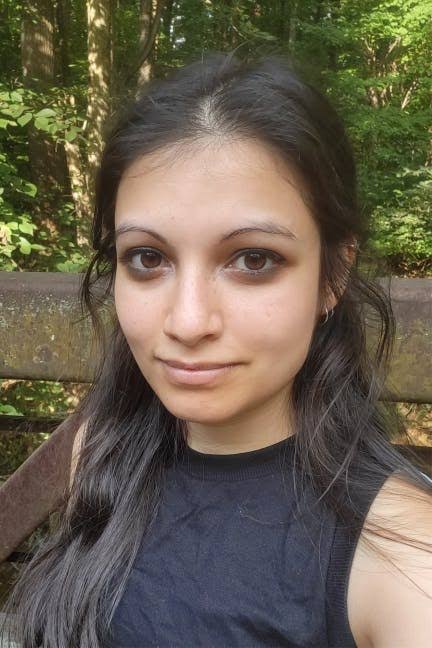
Ayida Shonibar (she/they) writes dark and wistful speculative fiction about misfits, monsters, mischief-makers. Spanning genres and age categories, their short stories, essays, and poetry appear in various publications, including Silk & Sinew (Bad Hand Books), Heartlines Spec, Worlds of Possibility, Luminescent Machinations (Neon Hemlock), Nature Futures, the Cursed Morsels Zine, and Night of the Living Queers (Wednesday Books), among others. You can find more information at ayidashonibar.com.
Social media links:
BlueSky https://bsky.app/profile/ayidashonibar.bsky.social
Instagram https://www.instagram.com/ayidashonibar
About the Narrator
Shweta Adhyam
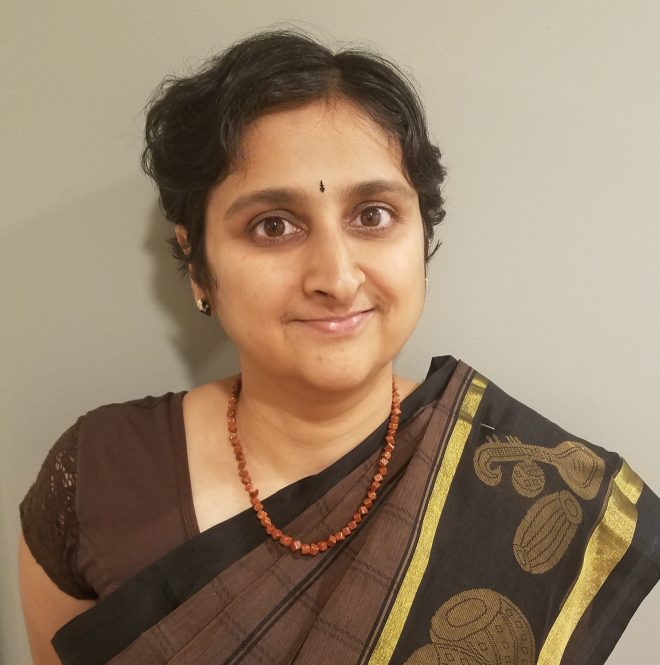
Shweta belongs to Madras, and Seattle, and speculative fiction. She speaks five languages, has had four careers, is three layers of immigrant, calls two cities home, and believes escapism is of the first importance. She is frenemies with ADHD, knows far more about Hindu mythology than is good for her, and attended Clarion West in 2017. She lives with her spouse and child.
