

PseudoPod 1041: Graves Basin
Show Notes
From the author: “I’ve heard many times, from people wiser than me, that a horror writer fares best when they don’t waste their time trying to figure out what scares other people, but instead write about what scares them. So, with that in mind: I am terrified of a world where people are unable to find any value in the traditions and wisdom from prior generations. But I’m equally terrified of a world so beholden to past tradition that there’s no room allowed for new ideas, for new ways of being. So how can we find the proper place to stand between those poles? Where do we find the healthy, life-giving tension that enables us to flourish? And what devastating things happen, to ourselves and our communities, when we fail to do so?
Scruggs County, where many of my stories take place, is a fictional East Tennessee county, sewn together from pieces of the many rural places I’ve lived and worked over the years. Any joy and love there are inherent to the people and places themselves. The horrors are all mine.”
GK Chesterton
https://en.wikipedia.org/wiki/G._K._Chesterton
Lullaby by The Cure
https://www.youtube.com/watch?v=ijxk-fgcg7c&list=RDijxk-fgcg7c&start_radio=1
Graves Basin
by Daniel Roop
Mr. Hoskins, across the dinner table, had seemed confused when I tried to introduce the topic of the democracy of the dead. Ever the businessman, he politely shifted the conversation to areas he could more comfortably navigate. Trying to ingratiate himself as we chewed mouthfuls of pork loin, he asked Ches, “And young man, what do you want to be when you grow up?”
Ches swallowed far too large a bite far too quickly in his excitement to blurt out, “Lotsa folks say my great-great-great-great aunts was witches, but that ain’t so. Daddy says they was more like scientists, and that’s what I wanna be. A scientist.”
Mr. Hoskins nodded and sipped his sweet tea, trying to decide which part of that answer to further interrogate in order to seem interested without giving offense. Witches? A farmer’s son growing up to be a scientist? Where to begin?
We sat in the pine-paneled dining room of the two-story farmhouse my family had owned for nine generations. We always kept the lights dim at supper as a matter of coziness, the amber glow from the aged sconces warming the wood of the walls and table. Selah, my wife, had put out a fine spread for Mr. Hoskins. Whether we truly welcomed his presence or not, the Stewart family had always believed in hospitality. Mr. Hoskins, preparing to dig into a piece of blackberry cobbler, decided at last to nod noncommittally at Ches, foregoing further inquiry into witches and science. He turned his attention back to me.
“Mr. Stewart—Karl—you and your family didn’t have to go to such trouble this evening, but I truly do appreciate it. A home cooked meal is a blessing on a cold night like this.” He cleared his throat, trying to find an appropriate segue, but he wasn’t that artful. He plunged ahead.
“I know you’ve been reluctant to sell the farm in the past, but I’m thankful you agreed to meet with me. I’ve put together a very attractive offer, Karl, including a sizeable plot of land, assuming you and your family would want to stay and build.” He reached into his briefcase and awkwardly wedged a plat map between our dishes, nearly knocking over my tea, talking all the while. I didn’t listen to a single word, but looked down at the map.
A golf course. My family had settled the small farming community of Graves Basin over two centuries years ago, and had lived here and tended our 400-acre farm ever since. Generation after generation, caring for this land, shepherding lives, witnessing births, honoring deaths. Hundreds of years of plowing, planting, pruning, and harvesting, as our sweat flowed into this holy soil. And this man’s vision for its future was a residential golf course development with a tacky monstrosity of a clubhouse plopped down on the razed foundation of our farmhouse.
“Mr. Hoskins—”
“Call me Matt.”
“Mr. Hoskins. I have no intention whatsoever of selling this farm.”
He flashed a predator’s smile, sure that this was nothing more than a bargaining tactic. “Karl, you’ve not even seen the offer yet. It’s got a lot of commas.” He pulled out two pages, setting one in front of me, and one in front of Selah. Ches jumped up and looked over his mother’s shoulder. “Wow! That’s a LOT of—”
“Mr. Hoskins, if Karl says he’s not selling, then we’re not selling,” Selah said, and smiled at me. Neither of us so much as looked down at the paper. I handed my copy back to him. He didn’t take it, but he managed to maintain his increasingly forced composure.
“Karl, in my experience, a man doesn’t bother to entertain someone unless he’s interested in hearing the offer.”
“Mr. Hoskins, there’s a great deal of life that’s outside your experience.” In response, his practiced smile faltered for the first time.
“Then why accept my call? Why agree to have me visit?”
“Every few months we get calls from developers. We rarely respond. But every so often, I feel the need to try to explain my decision, to elucidate the reason behind my perceived stubbornness. Not for their satisfaction, you see, but for mine. There are things about this place that are impossible to understand unless you’ve seen them for yourself.”
Watching his face, I knew that no matter what I said, all Hoskins heard was the promise of continued conversation. He believed that as long as we kept talking, he would find a way to separate me from this place. I’ve always marveled at what some folks will do to prolong a hopeless situation.
“What would you like to show me, Karl?”
“Let’s step outside, Mr. Hoskins.” I stood, laid my napkin on the table, and thanked Selah for the meal. Ches followed us out the door, grabbing his coat against the January chill. Snow was falling in thick flakes and beginning to lay. We walked past the guinea hens, scattering and reforming, chittering away mindlessly at every stray leaf that blew by. We passed Selah’s fallow herb garden and the hog pen, where Ches told Mr. Hoskins, “That big one’s Bessie. She was my favorite, but I’m mad at her right now, on account of last week I accidentally dropped my Batman comic in there and she ate it. She’ll eat anything.”
We walked to the edge of the south pasture, Hoskins rambling the entire way about how the golf course would bring jobs to the community, how he knows it’s hard to make a living on a farm these days, firing every scattershot approach he could think of. I offered a noncommittal grunt from time to time, until we reached the gambrel roof barn, and stopped at the door. Clouds covered the moon, and we stood for a moment in darkness. I said, “Mr. Hoskins, I’m going to need you to give me your phone.”
“I don’t have any service here anyway, if you were needing to—”
“It’s not that. It’s that I don’t want you taking any pictures of what I’m about to show you.” He only paused for a moment before handing me his phone. I looked at him, and tilted my head, as I said, “Fella like you, you’ve probably—” and before I could finish, he handed me his second phone. I nodded, swung the door wide, and we stepped inside. Ches closed the door behind us, and we found ourselves in blackness.
I clicked on a flashlight and guided them along the breezeway, Ches hopping and clomping with the endless energy of a ten-year-old, Hoskins stepping daintily to avoid getting dirt on his Allen Edmonds wingtips. Hoskins tried to charm me through my son again, asking about his favorite subject in school. “Science, of course. I’ve been homeschooled for two years, and Mama and Daddy are the best science teachers.”
Hoskins said, “I’m sure they are,” and managed to sound sincere. Maybe he was. To his credit, he hadn’t expressed surprise earlier at the number of bookcases lining the walls of our home or made any condescending comments about us owning more books than the average farmer.
We entered the farthest tack room on the left, empty and swept clean, and I lit a battered oil lamp. “Mr. Hoskins, I need you to swear you’re not going to tell anyone what you see here. It’s nothing . . . unlawful. It’s more like a family secret.”
His veneers gleamed in the flickering light. Surely I wouldn’t share family secrets unless he’d made a connection, the kind of connection that could lead to a deal. He said, “Of course, Karl. You have my word.” I nodded and knelt down. I unlatched and swung open the door that led to our root cellar. Our family had used it for centuries, and I was certain it was the largest in all of Scruggs County.
“Mind your head, Mr. Hoskins. Ceiling’s low here.” We sidled carefully down the narrow cinderblock steps, until we arrived at the small entrance room beneath the earth. Two narrow tunnels branched ahead of us. I pointed to the right one. “That’s where we’re going, Mr. Hoskins. I want you to see why I won’t be selling this farm to you.”
We walked down the tunnel, filing between doubled five-gallon buckets filled with rock salt. “Being below ground keeps the temperature just right,” I said. “The rock salt keeps the humidity low. You have to maintain the perfect conditions. It’s a fragile balance.”
Then we stepped into the dirt-walled chamber, and Hoskins screamed. “I know,” I said. “But there was really no way to prepare you.”
The light from the oil lamp danced across the dark, leathery faces, still as stone. Dozens of them sat preserved against the walls of the chamber. Some of the family had been here for centuries, some for barely a decade. They nestled shoulder to shoulder, an eternal council rooted beneath our home.
After a few moments of silence and what I assumed was internal motivational speech, no doubt from some aggressively-named sales podcast, Hoskins had calmed down enough to apologize for his outburst, and for yelling a few words that Ches was too young to hear. I told him no apology was necessary, and gestured for Ches to bring us a few empty buckets. We turned them over and sat in the center of the room, surrounded by the dead. “Mr. Hoskins, Ches was telling you the truth about his far-great aunts. Two sisters in our family, generations ago, were fascinated by the natural world. At that time, there was no money or tolerance to send women to school, so they experimented on their own. They developed their own process of mummification, which we’ve passed down in our family ever since. This is how we remember our ancestors. We preserve them beneath the land they loved. We bless their sacrifice, and their work. We honor our tradition.”
Hoskins, for once, was speechless, trying to find a new angle of approach in the cool of the room. I went on.
“My son is named after G.K. Chesterton, Mr. Hoskins—my favorite writer. Perhaps you’re familiar with his work, but I doubt it. Chesterton said, Tradition means giving a vote to the most obscure of all classes, our ancestors. It is the democracy of the dead. Tradition refuses to submit to the small and arrogant oligarchy of those who merely happen to be walking about.” I patted the bucket beneath me. “This is where I’ve always come to sit and ponder when I have big decisions to make. My grandmother wanted me to go to college to study chemistry, and other subjects, to improve our old aunts’ method. Before I made the decision to go, I came here and sat at Grampa Estel’s feet. Before I proposed to Selah, I hunkered down here and stared into Great Aunt Liza’s eyes. When I was debating whether to change to an organic farming method, I laid my hand on my great-great-grandfather’s brow and closed my eyes in the presence of his deep stillness. This is the council I keep, Mr. Hoskins. Tell me—what do you think the democracy of the dead would say about your golf course?”
Hoskins, who swam his life away on the shallow surface, who believed in only the promising present and the malleable future, sat in silence, confronted by the impossible gravity of the past. Ches broke the silence. “Every so often, if I’m extra good, Daddy lets me sleep in here just to be with the family. Great-Granny Keen is my favorite, ‘cause her eyes google out the biggest.” He pointed at her, and made exaggerated hand motions, exploding his fingers forward in front of his eyes. “They say she told real funny jokes, too. There was one about a husband and a wife and a milk bucket, and—”
“That’s enough, Ches. Mr. Hoskins has done us the service of hearing our story, and I’m sure he has a lot to think about.” I stood, and they followed me out of the door, up the stairs, and into the barn. We stepped outside as the snow salted our shoulders and hair, laying an inch thick on the ground already.
“You’ll want to stay the night, Mr. Hoskins. The roads this far out aren’t safe in this weather. I figure you need a bit of time to compose a final pitch, and I at least owe you the courtesy to listen.” He agreed, waffling inside, I’m sure, between the forced optimism of a born salesman, and our reflexive fear when faced with the dead. Selah showed him to the upstairs bedroom where he settled in for what I knew would be a fitful night’s sleep. We put Ches to bed, then Selah and I sat and drank sassafras tea together by the fireplace, watching through the windows as the snow fell on the orchard to the west. She asked how it had gone. I told her it went about as expected. Sometimes a man just had to share the weight he carried, even if it was with a stranger. We nodded off holding each other on the couch, then stirred at a popping log from the fire, and went down the hallway to bed.
Before I drifted off, I imagined Hoskins staring at the ceiling in the bedroom above. I imagined he got over the horror more quickly than he believed he could. I imagined that most of his mind moved on to planning his final pitch, while a small part of him operated in the background, calculating the worth of my family. What would a museum pay for such unique remains? Was there a chance he could pry the process itself out of me? He would wring whatever value he could out of every crevice and stone. It made me think of my Great-Great Aunt Olgie who insisted we use “every part of the pig ‘cept its squeal.” But at least Olgie raised and cared for the pig herself first. She paid with sweat and stewardship long before the butchering. Hoskins just wanted to waltz into other people’s lives with the cleaver drawn, with no respect for the sacrifice that had enabled those lives.
The snow blanketed the ground, six inches thick the next morning. I stood in the kitchen with Selah drinking coffee, while Ches leaned over the table at his science homework. He was determined to memorize the periodic table by the end of the month. Hoskins stepped into the room, smiling his professional smile. He had recovered his confidence, or at least enough of a semblance, to rally for his final pitch. “Karl, I have to say, in a place as peaceful as this, away from the noise of the city, well, I slept like the dead.” I wondered how long he’d lain awake crafting that sad attempt at a joke. I smiled and handed him a cup of coffee. I’d wondered, when he’d entered the kitchen, if he would notice, in the newly fallen snow, the footprints leading back and forth across the pasture towards the barn, but he hadn’t. “Selah’s making biscuits and gravy if that’s all right. We can hear your offer over breakfast.”
He took a sip of coffee. “Karl, I want you to know that I truly do appreciate what you showed me last night, and the work your family has put into this place over the years. I think I’ve adjusted a few things that might appeal to you, not just financially, but in regards to your, well, special situation.” He gestured out the window towards the barn, and in his slight double-take, I knew he saw the footprints. I clamped his wrist to the sink’s edge as Selah brought the cast iron skillet down on his head.
After we carried him to the barn, into the root cellar, and down the left-hand tunnel, I stood over him and tried to imagine how the workroom would look through his eyes when he woke. I’d spent so many years there, using what I’d learned to improve my aunts’ process, that everything in the space seemed normal to me. The sticks, bound with animal sinew, twisted into what Aunt Gillie had called Appalachian Glyphs. Further, longer strands of sinew stretched layer upon layer into an intricate web across the smoke-blackened ceiling, a suspended language only our family could read. When my grandmother first taught me the process, I was in awe of its beauty. When she encouraged me to study and improve on it, I thought that was impossible. But, as I’ve so often found, there was wisdom in trusting those who came before. She was right, and I discovered things my aunts couldn’t have imagined centuries ago. Ches interrupted my rumination. “Daddy, he’s waking up!”
So he was. Hoskins woke, strapped to the table, and asked his meaningless questions, and stammered his inconsequential threats, and begged for his waste of a life. He pleaded, “Don’t turn me into one of them!” as though I’d ever show him such honor. After a few minutes, Selah duct-taped his mouth, her fingers warm and graceful as though she’d never died from the virus two years prior. Ches hopped around Hoskins, laughing his sweet laugh, his cheeks rose-red with the flush of youth. He didn’t look for a moment as though he’d died two days after his mother. They looked like they would live forever.
And so they would, with my improvements to the process. I’d found, through trial and error, through hypothesis, experiment, analysis, and refinement, that if I drained the life from one person a year, it would keep my wife and son alive. Unchanging. Mine. I positioned the flasks and beakers around Hoskins. I inserted the needle into his vein, his arm bulging helpfully as he strained against the straps. Ches and Selah stood in their appointed places, mouths open, nostrils flared. I swirled the solution, modified from my aunts’ ancient recipe. I opened the tome. I began to chant the words my aunts had never known, that I had learned in my studies. Life, green and blue and misted, began to pour from every hole in Hoskins’ head. Beneath the ground of Stewart Farm, I honored those who came before. I preserved what was mine to preserve.
Host Commentary
Here’s what Daniel had to say about the story:
I’ve heard many times, from people wiser than me, that a horror writer fares best when they don’t waste their time trying to figure out what scares other people, but instead write about what scares them. So, with that in mind: I am terrified of a world where people are unable to find any value in the traditions and wisdom from prior generations. But I’m equally terrified of a world so beholden to past tradition that there’s no room allowed for new ideas, for new ways of being. So how can we find the proper place to stand between those poles? Where do we find the healthy, life-giving tension that enables us to flourish? And what devastating things happen, to ourselves and our communities, when we fail to do so?
Scruggs County, where many of my stories take place, is a fictional East Tennessee county, sewn together from pieces of the many rural places I’ve lived and worked over the years. Any joy and love there are inherent to the people and places themselves. The horrors are all mine.
I love, SO MUCH, that the villains of this story live by a quote they have completely misunderstood. Better still, here in month 8 of 202infinity, the fact they have utterly failed to spot satire is just delicious. Nothing but kudos. 10.0s on every judge’s card.
Let’s take a look at that quote.
Tradition means giving a vote to the most obscure of all classes, our ancestors.
Chesterton loved this sort of writing. It’s formal and at the same time cheeky and wry.
It is the democracy of the dead. Tradition refuses to submit to the small and arrogant oligarchy of those who merely happen to be walking about.
Those of you who are familiar with what we, and I especially do, will understand completely where this hits me. For everyone else, if you’re a genre fan you’ll have encountered this exact thinking in some form. We have to honour the memory of this long-dead author or that one. We must consider Roddenberry’s ‘true’ vision. Tradition becomes holy text and holy text becomes holy writ and holy writ becomes calcification of culture, of personality, of development, of fandom and of self. We spend so much time pledging obeisance to the dead that we forget to live. ‘The small and arrogant oligarchy of the living ‘is such a lovely turn of phrase and such a vicious, cutting exposure of every element of extreme conservatism and the claws it’s gouged across the flesh of the world for five decades and counting.
There is, of course, an extreme on the other side. Those who don’t learn from history’s mistakes are doomed to repeat them but those who do nothing but re-litigate history’s mistakes will never see where they’re actually going. There’s a deeper point here too, i think, about anxiety. Fear of failure stops progress. Stasis encourages stagnation. And that brings us to the basement of the house and the two lines I noted down from this story.
‘An eternal council rooted beneath the house.’
A foundation, certainly but a foundation built of the decayed and harvested husks of the family used to power a very personal longevity. That’s a building waiting for deserved condemnation, an endless now trapped in blood-soaked amber by the belief that honor is atrocity and exploitation is veneration. It’s such a wonderful, horrible image and one that speaks so powerfully when you put it next to that wilfully misinterpreted quote.
And then there’s one word:
‘Mine.’
To beat death. To break the last barrier. To do that and to do it just to keep your family exactly where you need them to be. To feather your nest with the blood of the past and the potential of the future. Chesterton would be ashamed. What a fantastic story.
About the Author
Daniel Roop
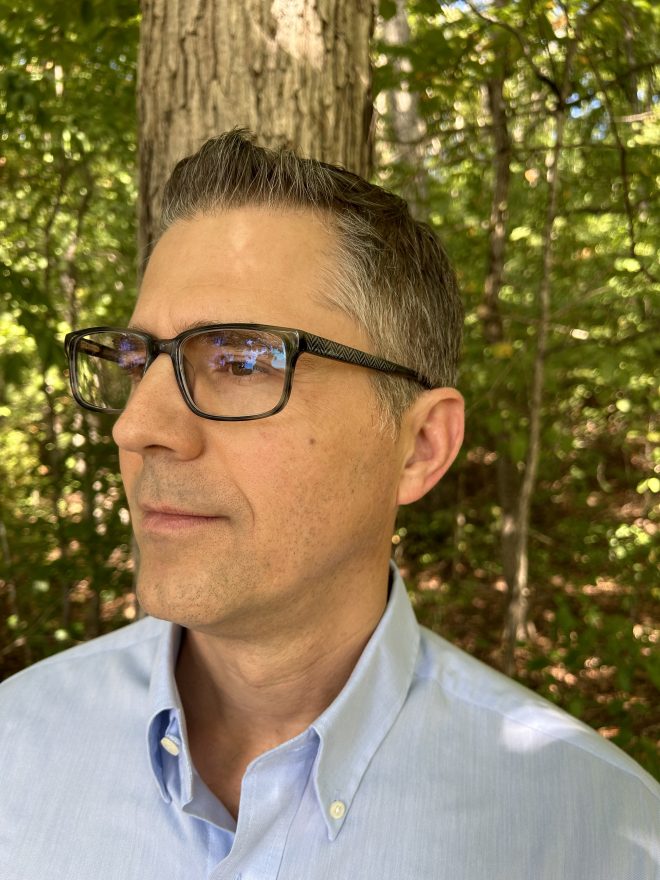
Daniel Roop is a member of the HWA and SFPA. His speculative fiction has appeared or is forthcoming in publications including Apex Magazine, Cast of Wonders, Cosmic Horror Monthly, and others. His favorite Pseudopod episode is 560: “Where the Summer Ends” by Karl Edward Wagner, which he first listened to one sunny afternoon while driving down the Knoxville street where all the horror happens. He is a seventh-generation East Tennessean, and his favorite superhero is Kitty Pryde.
About the Narrator
MN Wiggins

MN Wiggins is an internationally published author, surgeon, professor, and voice actor from the American South whose short stories have appeared in The Horror Zine, The Hooghly Review, Once Upon a Crocodile, and many others. His stories have been read on multiple podcasts, such as Frightening Tales, The No Sleep Podcast, Thirteen, Creepy, Kaidankai, and more. Dr. Wiggins’s latest novel, EL DORADO, is available through Solstice Publishing. His complete works, including his narrations, may be found at www.MNWiggins.com or at www.facebook.com/
