

PseudoPod 1039: The Song of the Living
Show Notes
Please see the host commentary below for notes from the author.
The Song of the Living
by Tonja K. Johnson
When the trees start to smell sharp and crisp, I know The Dead Things are coming. That warning scent perfumes the air now. The fading summer gale bellows over a field of rolling wheat. Golden stalks bow to the force like cracked swan necks. They waltz to the tune of pine breath. Pirouette to the riotous rhythm of rot carried from The Dead Things shambling in a mass through the mountains. Below the craggy pass, craters blister up from the earth’s surface, oozing brackish slime. We are mostly alone out here. The land, too wild. The wind, too full of teeth. The river’s rush, brutal as tempest waves. Only micro pockets of Living rough the backwood to form small fortified settlements. It’s safer in the cities, with their high electric walls. Because when the trees tear up their roots and run, The Dead Things are close and only the ancestors can save you.
“Grandmama, the trees are moving again!” I shout over the wind toward our house. She’s getting on in years and her hearing ain’t what it used to be. Just in case, I text a quick message through our wrist comms. My wristlet blinks a fluorescent jade, text scrawling across the screen, confirming she’s seen the message.
A tattered screen door bangs open from the kitchen, making the chickens squawk and flutter several feet off the ground. Grandmama limps onto the back stoop and squints into fading sunlight, mouth a thinned line in a granite-cut face. Her waist apron is smeared in gore. She’d been busy cleaning and boiling chitlins and the awful stench of excrement dogs her heels. Open air had been my only refuge from the odor, and I’d enthusiastically volunteered to take over the day’s outdoor chores. Fresh linen dries on a line from my labor. A warm upward draft carries the fabric, spreading the clean scent of soap and river water.
Grandmama scrubs her well-worked hands on an ivory kitchen towel as she searches over the southern wall toward the distant oak stand. Raw guts splat onto the cedar panels at her feet, and a trail of fast-moving slugs lap up the carnage. Innards still cling to her knuckles, speckling her walnut brown hands in tiny, pale constellations. Those hands can tan a hide just as easily as they soothe tears or sign the Song of the Living.
Her fingers move in a blur. “Get ‘cho behind in the house. We got work to do. Ain’t no trees walking around today.” I’m about to argue that the forest really did move but the young maple sapling that makes good switches sways, catching Grandmama’s attention. Those coal eyes are sharp as her kitchen knives.
“Yes, Ma’am.”
I can’t help but tear one more backward glance at the horizon. The setting sun bleeds saffron and peach hues onto the hills. The wheat field is alive with a burning glow as the last vestiges of day give way to night.
I try to imprint that brilliant palette into my brain to paint later. But the shape of the world is slippery, now more than ever.
The ground rumbles, just a slight tremor. The Dead Things smell worse than chitlins cooking, and they are so hungry. I know Grandmama feels them coming too. The kitchen towel slips from her palms. Then she’s grabbing at my shoulders, urgent, trying to shove me inside.
In a panic, the stupid chickens have flown the gate circling their coup and scatter in the backyard.
“Hurry and lock the doors. I’m coming,” I sign to Grandmama.
One handed and trembling, she tells me, “No, I’ll do it.”
Out here, those chickens are a lifeline. We haven’t been able to keep proper livestock since Daddy died. “With that leg?”
She shifts tenderly on her twisted foot, but I don’t give her the chance to argue and dash for the escaped hens instead.
I know Grandmama is gone be hotter than sugar grits. Even still, one of us had to do it. The horde forages for Living skin to slip into. They don the stolen flesh until it’s maggot-riddled and rotting off them and then they discard that ruined carcass to find something else to wear.
I press my legs into a downhill sprint, allowing the momentum to propel me faster. I scoop up the first chicken by the neck, just as a second tremor hits. It rattles through my bones.
Three…
Four… seconds.
The trees are moving. I see their silhouettes shifting along the horizon as they run.
The Dead Things are here.
Another chicken thrashes when I catch it by the wing just as it’s about to take off. Blasted creature scratches up the inside of my arm. I try not to think of the blood running into the soft soil. A beacon to The Dead Things that there is a fresh meat suit outside chasing chickens, when it should be indoors securely locked away, singing the Song of the Living to keep death at bay.
I can’t find the other two hens. Rot have them. These two will have to last until we can safely make a trip into the next parish.
Thud!
Earth trembles. Sky comes tumbling.
The southern wall goes down. It collapses in a pathetic screech of rusted metals and scavenged parts. It wasn’t strong like the ones they engineer in the city. It wasn’t built to last. We only pretended it would to stave off nightmares of decay. Dust belches in a great, dark plume through the air. Spreading, spreading to the steady march of Dead Things.
Both wretched chickens tucked under my arms, I race to the house. The pair squawk and scream the entire time. They just don’t know I’m saving their miserable lives. Heart lodged tight in my throat, I urge myself faster.
Grandmama is at the back door waving me inside, a towel muffling her nose from the rot stench barrelling down the mountain pass.
I stop short. Nearly drop both those precious, idiot chickens.
A boy stands just at the edge of the yard, by the maple sapling. He doesn’t move, doesn’t speak, but his large eyes bore into me, like we know each other. Like The Dead Things aren’t already here.
From my periphery, I see Grandmama signing frantically. I only catch snatches of what she’s saying.
“Stranger—”
“Meat—”
“Run—”
I can’t leave him. That’s not how we treat skinfolk in the backwood. He might be lost—hurt. Why else would someone be standing out here, eyes glazed over like a rooster before the slaughter?
“Who’s your people?” I ask, voice carrying more authority than I feel in my trembling guts.
He points a dirty hand toward the western wall that’s miraculously still standing. Beyond that rise is a sprawling grape orchard buttressed by solar wire and spellwork.
“You kin to the Mallards?” They own that land. He kind of favors them with his tight coils that come to a slanted widow’s peak. He even wears the wild, wired look stitched into their mouths as they tote around loaded shotguns.
The boy nods solemnly.
Grandmama slaps her palm against the screen door, thwack, thwack, thwack, drawing my attention from the most unusual pair of copper-colored eyes only marred by a dark bruise below the left lash line. I sign to her what the boy told me and she tells us both to get inside before we’re swarmed.
I motion the boy ahead through the backdoor, but before he can even cross the threshold, Grandmama clamps a heavy hand on his slender shoulder, stopping him short. Those serrated eyes cut into him, searching his innards for some hidden question. She must find the answer because she swats him inside.
Chickens and all, we hunker below in the cellar. It’s cramped, dark. And the air down here tastes thick and mildewy with moisture. My hands find the mud-packed walls as I blindly trace my way to the chairs I know are propped in the corner. Little treasures lay buried in that dirt. A dried beetle cadaver. Skeletal remains of a centipede. A chipped blue shell from the one time Daddy took me to see the ocean.
I help Grandmama find a seat and she more collapses than sits. When her breath steadies, she slides her right hand into mine. It’s rough with callouses. “Sing,” she signs. “The Song of the Living.”
A small candle winks to life—old spellwork. The flame under lights our faces in long creeping shadows. The boy’s copper eyes seem illuminated in that fragile ember as a ribbon of smoke dances over his stark features.
I hum. A low mournful keening to call the ancestors. Beseech their protection. My chest vibrates with their ancient rhythm.
Grandmama places a hand on my sternum to find the beat. Once she’s tuned to notes no longer my own, she joins. Her voice starts out rough. Unshaped. A spring run dry and only after years of drought has water begun to gush through the cracked surface. Both our eyes well as the ancestors’ love fills us to the brim. Overflows and kaleidoscopes through my spirit.
“Beautiful. You sound just like your pa.”
The air deflates from my lungs.
The boy’s voice is a deep tenor. Too resonate a sound to belong to a child.
Grandmama’s hand on my chest signs, “What’d he say?” fingers bruising in their pressure.
Between my ears feels fuzzy. Stuffed with cotton. Like I’ve suddenly tipped upside down and submerged in frigid waters.
“Wh-what you mean about—” my throat convulses around the name I haven’t let myself say in a long time, but I force my voice to work, “—Daddy?” I stutter around the consonants.
My joints calcify, like dragging through molasses. Something is wrong.
He reaches out as if to touch me, but then doesn’t, extending further past my shoulder to Grandmama. Two small fingers tap her furrowed brow. At his touch, her skin wrinkles like raisins in the sun. All the light siphons out of her, eyes dimming, but that sharp gaze never leaves me.
My body screams at me to do something. Anything. But it is like I’ve sprouted roots instead of legs that stretch, down, down, into the dirt, forcing me to watch as the unbreakable woman at the center of my world slowly fades.
Grandmama falls in a skeletal heap to the ground. Chickens cluck somewhere far in the background.
I can’t move, but my stomach creeps up the back of my throat. Vision blurry, I can only blink in horror as that hand now stretches toward me.
He’s smiling. White chicken feathers stick out between his teeth along with something fat and meaty. Blue blood dribbles down his upturned cheeks; it could almost pass for tears. It wasn’t a bruise. A dark patch of rot spreads over his black skin from the cut just below his lash line. I catch what I missed earlier, a glimpse of what’s hidden underneath. It’s not the flesh and blood of the Living. But that iridescent indigo of the Dead Things.
He glows with that inner ghost that craves fresh skins to wear.
No breath. No thought. Just blinding, unyielding terror.
“We can’t wait to chase the trees dressed in your flesh.”
Host Commentary
Of this story, Tonja says, “My grandmother used to draw these incredible pictures and while she would draw she would tell me stories—tales about haints, and boo hags, and men at crossroads who sell their soles (instead of their souls) to the devil. All these fantastical webs are part of a larger, rich tapestry of Black American folklore that my grandmama told me not to forget. It’s important for me as a griot to infuse the stories of my elders with my speculative fiction, so the ones who came before me can never be erased. This is my loose interpretation of the mythical boo hag that steals the skins of the living to wear for a time. These stories were passed down to me like heritage—like a warning to never stray too far from the ancestors, to respect the land, and to always keep your kinfolk close.
“Side note: The child in the story is intentionally not gendered because they are non-binary and the way in which they experience the world is not limited by traditional gender expression. Plus boo hags don’t care about how you express, they just want to chase trees while wearing your flesh.”
Now folks, I’ll admit I’ve not heard the word “griot” before, so for the benefit of those as uninformed as myself, a griot is “a historian, storyteller, praise singer, poet, and/or musician. Griots are masters of communicating stories and history orally, which is an African tradition.”
Griots are masters of communicating stories…
I think that’s a pretty appropriate appellation for Tonja. I cannot remember the last story I read where so many of my senses were engaged at once. Just in the first paragraph we have sight, sound, smell… odors, movement, colours… it’s kinetic, it’s noisy, it’s a constantly moving narrative. An immediate sense of urgency. A feeling that something… something unhealthy… is happening.
It’s worth looking back over the gorgeous language in that first paragraph.
“The fading summer gale bellows over a field of rolling wheat. Golden stalks bow to the force like cracked swan necks. They waltz to the tune of pine breath. Pirouette to the riotous rhythm of rot carried from The Dead Things shambling in a mass through the mountains. Below the craggy pass, craters blister up from the earth’s surface, oozing brackish slime.”
Ah man, the sheer rhythm of that language! The evocative words. And ugh, that last line, like pus-y buboes splitting open and spreading their unhealthy discharge. <shudder>
And it doesn’t stop there. The whole story engages your senses every step of the way. The smell of the chitlins preparation. (Sidenote: chitlins, something else I looked up. If you don’t know, look it up and you’ll know why they stink.). The ground rumbling. The slugs lapping up the guts. The squawking, scrabbling, chaotic chickens. And the singing. The singing of the Song of the Living which is too little too late, for Death has already claimed them, is right there in the room with them.
Wow. Does this one pack a big punch in a small space.
I’m so glad we publish the text of this story, as we do for all our stories now. Don’t get me wrong; we’re an audio medium and the spoken word lends new meaning and depth and colour to the written word. That’s why I do narrations, because I love the spoken word and the shading and nuance it brings. But sometimes it’s nice to just revel in the language, and I do that best looking at words on a page. Take a few moments to look back over this story and savour the writing.
Thank you Tonja for this wonderful, horrible story. And thank you Cherrae for bringing it to life.
About the Author
Tonja K. Johnson

Tonja K. Johnson is a Black American speculative fiction writer. Her work honors the rich, diverse culture of her ancestors while also representing Blackness in all its resistance, queerness, and neurodivergence. She is an acquiring editor for FIYAH Literary Magazine, won the 2024 MN BIPOC Emerging Writer award in fiction and was a recipient of the 2023 Write Like Us Grant. She is a Go Back & Fetch It fellow. Her fiction can be found or forthcoming in Blue Earth Review, FIYAH, Tordotcom and other publications.
You can find her at https://tonjakjohnson.com/
About the Narrator
Cherrae L. Stuart
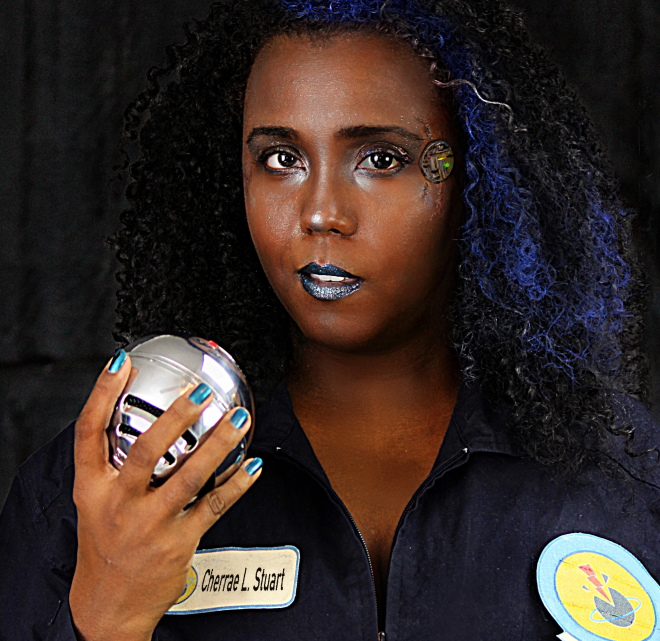
Cherrae L. Stuart has directed several projects available on Amazon Prime and lends her voice talents as a regular guest narrator for the Nightlight Horror Podcast. Cherrae has recently acted in NCIS-New Orleans and Return to Sender with Rosamond Pike and Nick Nolte. Currently she’s busy working as Writer, Producer and Narrator of the compelling and unique Podcast experience Good Morning Antioch, a science fiction black comedy and Co-Host of TCAD (Theatrical Conjecture and Dissertation) an “Unfancy” Entertainment News and Movie-Review show, both available now on Spotify and Apple Podcasts.
