

PseudoPod 1033: Devil is Fine
Show Notes
Author notes: “I was still pretty drunk on the experience of playing Red Dead Redemption 2 when I wrote this story and wanted to write a Weird western that took place in the plains where I’m from – and of course, add my touch of Weird/religious horror to it.”
Devil is Fine
By Michael Bettendorf
I ain’t a good man, but that don’t mean I like doing bad things. Not everyone is afforded the choice. Not truly, anyhow, but I’ve accepted that one day I’ll be judged for what I’ve done. What I do. My lot in life didn’t leave me with a good family or much in ways of inheritance, but I was gifted with a decent mind and an eye for opportunity.
It’s how I’ve found myself huddled on the ground near some boy named Mitchell who’s convinced he’s a man just because he don’t live at home no more. But the boy’s so embarrassed by his lack of whiskers, he covers his face with a bandana all the time, like he’s playing bandit. Well if anyone is going to be suspected a bandit, I suppose it’s better Mitchell than me.
“It’s colder out here than I thought,” Mitchell says, poking the fire.
“The plains tend to trick you. Hardly any cover out in these parts. Makes any breeze feel ten times colder.”
Mitchell rubs his arms, hugging himself.
“It true you took that stagecoach yourself?” the boy asks. “That how you get that beautiful horse of yours?”
“Don’t know what you mean.”
“No need to be coy,” he says. “I heard you took a guarded stagecoach and everything in it all by yourself. Not a single breath of air left in anyone’s lungs. That true, mister Grant?”
“Just Grant,” I say. “And I ain’t interested in tall tales.”
“That’s not all I heard. I heard you make short work of tall tales. That you’re a hell of a gunslinger. Ruthless. No goddamn heart in ya.”
“Watch your mouth, son,” I say.
“Didn’t put you for a religious man, mister Grant, given the killin’ n all.”
“Just Grant,” I say. “And I ain’t. I’m just tired of hearing you talk.”
It’s all half-truth, of course. My opinions of my father and his god couldn’t touch the clouds, but he instilled into me not saying the Lord’s name in vain. Always felt like I was welcoming a curse by doing so. And all them stories are just stories of a man getting by. Ain’t nothing to be proud of.
Some men are born lucky—ain’t concerned much about getting by. It’s one of them things you can hear in the way a man speaks. My employer, David McNally, for instance. Boy how I hate this man’s voice. How I hate taking commands from this man’s voice, all stiff and lifeless like one of them wind-up clocks.
The man’s pockets are so deep you could pump water from his boots. Though it may be truer to say you’d strike oil, seeing as he inherited so much of it. It’s why he thinks I’m here. To protect him and his wagon full of oil money from folks the likes of me.
McNally steps from his wagon, grinding my thoughts of robbery into dust. “All right fellas. It’s getting late,” he says. “One of you rest. The other take watch. Then switch when you’re tired. We’ve got a long day tomorrow and I don’t want no problems.”
Mitchell is eager to take the first watch, which is fine by me. The boy waits till McNally returns to his wagon before he opens his mouth, nothing but bad breath and worse proclamations pouring from it.
“I know what you’re here for,” he says. His eyes shrink when I don’t respond.
“Don’t you try nothing,” I say.
“It’s too late for that, mister Grant,” he says. “And it don’t matter anyhow.”
“What are you getting at?”
“I mean that it don’t matter, mister Grant. That case is empty as these skies.”
“Emptier than that head of yours, more like,” I say. “And it’s Grant. No mister.”
I rub my chin in contemplation, figuring the boy could be telling lies to take the haul for himself while I’m asleep. Maybe he just looked in the wrong case. “What do you mean empty? No bank notes? No clothes—”
“No nothing, mister Grant,” he says. “Well, nothing anymore. I peeked in there our first night out, figuring we was still so close to town, I could make a break in the night and catch a train out east. Thought I saw a lone bar of gold in there, but it was nothing but an old harmonica.”
“Well it ought to be worth something to someone.”
“Don’t see how. It don’t make no noise. I blew a note that first night. Made no more noise than a man sleeping in peace. The next night I peeked in the case, just to make sure, and there was nothing. I think McNally caught wind though. Been giving me weird looks ever since. I’m waiting for the right time to make a break for it.”
“Oil your gun and count the stars,” I say. “I’m tired of listening to your bad ideas.”
I wake and stretch and pat my horse, Sadie. Given the way the stars seem to ripple across the glassy sky and the way my gut rumbles, I’d say it’s nearing three in the morning. I walk a quick oblong pass around the wagon, ensuring he didn’t do nothing stupid while I was asleep.
I walk to where he’s sitting—snoring—disappointed by his lack of responsibility, but glad to see he hasn’t run off nonetheless. I nudge his boots once, then kick him when he doesn’t stir. I get in close and tug the bandana from his face.
I knuckle the sleep from my eyes, unsure if what I’m seeing is real. The thought hits me I may still be asleep, as I’ve been known to control my dreams from time to time, but this ain’t like that. Black drips from the boy’s nose and mouth. His jaw’s set at an unusual angle, almost like it’s two sizes too small, appearing like the mouth of a cave. And there’s this unusual glow about the hole, which ignites the boy’s fury and sends him into a rage I ain’t ever seen in a man’s character before. Not even my father’s righteous wrath.
Mitchell covers his face, pulling the bandana tight. I can’t help but notice how clean it is, unsoiled by the substance oozing from his flesh. How curious of a wound that is, and I consider it’s not a wound at all.
“I’m just sick, okay? Don’t mean nothing else.”
I hold up my hands to show I don’t mean no harm, but he starts swearing at me and God himself in a language I can’t place.
“Keep your voice down, boy,” I tell him, but it don’t matter. McNally stumbles from his wagon, pistol drawn. The boy’s gaze shifts from me to McNally.
“Mitchell, don’t!” I shout and my hand is at my hip, gun drawn. The boy turns to me and shoots. My vision turns strange. An intense pain throttles my head. I fall to the ground. Sadie, though she’s a good and loyal horse, is not the bravest, and I watch her grow restless.
Then the boy shoots our employer and his horse. I crawl over to McNally on my hands and knees, watching as Mitchell mounts Sadie, and rides away into the empty night.
I’m stubborn, but I can accept when things have gone to shit. McNally lies dead beside me. His wounds appear like two crimson eyes on his chest, and maybe it’s my vision playing tricks on me, but I swear they open and close as if trying to blink away tears of blood. When I muster the strength to do so, I stand and touch my face. I feel around shredded skin and broken bone and blood already turning sticky, and find myself in an intense confusion. A chaotic double vision. One where I see midnight blue stretched across the horizon until infinity—and one staring at my boots, covered in bloody muck.
The shot has removed my eye from its bony home, the socket shattered by gunpowder and lead where it hangs, unraveled, still somehow granting me one of life’s great senses.
I bend over and heave, carrying on like this for what I feel is an appropriate amount of time, the stinging pain subsiding due to shock, stress, or perhaps the universe’s gift to me. I cook my knife in our fire’s dwindling coals until the steel glows, and do what needs to be done to my right eye. My best eye. My hazel eye, the other being blue. My shooting eye.
I’m not sure why I do it, but I place my severed eye into McNally’s open mouth. Then I walk away, same direction as the boy.
Moonlight bathes the prairie in a pale glow, creating a ghost-like landscape that is nearly treeless and seems to call out to the sky’s enormity, almost maddeningly so.
Thoughts poke at me while I walk across the plains. Did the boy’s sickness cause him to crave violence? Did I cause this by revealing his face n all? Was McNally sick too? And will I succumb to the strange illness, just the same? Maybe I already have, for what’s more contagious than the desire for retribution—for violence? I consider I’ve been sick for a long, long time. An illness passed down to me by a cruel, violent father who serves a cruel, violent god.
“Go ahead,” I call out. “Strike me dead for all I care, goddammit…you’ve taken everything else.”
There is no lightning, no thunder. The earth does not crack open to swallow me whole. But I do hear the faint sound of music in the distance.
I hobble toward the noise. A few dozen yards out, a figure sits atop a trunk the color of wine in the middle of the road, playing the harmonica. The notes are somber and drawn out and seem to convey a particular kind of sadness.
“Mister,” I call out, trudging through the water towards him, drawn to the tune. “Hey, mister.” As I get closer, I see he has no clothes on and he is built like a skeleton, with skin pulled so tight and paper thin across his bones you can see all his veins and all the blood coursing through them. A roadmap of black underneath pale flesh.
“Mister,” I say, but he keeps on playing. “Have you caught the sickness, mister?”
He pauses and smiles. I wish I could say it were an empty one, but it ain’t. His smile bears the stars and seems to contain the vastness of the universe.
“No. I am the sickness, but I am also the cure.”
The figure grips my head in bone-white hands, brittle and smooth as driftwood, and kisses my eye, his tongue dancing inside my broken socket. Could be weak nerves, but I can’t move. His tongue is rough against my tender cauterized flesh. There is a cool numbness as he pulls away from our embrace. He licks his lips and begins to play a tune, and my world turns unholy black.
There’s a moment where I believe the pale man is holding me in his arms, for I feel weightless as if the earth no longer cares to pull me close, but there’s no way he could hold me so. Something in my mind whispers believe. His hand, cold to the touch and heavier than it ought to be, rests on my shoulder. The way I imagined my father always doing, but never did with such kindness or grace. And as if he can read my thoughts, the pale man says, “He never loved you, Grant, but I do. I’m giving you all of this,” and he stretches his arm wide with an open palm as if he’s serving me the world. “No price, but your love in return.”
I gaze at these ethereal plains, seeing the DNA of all that makes up this world overwhelming my senses, tears in my eyes at the beauty—the truth of nature. After a while, the pale man speaks. “So what do you say, son?”
Were I not so broken, I may have questioned this stranger’s intentions, but instead, I lean into his embrace, his flesh soft as a snake’s belly. His sunken eyes tell me he’s proud of me. The pale man snaps his fingers and dissipates to gun smoke, turning the air around me oily and unsavory.
When I open my eyes, it’s as if I’m looking at two different worlds simultaneously: the one as we perceive it, beautiful in its own right, but awfully fallacious in its presentation; and the one as it truly is, neither gorgeous nor hideous, but composed of the dust motes of veracity.
I stare at my hands, one eye seeing dirty flesh, the other—the geometry within by skin and gristle and all the molecules of man that I am made from. Bursts of light in the shape of a doe runs in the distance. Ribbons of life and death spiral through the air. I’m inclined to gaze at heavens to see if my father was right, but there all I see is swirls of particles. I set my eyes forward, toward this intuition in my mind I cannot ignore, nudging me toward the boy, and my horse.
I walk for days without tiring, guided by the voice in my mind. Storm clouds form before my eyes days before the rains fall. Winds shift. Buffaloes migrate across this frontier, though they don’t know it, they’re among the last of their kind, and this saddens me. These are among the truths I see, and yet, I know I’m not the only one looking through these eyes no more. Nor my thoughts, my own. But the promise of recovering my sweet Sadie pushes me onward, fighting through bloody blisters and my aching heart.
Whether it is the result or the cause of my new vision, I cannot be certain, but it leads me to a place where my mind finds no respite, only gloomy death. Only truth. For I am confronted with a scene not even my eyes have witnessed in all my gunslinging days.
A camp, painted red. A man flayed and dumped, crackling in a weak fire. A child of no more than eight years, huddled in the slumped, dead arms of her mother, whose decapitated head stares at her from below through milky eyes.
I vomit into the grass.
Though the child lives, I only see death when I look at her. It’s in her heart and it’s in her mind and it’s in her thoughts. The once innocent story of her life has been rewritten by someone else’s hand—the boy’s. She wants to be left alone. I see that, and oblige, following the trail I know will lead me to Mitchell.
No more than half a mile northeast, I catch sight of the boy kneeling in the middle of a river. I could shoot him dead here and now, without so much as a blink, but the voice in my mind tells me otherwise.
I carry on, stepping into the shallows of the river which carries blood downstream. A pink froth laps at my boots. The boy is still crouched on a sandbar a few yards upstream, tending to what appears to be a snakebit horse. And no matter how much I want to lie to myself, I simply cannot, for I know the truth which lies before me.
My sweet Sadie, a Dutch warmblood the color of buckskin, lies bleeding into the river. Tendrils of shallow breath emanate from her nostrils, a weak whinnying sings somber in the air.
“Boy!” I yell.
He turns, hand and face covered in Sadie’s blood. Meat stuck between his rotten, jagged teeth. I ain’t ever drawn my gun so fast, but despite the voice in my head telling me to pull the trigger, I hesitate, waiting for the boy to speak.
“I didn’t want to,” he says. The words form in the air, written in the breeze. “I’m sick, and now so is you. You don’t have to do this. You’re a good man. He fooled us both, mister Grant.”
The boy’s tongue is twisted. The words pouring forth simultaneously from two different worlds. They collide with one another in the air, truth and deceit battling for ownership.
I’m not a good man, but that don’t mean I like doing bad things, but seeing Sadie suffer puts a fury into me I’ve only ever seen once in my life, and I fire my pistol—watching the cylinder spin in slow motion—as I empty it into the boy. He writhes amidst the oily black seeping from his body and I am not convinced he will ever die, though I know he can feel pain.
“Just Grant,” I say. “No mister.”
Moved by burning thoughts, I stumble to Sadie, falling to my knees at her side. I stroke her neck and tell her I’m sorry, convinced she was judged for what I’d done. “You were my only friend,” I say. Weep for her, son.
Black tears pour from my eye and seep into her wounds, an unholy tincture which brings life back into her pale eyes. She snorts, spraying blood across my hands, but stutters to a stand nonetheless. Dark, ropey sinew knits her muscle together. Soon, comes the flesh. And a pale patch of hide dots her buckskin-colored coat.
I mount, and ride across the plains, guided by the voice in my head to deliver retribution, an obedient son.
Host Commentary
We all know a Michcell, don’t we? Someone who wants to be The Man. To be The Diva. Envied, admired, and desired. Someone who is famous now, remembered years later, a legend for the ages. Part of the problem is that he doesn’t have the talent, the drive, or the discipline. A lot of us have that problem. The other part is that he is convinced that he has the talent, the drive, or the discipline when he really doesn’t. A lot of us have seen way too many examples of this in our lives. As Grant says “…Mitchell who’s convinced he’s a man just because he don’t live at home no more.” Mitchell really resonates because we have had a stampede of Mitchells in recent years. And like the Mitchell in the story, when given some power, they can only cause chaos, destruction, and death.
Some of you might argue that there is a stone cold gunslinger and a supernatural being that just might be the Devil. I’m not worried about them. Grant has self awareness which puts him way above Mitchell. As Grant says “I ain’t a good man, but that don’t mean I like doing bad things.” Grant has earned his reputation with grit, determination, and blood. He doesn’t want to be envied, admired, and desired. He just wants to do the job, whatever that entails. Hell, he doesn’t really go after Mitchell over shooting him and losing an eye, it’s because he stole Grant’s horse. It’s not revenge, it’s rescuing his friend. And as to, let’s call him the Devil. He could totally be lovebombing Grant, knowing his history and the hole in his soul. Grant admits that he would be more suspicious if he hadn’t been shot and lost an eye. Maybe though, this being could be sincere. Grant seems to have a good sense of people, even in his diminished state. Grant knows which monster to put down.
About the Author
Michael Bettendorf
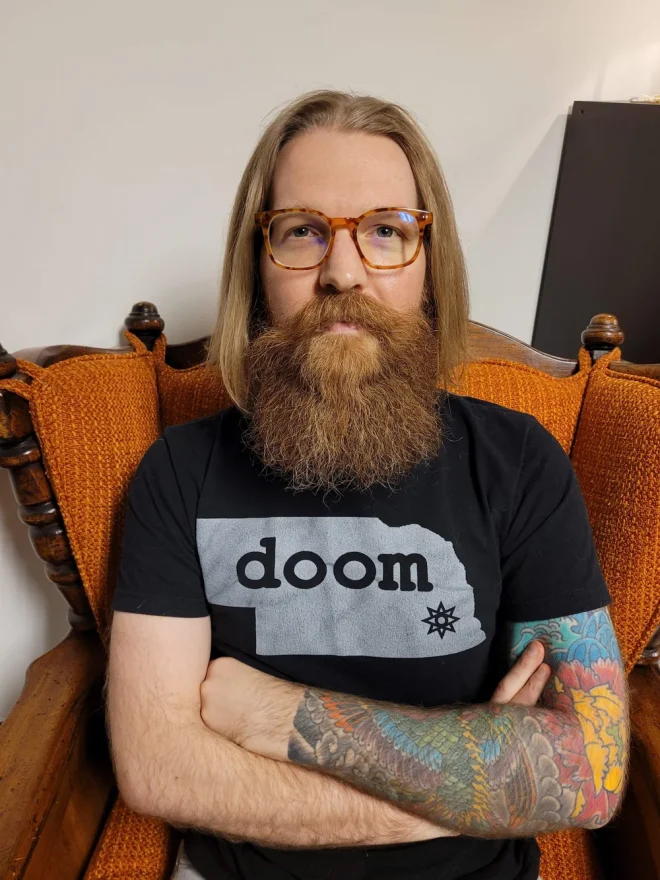
Michael Bettendorf (he/him) is a multi-genre writer from the Midwest. He’s the author of experimental black metal gamebook TRVE CVLT (2024), cyber-noir collection Midwestern Chrome (2026), and literary bizarro novella Help! I Can’t Stop Shitting Snakes (2027). His short fiction has appeared/forthcoming at Cosmic Horror Monthly, Mythaxis, and elsewhere. He works in a high school library in Lincoln, NE – a place he believes is too strange to be a flyover state. Find him on Bluesky @BeardedBetts and www.michaelbettendorfwrites.com.
About the Narrator
Norm Sherman

Norm Sherman is the multi-talented master of all things weird and wonderful. In addition to founding, hosting, and producing the Drabblecast, hosting and co-editing Escape Pod, and creating his own original music, he also runs a non-profit organization. Norm lives on a small ship circling Phobos with his Nigerian princess Tinunbu. He occasionally lands long enough to read stories for us.
