

PseudoPod 1030: Keeping Up With the Conan Doyles
Show Notes
May 22nd is Conan Doyle’s birthday and Sherlock Holmes Day
Keeping Up with the Conan Doyles
by Jess Whitecroft
From the Journals of the Society for Psychical Research. Interview with Angela Patterson, housekeeper of Latham Hall, present at the last séance of Neville Worth. 14th August 1956.
You want me to talk about the last séance? All right, but I must start at the beginning. I think it was around ’25 that her Ladyship began manifesting ectoplasm. It was definitely after the fairies incident. You remember the fairies, don’t you? Although of course you don’t – I doubt you were even born, or just a babe in arms. But you’ve heard about it, of course – Cottingley Glen?
Oh, we did laugh. Becky, she was a young thing like you. They kept her downstairs for years because Lord Latham objected to her Midlands accent – sort of a singsong about it. She was from Nuneaton. Don’t know if she ever went back there, but she disappeared after the… the incident. Anyway, I get ahead of myself – she had a brother who knew his way around a darkroom, you see. Took one look at the picture of the fairies and laughed fit to burst. “I don’t know what those fairies are,” she said. “But they’re not moving. Look. If they’re flying their wings should be going flap flap flap like a butterfly, right? But they’re not. Look at the waterfall behind the girl, Mrs P. See how it’s blurred? That’s shutter speed, that is. It’s faster than it was in the old days when you used to have to stand still as a statue for minutes to have your picture taken, but even then if you’ve got something moving fast – like a waterfall or the wings of a little flying creature – it still shows up on the photograph as a blur.”
When she pointed it out like that it was obvious, and it turns out the girls who took the pictures were quite the artists. Sir Arthur said they were too young and too common to pull off such tricks – “children of the artisan class,” he said. Shows how much he knew. I heard one of them even worked in a photographic lab, making composite pictures. Always dangerous to underestimate people, especially young women.
Yes, I met him…well, bumped into him in the hallway and bobbed a curtsy. Do you curtsy to knights? I never know. I never knew the protocols to be honest, but I wasn’t supposed to be seen. That’s what I used to say to my girls – be like real fairies, not the fake things in the photographs. In and out. Quick as mice. The upstairs folk don’t want to see your faces. They just want to see what you’ve done – a tidy bed, a clean hairbrush, a lavatory you could eat your dinner off of. Spotless, so they can take it for granted.
No, I didn’t really know Sir Arthur, although his influence was everywhere. I’d met his wife a few times, though, before… well, like I said, I mustn’t get ahead of myself. She was a talent, that one. God-given knack of telling a man what he wanted to hear. A marvellous manager of her husband. When Sir Arthur took to the séance room she followed, became a vessel for ghosts. A ghost. A Babylonian seer named Pheneas. He was her spirit guide, or so she said, and he used to advise Sir Arthur, using her as the medium. He was full of wisdom, that Pheneas. Handed out all sorts of advice, although not always tasteful, in my opinion. Mauve is not a colour I would have picked out for a dining room, but there. Pheneas said it was a very spiritual colour. He was very specific on domestic arrangements, if you catch my drift. Not only did he determine the interior design choices, but he personally picked out the house himself, a lovely spot in the heart of the New Forest. He also said the children should have a dog to further their spiritual development, and that golden retrievers were the best breed suited to this purpose.
Like I say, she was a genius at managing her husband.
And obviously she passed on some advice to her Ladyship, Lady Latham, because it was round about that time that ‘Dr Magari’ appeared. Another spirit guide, this time an Italian from Florence, where he’d lived and died in the time of Dante. He gave good advice, too, including a recipe for a tomato sauce. Now, the cook thought that was curious, because of course there were no tomatoes in Florence in the time of Dante. But there – I expect Dr Magari picked it up in the afterlife, along with a taste for profanity and a Venetian dialect.
Yes, Venetian. I’m no expert, of course, but my grandmother was from Tuscany, and back in the day I spent time with her Ladyship in Venice. I was a lady’s maid in those days, before I rose to the giddy ranks of housekeeper, and long before Becky showed up with her needle.
That girl was a genius, too, although you wouldn’t have known it to look at her. Snub nose, flat feet, dull hair, and rather fat. They tried to make her a Rebecca when they promoted her upstairs, but it wouldn’t stick. She was a natural-born Becky and there was nothing that could be done about it – sharp as her needle and quiet as a church mouse.
Before her there’d been a French girl, all eyelashes and accent, but she had to go. No, not sure why exactly, but it’s probably what you’d guess. And it didn’t help her case that she couldn’t sew a straight hem any more than she could fly. Now Becky, on the other hand, there was a talent. Her Italian was authentic – Italian hemstitch, that is – tiny little criss-cross on the back, invisible dots on the front. And silk? Oh my word. I don’t think there were couturiers in Paris who could roll a hem as smooth and tight as hers. She showed me once – “Rule of three, Mrs P,” she said. “Three stitches at a time. Some people do it in fives, but you’re more likely to muck it up that way. See?”
She’d sew these three tiny chevrons along the edge of the hem, on fabric so fine you’d think it had been woven by spiders. Up and down, up and down, just catching the edge of the silk. Then pull…and whoosh. The hem would roll in itself like magic, with no sign that a needle had even touched it except for a line of dotted stitches so small you wouldn’t have even seen them if you hadn’t known to look. There was a kind of witchcraft to it. Nothing so ostentatious as talking to the dead or oozing ectoplasm all over the drawing room, of course, but it’s there in the everyday, if you care to look. In a woman muttering as she stirs the soup widdershins, or a tightly furled hem.
But the ectoplasm…yes. That’s what you’re here for, isn’t it? You want to know what happened that night. And Mr Worth. Funny story attached to that, actually, but I should get to him in his own time.
Let me see – the ectoplasm definitely came after Dr Magari first appeared on the scene. I remember because that was around the time it escalated into a sort of… well… keeping up with the Joneses, I suppose, only in this case the Joneses were dead Babylonians and paper fairies. Everyone was doing it. A knock-knock here and a table tip there. No furniture was safe. And then there were the apports, of course, the ghostly flowers and such appearing apparently from nowhere in the séance room. The local florists made a fortune. There wasn’t a darkened room in the county that wasn’t awash in violets, and one lady – a Marchioness, no less – acquired such a rare and exotic spirit guide that she was regularly apporting orchids and frangipani. Can you imagine?
… no. No, dear – bless your heart. Nobody noticed. You think a Marquess combs through his wife’s accounts and notices they’re suddenly spending a king’s ransom on orchids? No, the husbands just took it as a given that their wives spent money and carried on… doing whatever it was they did. Being head of the household, whatever that involved.
Not much, that I could tell, but there. I was only the housekeeper. I didn’t have their schooling, their university education. I came to the hall as a girl of thirteen, a child of the artisan class. Same as Becky, although obviously she was younger than me. Different generation. Blighted generation. She was born in the thick of it, you know – 1916. Her father was already out of it by then – gassed at Ypres, friendly fire, although I don’t know how poison gas can ever be friendly. And there were six children at home in the end – well, six that survived. Her dad lived until ’22, with ruined lungs and a pittance for a pension. Becky told me that when he died her mother made a scene at the funeral. She was supposed to be consoled, you see, that their tiny pension had now increased to a widow’s pension, but instead she tore the flag off her husband’s coffin and tossed the coins into the gutter – “Where the eff were you when we were eight bodies living on pigeon’s eggs and porridge?” – I remember the words because Becky didn’t pull any punches with her mother’s foul mouth. Besides, if you ask me, she was right. Perfectly justified.
And I remember Becky telling me about the slap she got at the funeral when she cried. Her oldest brother cracked her round the face and said “None of that blarting now, our Becks. Time to grow up.”
She came to us a couple of weeks later, not much older than I’d been when I first came up to the hall. Tossed out of the classroom at fourteen because she’d learned enough to earn a crust. Not really fair, when you think about it. Not for a girl with that head on her shoulders. I noticed from the get-go that she learned faster than some of the others, but some of the other staff were slower to catch on. I remember the hall porter, Albert, his name was, ribbing her for reading books at dinner – “Didn’t know you read lit-rit-chure, Becky,” he said, turning up the end of his nose with his fingertip. Because she was deep into Northanger Abbey, you see, and I suppose he thought she should be reading magazines, or nothing at all.
“I read lots of things,” she said, and ignored him. Like I say, sensible girl. Him, not so much. Silly boy. Always chasing skirt, or dropping his cigarette ends at the back door for everyone else to sweep up.
And then he tried to drag me into it, the nitwit. “Mrs P,” he said. “Why is Becky allowed to read books at table? It’s bad manners, you said.”
“It is,” I said. “But so is leaving your dog-ends all over the back doorstep after countless people have asked you nicely to pick up after yourself. Finish your pudding, Albert, and mind your own business.”
He didn’t. “Your eyes will go next,” he told Becky. “All that reading, all that sewing, and then you’ll need glasses to go with your rubber lips and beady eyes. Will you have to get special specs to fit the shape of your nose? It’s not like regular noses, is it? Perhaps they make glasses frames for flat-faced ugly dogs, or maybe they can give you a set of goggles that wra – wra…wra…”
Didn’t finish the word, you see. Started saying wrap, ended in a retch. He was gagging all of a sudden, like a bit of jam roly-poly had gone down the wrong way. Everyone panicked, except Becky, who only glanced up from her reading when he’d started going blue around the lips. Then, finally, the butler slapped him between the shoulder blades just right and something flew out.
“She did it!” he said, the minute he could catch his breath. He jumped up and would have swung for Becky if the butler hadn’t held him back. “It was her – I know it.”
“How?” I said. “She didn’t move from the table, you daft ‘aporth. Didn’t move a muscle. Didn’t reach towards you. Didn’t touch your dish. Nothing.”
I had to defend her, of course, but afterwards I asked her why. Why hadn’t she moved? Why hadn’t she even reacted when he started to choke? And Becky just shrugged. “I was reading,” she said. “And it was a good bit, too. The heroine had just met a man who understood muslin. Anyway, what was I supposed to do?”
“Something. Anything,” I said, but I didn’t say much more, because the hairs on the back of my neck were standing up already. You see, I’d seen what flew out of poor Albert’s throat. It was a cigarette end, like the one we always complained about him leaving on the back doorstep. Hand rolled, but somehow the paper hadn’t dissolved in his spit despite being rammed down his throat. The tobacco was wet, as you’d expect, but where it should have been paper I’d swear it was silk. Rolled up tight in a perfect little tube. And a line of nearly invisible dots along the outside.
I burned it. Tossed it on the fire.
But it became a bit of a craze after that, people coughing things up. Unlike the upstairs crazes – with their flowers and their ectoplasm and whatnot – this one came down to us, too. I saw the cook pull a whole wishbone out from round the back of her teeth once, and the look on her face, like she had no more idea how it got there than I did.
And her Ladyship kept spitting out pins. Coincidentally, that always seemed to happen after she’d told Becky she ought to go on a diet.
But Albert got it more often than not, although once the butler sneezed boot polish at breakfast. One morning I woke up with wet feathers all over my tongue, and remembered I’d been short with Becky the day before, while we were changing a feather bed.
“What do you mean by it?” I said, when I saw her later. She raised an eyebrow.
“What are you saying, Mrs P?” she said. “That I crept in your room at night and filled your mouth with feathers?”
“No.” I left it at that, because I knew I was acting as silly as the people upstairs, but it got to me, you know? I kept thinking over and over about what I’d said to Albert. Because Becky hadn’t moved. Hadn’t reached towards him. Hadn’t touched his dish. And that’s where the story gets even stranger, because that’s where we get to Mr Worth.
Mind you, he wasn’t Mr Worth when I first knew him. He was The Great Worthington, doing tricks in a theatre in Bournemouth. He wore a scarlet coat and had a curly moustache painted on with eyebrow pencil. He sawed a woman in half, but his patter – as they say in the business – just wasn’t very good. No stage presence.
Maybe that was why he abandoned it, and turned up on our doorstep years later as Neville Worth, psychic investigator. Of course, you know about the hauntings he was involved with, don’t you? That place in Suffolk where the wine glasses used to levitate at dinner. That’s easily done, by a conjurer who knows his onions. Or her onions.
Anyway, I thought of him, and how Becky hadn’t moved, hadn’t reached towards Albert before he choked on that thing that looked like a bit of rolled up cigarette. And I got to thinking – what if she had moved? But nobody saw it. A distraction, a sleight of hand – that’s all it takes, and goodness knows we were quite the music hall in those days.
Where’ve I got to? Oh, yes. It was the ectoplasm that brought Mr Worth to us. It was new, you see, and shocking. Likely to get in the papers, and Neville Worth never met a headline about himself that he didn’t want to take to bed and cuddle.
I only saw it once myself – the ectoplasm. No, twice, if you count That Night. It didn’t seem decent to me. I was shocked. I think I still had it in my head somewhere that the people upstairs were my betters, no matter how childish I thought their games were. I indulged them, because they were like children to me. Helpless things that wouldn’t know how to feed themselves or sew on a button. That’s why they had us, after all.
I was upstairs the first time, adjusting the spirit cabinet, or so they called it. No kind of cabinet I’d have put crockery in, but it was only to shield her Ladyship from view when she went into her trance, grunting and groaning in a very unsavoury way. They rested a curtain rod across a corner of the room, propped on the lips of the picture rail, and hung from it a long velvet curtain. The curtain was too long, his Lordship said. He wanted everyone to be able to see the medium’s feet, so they could be sure she wasn’t moving around in there. So I went up with Becky to pin it up.
I was kneeling on the floor, I remember, and I’d run out of pins, so I held out my hand for another and said, “pass me a pin, Becky.”
Only it wasn’t Becky standing behind me, was it? It was her Ladyship, and the pin that landed in my palm was flecked with blood. “Oh,” I said, and saw the blood on her lips, too. “Is that still happening?”
“He thinks I’m doing it on purpose,” she said, meaning her husband. “But I’m not. Sometimes my throat’s so tight I can hardly breathe or talk. How am I supposed to swallow anything, let alone a pin?”
Turned out that was still happening, too. She’d been short of breath for so long that they sent her for X-rays, but the doctors couldn’t find anything wrong with her lungs. After she’d been poked and prodded seven ways until Sunday they came to the usual conclusion they reached with ladies and diagnosed her as neurotic. “A hysterical stricture of the throat muscles,” apparently, although I did wonder.
I kept thinking of that silk cigarette end I’d tossed on the fire, and I looked at Becky differently. Her Ladyship seemed to take personal offence to Becky’s fatness, reminding her that she was an upstairs maid now, and that she’d do well to make at least some effort to look graceful. Every time Becky so much as mentioned food, her Ladyship would incinerate her with a look, and Becky would raise that eyebrow.
But there, I’m being as silly as they were. And this is what I mean – the foolishness of it all. I didn’t get to talk any longer with her Ladyship because right then Becky swooped in to dress her, and thank goodness she did, because her Ladyship was in nothing but a kimono. I remember thinking, “she’s not going to be sitting in front of those men in the nude, is she?” and no. She wasn’t. It was worse.
Becky sewed her into her séance dress every time, you see. Tight black satin, like a coat of paint. You could see every detail of her figure. They said it was to rule out trickery, but it wasn’t. Come on now. We both know what it was really about, don’t we? She had to hobble into that cabinet because her dress was so tight, and as she hobbled I saw the men’s eyes light up. No, not light up exactly. It was more like a glitter in their eyes. Oily, predatory, like snakes waiting for an opportunity to strike. I heard one whisper, “has she been searched?” and the other said, “yes, rectum and vagina” – just like that.
Oh, I wanted to slap them all for the dirty little children they were. Yes, it was childish what they were doing, but it was also quite disgusting, doubly disgusting because they were pretending it was for science and not for cheap thrills. These were men with titles, doctorates, so many degrees you’d have needed a paper mill to print them all, and yet here they were, playing doctor like mucky-minded kids in the woods. And these were my betters? No, I don’t think so.
I’d like to tell you that the ectoplasm was astounding, but it really wasn’t. Yes, I saw white shapes moving in the muddy red dark – red because they had a red light in the séance room, in case those snake-eyed men weren’t already satisfied with the impression the skin-tight satin conveyed, I suppose. But spirits and spectres? No. I just saw a woman doing funny voices in the dark while something – probably cheesecloth or muslin, slithered out from under her nose and rose up into the air. Nothing you couldn’t have done with a broom handle or a judiciously applied length of clothesline. Dr Magari talked a good deal of mangled Italian, and something that looked like a dead baby appeared and spoke in a piping little voice that was about as convincing as Groucho Marx’s moustache.
And Becky… well. Becky was somewhere in the room. I knew she hadn’t left, after she’d finished stitching up Lady Latham. Although I hesitated to ask too many questions in case my throat sealed up, or I caught myself literally spitting feathers again.
But ask I did, when I found her later. “Why did you stay sitting in at the séance, Becky?” I said, and she laughed.
“Oh, I’m just there to help, Mrs P,” she said. “That’s me. The help.”
Again, I hesitated to ask. I wouldn’t have put it past her to arrange cheesecloth in the dark if it served her Ladyship’s purposes, but of course I didn’t say it like that. I minced my words a lot more in those days. That’s the one pleasure of being old, you know: you can say exactly what you think and people just pat you on the head and say, “Never mind, grandma.” I think I said something more along the lines of, “you know her Ladyship is supposed to produce the psychic phenomena all on her own, don’t you?’
Becky laughed again. “Please,” she said. “We both know if they had to do anything on their own they’d either starve or drown in their own filth, whichever came first.”
“Watch your tongue, Miss,” I said. “They pay your wages,” and I swear she cackled that time.
“Yes, and aren’t I flush?” she said. “Fairly rolling in it.”
We always thought she had socialist leanings, that girl. And she was quite right, in her own way. Lady Latham could never have come up with all of that on her own. I knew enough Italian to know that Dr Magari’s was mostly borrowed from gondoliers and whoever had waited on her at the lido, and there never would have even been a Dr Magari in the first place if Lady Doyle hadn’t kicked off the craze with whatsisface the Babylonian.
She wasn’t a bad woman, her Ladyship. She was just bored, and unoriginal. She’d never really had to think, you see. They don’t, those types. When you have everything handed to you on a platter from birth it makes sense that you don’t have to think much. You don’t have to walk around the market, adding figures in your head so you won’t be humiliated when you have to pay. You don’t have to think about how to store the leftovers, mend the clothes, or keep water from coming in at the back door when it rains too hard. It’s all done for you, so you never have to do those daily mental exercises that keep your brain limber.
But brains want activity. It’s just their nature. A brain needs exercise, and maybe that was the point of all the raps and taps and cheesecloth – something to think about, something to do. I don’t know. I daresay they all had their reasons. With some it was grief, others faith, and some – I think – were simply bored out of their rich little minds.
Neville Worth? Ha! I refer you to my previous answer. He wanted fame, that one. Fame, money, and attention. No, I couldn’t stand him. Maybe it was because I’d first seen him sawing a woman in half in Bournemouth, but there was always an end-of-the-pierness about him, you know? A real carnival barker, that one.
When he turned up at our door he’d swapped the scarlet coat for a tweed one, and had leather patches on his elbows, perhaps to blunt their sharpness. He smoked a pipe constantly – reeked of it – and wore a pair of wire rimmed glasses, the better to peer over them when he was interviewing people. He interviewed us all, starting with his Lordship, and got straight to the point.
“Does your wife have any confederates?” he asked.
I was lurking just round the corner, you see. Pretending to arrange some gladioli I’d arranged ten minutes ago.
“Any accomplices who could help her produce the effects in the séance room? I do hope you don’t mind me asking, but I have to be thorough.”
“That’s why you’re here, Mr Worth,” said his Lordship. “To clear up any allegations of cheating. And no, no associates. There’s only her lady’s maid who sews her into her séance dress, and I doubt she’d have anything to do with it. She’s from Nuneaton, after all.”
“Ah, I see,” said Mr Worth, like that explained everything. I had no idea Nuneaton was such a notorious intellectual void, did you? No. Well, I never went to university.
He talked differently to us downstairs. He whipped out a set of photographs of a medium with ‘ectoplasm’ flowing from her mouth and asked us if we’d ever seen anything like it. I said no, of course not, but he pressed me. “Take a long hard look again, Mrs Patterson,” he said. “Because there might be more to this woman than meets the eye. It’s my theory that she is able to swallow and regurgitate extraordinary quantities of muslin as a result of an abnormality of the throat.”
I looked him straight in the eye and asked him if he was trying to imply that her Ladyship was part pelican. He balked a bit at that, and looked over his glasses at me. “This is a very serious investigation,” he said. “And if you continue to make fun of me then I’m inclined to suspect you’re part of the mischief.”
“Suspect what you like,” I said. “I’ve never had any truck with this nonsense, and neither should you. Her Ladyship has never swallowed so much as a swatch of muslin in her life, and I doubt she could if she wanted to. She has trouble with her throat.”
And yes, I regret saying that. I don’t know if me not saying it would have prevented what happened, but I’ve always had a nasty feeling that I didn’t help. I might have given credence to his suspicions, and that’s why he… did what he did.
Becky didn’t give him anything to go on, anyway. She barely looked up from her sewing and answered in her broadest accent. I took a peek at his notes later and saw that he’d written her off entirely “A sewing machine. Not much more brains than a Singer.”
Well, we went upstairs again that night. Becky needed help with the séance dress, because she’d had to take it in. Her Ladyship was eating less and less because of her throat, and her collarbones looked sharp as knives. “I’m not that thin,” she insisted, as Becky fussed over her seams. “It’s probably relative anyway, since you’ve put even more on.”
I saw Becky’s jaw tighten as she sewed in the back of the dress, and nobody said anything for a long and uncomfortable moment. Her Ladyship was never the most sensitive of people, but I think even she could tell she’d gone too far.
Becky held her pins in her mouth – a hard, thin, line, and didn’t make eye contact. Her hurt filled the room like a gas, and her Ladyship began to cough. I fetched her a glass of water, and when I came back she was still coughing. “There’s something tickling the back of my throat,” she said. “And I can’t seem to get it out.”
“Perhaps you shouldn’t do this tonight,” I said, but she insisted.
“The sooner I get this over with the sooner Worth goes away,” she said. “And I’m already sick of him breathing pipe-breath all over me.”
And there – you know what happened next. The infamous last séance. In front of all the snake-eyed men she hobbled into her seat behind the curtain. And she kept coughing. Dr Magari popped up and started talking, but it seemed like he had a cough, too. Mr Worth asked him if he was alright, and the good doctor replied with an Italian expression so rude it was a bit much even for Dr Magari – va a farti fottere. It means, ‘go fuck yourself.’ Don’t ask me how I know. I’ve learned a lot over my life, and forgotten even more. Anyway, the coughing got worse and his Lordship said maybe this would be a good time to stop, but Mr Worth was lit up, gleeful, like he’d got exactly what he came for.
“Is your throat bothering you, Lady Latham?” he said, and finally he jumped up, threw back the curtain, and lifted her Ladyship’s chin with his fingers.
“Pack it in, Worth,” said his Lord Latham. “How dare you handle my wife that way? She’s not one of the common women you poke and prod, you know.”
But Mr Worth didn’t stop. A sort of mania had come over him, and he forced her mouth wide open with one hand and pushed his fingers down her throat. “I’ll have it, I’ll have it,” he kept saying. “I know your game, Madam!”
You would have thought all those men would have said something about him assaulting a lady in that manner, but they just…watched, other than his Lordship. He stood up, and would have rushed at the stage, except the rest of them held him back. They thought science was happening, or at least the dramatic reveal of whatever they thought she was hiding inside her throat. But of course there was no muslin or cheesecloth down her throat, never had been. Worth shouldn’t have had anything to pull out of her mouth. Shouldn’t have.
But he pulled… a thread. That’s all it was.
Amazing that such a thing could do so much damage. He reached into her throat and pulled out a thread, a sewing thread, firmly attached to something inside. I can still hear her screams – horrible, gurgling screams. Me and Becky, we jumped up and tried to stop him, but he kept pulling, pulling until… well, I thought the thread would snap. Had to snap, right?
But no. It didn’t. It was strong thread, like silk.
The thread was wrapped around inside, you see. Like it had been stitched into her innards. Chevrons. Three at a time. And then you’d pull the whole thing and it rolled up tight, like a magic trick.
I watched Worth saw a woman in half, once. Never thought I’d see him turn one halfway inside out.
They tore the séance costume off her when they were trying to save her, but it was too late. Too much of the inside was on the outside. Blood everywhere. So much blood you would have missed it, and they did.
But I didn’t. Not ectoplasm, no. But muslin, yes – it was a thin layer under the satin. That’s where she’d been hiding it, the whole time. Like I say, Becky was a genius with sheer fabrics.
And invisible stitches.
Host Commentary
We might think the ideas of misinformation and ‘fake news’ have only really proliferated in our information age, but there have always been pieces of information that we think we know, but which are nonsense. Or which, at the most, contain a nanoparticle of truth wrapped up in misunderstandings and exaggeration. Indeed, this is such a common phenomenon, there’s even a word for it in the English language: ‘factoid’, first coined in 1973. The beautiful irony of this being that many people, if asked, will probably tell you that ‘factoid’ means ‘a small piece of information’ and not, as is the actual case, ‘a piece of unreliable information – often false or unsubstantiated – that is repeated so frequently in print or media that it becomes accepted as fact.’
One story along these lines is that of the Cottingley Fairies. ”Ere,’ someone will say, ‘did you know that these two little girls cut some pictures of fairies out of book, took photos of them and convinced that bloke who wrote Sherlock Holmes that fairies really existed? People believed what they saw in photos in those days, y’know.’
Hm.
So, those ‘little girls’? One was nine years old. But the other, Elsie, turned sixteen in the summer the photos were taken. And she was a student at the Bradford College of Art, and worked in… you’ll never guess… the photography studio of a greeting card factory, where she touched up flawed photos with paint, colourised images, and created composite images of soldiers who’d died during the war with portraits of their families. It was terribly tragic work that was in high demand in 1917. It was also highly skilled work.
And as you might have guessed by now, there’s an awful lot more to this story, for which I direct you to the ‘Photographing Fairies’ episode of the Cautionary Tales podcast, presented by Tim Harford – link in the show notes.
Doyle himself was a skilled amateur photographer, and he knew photographs could be edited. But he couldn’t imagine how two young children, girls no less, could possibly have done so. To him, it seemed so unlikely as to be impossible. And once you have eliminated the impossible, whatever remains, etc. etc.
Thus we come to a tale as old as time: that of men underestimating women. How could a mere girl do something so difficult? Why, everyone knows women are the inferior sex. Let me explain it to you, Dr Day.
This episode’s story is, of course, a work of horror fiction, and therefore the supernatural events are allowed to be presented as real. We know that, in real life, a housemaid can’t actually make people spit out spins. Probably.
The goal of speculative fiction is not just to invent fantasy, it is also to make you question reality. As G. K. Chesterton said, “the function of imagination is not to make strange things settled, so much as to make settled things strange.”
The various men in this story that constantly underestimate the extremely capable women around them are painfully believable. From the hall porter, Albert, to Conan Doyle being expertly manipulated by his wife (which really happened, by the way), to Neville Worth describing Becky in his notes as, “A sewing machine. Not much more brains than a Singer,” and all the way to the snake-eyed men at the end, who see Lady Latham as little more than a female figure in a tight dress.
What I like about this story, in a bleak sort of way, is that it would have been tempting to make all the women badass and superior and have them all win out over the horrid men. But in this piece, Lady Latham is that rather more insidious thing: the woman who has internalised the misogyny and is actively supporting it, because, well, it works in her favour, doesn’t it? You could argue she has no choice, she has to work in the system in which she finds herself, and maybe that’s true, but at the same time… oh… she could have been kinder to Becky, couldn’t she? The constant jibes about her weight were a choice that she probably didn’t have to make, not really. Projection? A reflection of her own trauma? Again, maybe, and again, a few seconds thought might’ve turned her from cruelty to empathy. But she didn’t take those seconds, and that is why she is the villain here.
Mrs Patterson is awesome though, isn’t she? And Becky. I wonder what happened to her… presumably she died at least a couple of decades ago.
I asked our author Jess Whitecroft about this, actually. She said she thought Becky’s haunting a sewing box somewhere, whispering to some seamstress who’s had it with bridezillas, ‘you don’t have to put up with this, you know….’
And I said, well, there you are. There’s your next story.
Amazing work, thank you, everyone!
About the Author
Jess Whitecroft

Veteran romance writer Jess Whitecroft moonlighted into writing horror when she moved to a haunted location and discovered that none of the alleged ghosts did any haunting, and that she would have to supply her own. A rank amateur at the art of self-description, she outsourced her author biography to her nearest and dearest, who said, “Great cook, but sometimes eats crisps in bed.” Twitter: @JessWhitecroft. Patreon: https://www.patreon.com/jesswhitecroft/
About the Narrator
Louise Hewitt
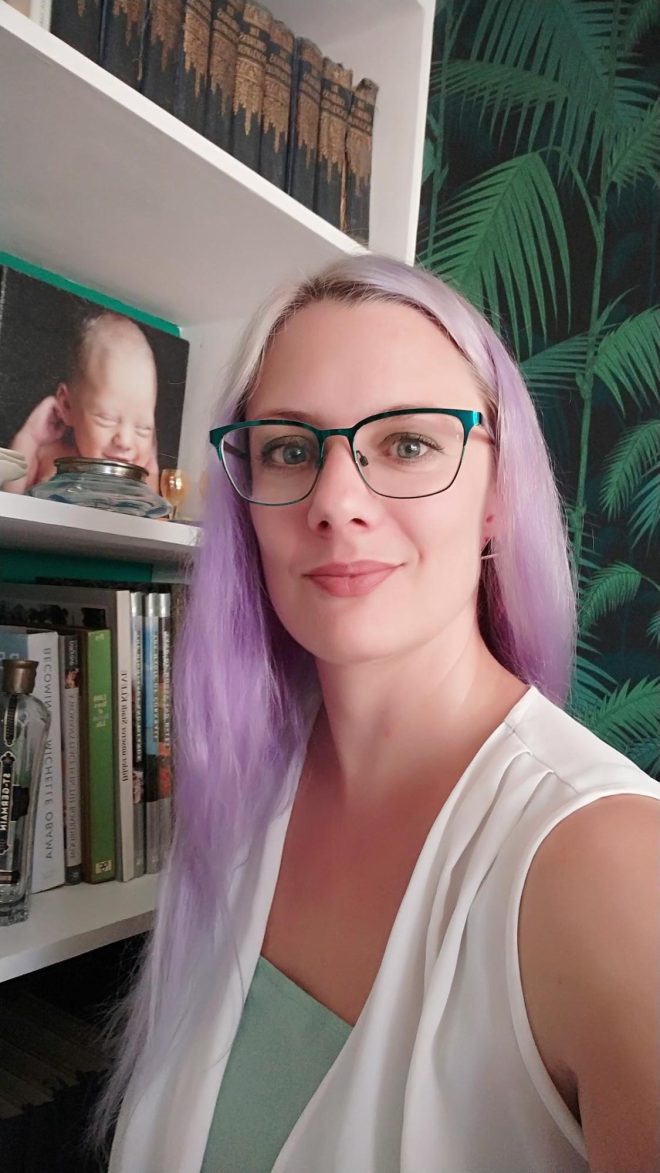
Louise Hewitt (she/they) is enthusiastic about stories in all their forms. She is an advertising copywriter by day, a reader of bedtime stories in the evenings, and a D&D dwarf cleric at the weekends. Lou to her friends, she enjoys cooking up a storm, riding her bike in the rain, feeding ducks, doing yoga, and attempting to meditate. Her favourite stories are about dragons, but pirates and sea serpents are also good. She lives in London, UK, with her partner, her child on alternate weeks, and a very large ginger cat.
