PseudoPod 1020: Walking Tour of Scarborough in Nuclear Winter
Show Notes
From the author: “All of the landmarks in this story are real places in Scarborough, where my mother grew up and where I spent many childhood summers dining on crisps and 99 Flakes, and drinking fizzy drinks and orange squash in a rented chalet with only a small amount of sand included. It is important to note that the beachfront and attractions are much less haunted than as depicted in this story—pay the town a visit now, before the end times cometh!”
Walking Tour of Scarborough in Nuclear Winter
by Stewart C Baker
- Scarborough Spa
The tour starts the same way they all do—in the Spa’s outdoor suncourt, as the bloated, swollen sun tries its best to pierce the eternal grey clouds and reach the ashen waves below.
Kat’s been doing this once a week for longer than she’d like to remember, ever since she moved up here and the world ended. She’s found it’s best to give her super-wealthy tourists a while to orient themselves and take in the ruins of the grand old Victorian building. While they file through the rotting beach chairs and superfluous sun umbrellas, she stands beneath the gold-capped rotunda with her robed back to the sun and her arms raised to the sky as if in supplication. As if she were a statue. As if she were more than human.
But today’s group takes their sweet time poking about the place, and by the end of half an hour, Kat’s arms ache like hell and she’s shivering, full-body cold. Sometimes, she wonders if she should go back to starting the tours in the lobby, which she managed to rig with a working heater. But her patrons like a touch of theatre. A sense of the otherworldly.
Besides, considering how the tour will end for some of them, it seems only right to Kat that she suffer a little as well. That she engages in some form of penance.
- South Bay Beach
As she guides the group north along the pockmarked beach-front road, Kat points out famous landmarks like the Grand Hotel, as well as the kitschy seaside arcades that once lined the streets—now so much soggy rubble.
When they reach South Bay proper, she launches into what should be a lengthy speech. “Of course,” she begins, “only the City Council’s early action on sea level rise preserved this section of glittering beach, freezing it in time in the late twentieth century. After the events of…”
But the tourists, she notices, are already ignoring her, spreading out to explore. So she lets the monologue peter away to nothing and watches them carefully as they go.
Some walk further down the sidewalk, peering into burnt-out shops. A man Kat dubs “Mr Waistcoat” (for professional reasons, she never learns her charges’ names) gathers with a few others outside a ruined pub and brays with too-loud laughter about a childhood excursion to the glittering beaches of Mallorca. Others venture onto closer sands, strolling with their shoes off.
One couple goes all the way down to the water, splashing in the sea with shrieks of much more honest laughter in their every motion. Kat shudders at the way the waves tug their clothing this way and that, thinking of tentacles sliding across flesh. She removes them both from the mental list she’s begun to compile, and takes slow, deep breaths until her heartrate slows.
There are plenty of others to choose from, anyway. Women whose diamonds dazzle even in the ever-shrouded skies that now pass for summer; men whose wealth is obvious solely from the arrogant disdain with which they carry themselves.
She’s trying to pick the ones who might deserve it most when someone clears their throat and asks, “What’s all this?”
Blinking, Kat glances over. The speaker’s ratty satchel and grubby overcoat look vaguely familiar, and from the way they’re looking at her they’re definitely local. Once upon a time she was nice to survivors like this, but nice is a luxury she can no longer afford.
“Tour customers only,” she bristles. “Piss off.”
Mx Satchel scowls. “I am one. I was asking about the sign.”
Kat flushes—no wonder they looked familiar—and forces herself to look up instead of snapping something back. She’s in her habitual lurking spot at the front of a shop whose banner proclaims it to be TERROR TOWER. She’s never watched the old horror movies painted on its walls, but she likes the irony of its name. Not like she could tell that to a customer.
“Bit on the nose, innit?” Mx Satchel asks.
Kat’s blood runs colder than the waves. She stammers something incoherent in reply and dashes off to gather up the rest of her charges. If Mx Satchel is implying what she thinks they’re implying, all of them are in serious danger. Kat most especially.
- Sea Wall Trail
The tour, as they say, must go on.
Kat herds the group around the trail marking Scarborough’s historic sea wall. Even before humanity’s climactic finale plunged the Earth into an ice age, walking on Marine Drive was risky when the tides were strong. Kat has seen scraps of the old papers, talk of twenty-foot waves sweeping unsuspecting tourists out to sea, turning a day out into tragedy.
Things only got worse as the oceans warmed, summoning up ever more powerful winds that, in turn, battered the road with ever more powerful waves. These quickly overtopped the headland’s coastal defences, and although the Council talked up a glittering new high-tech dyke a half-mile offshore to match their efforts in the South Bay, the funds for it never materialised.
And then there was the war, and how it ended. The global temperature dropped fifteen degrees Celsius, and what the waves and erosion had started the new threat of sea ice finished off.
Now, only fools and Kat’s tour group ever walk the sea wall trail’s slippery, crumbling concrete path. Fools because they’re fools, and Kat’s tour group because it gives her a chance to check for undesirable traits like risk assessment and avoidance of obvious danger. She’s relieved to see the laughing couple from the beach shy away from the seaward edge, and less than surprised when Mr Waistcoat and a few others walk right alongside it, seemingly oblivious.
After a few minutes of observation, Kat catches Mx Satchel’s frowning stare and moves them all along to the next destination.
- Scarborough Castle
The path up from the sea wall is steep and gravelly, but unlike the rest of the town it’s in good repair and still has handrails. Kat knows exactly what pays for this and is relieved when Mx Satchel doesn’t ask about the difference.
Inside the castle gatehouse there’s an open field where dandelions, seagrass, and other hardy plants have long since replaced the summer flowers Kat remembers from her childhood. The sea wind is bitter and brisk, making conversation difficult, but Kat powers through, showing her group through all the usual sights: the ruins of the Roman signal station; cannon from the Civil War; signs of damage from U-boat attacks in the early 1900s; still-pristine anti-aircraft guns—never fired—from the midst of that final, disastrous war.
Three of the tourists wander away from the main group and towards the viewing platform inside the Inner Bailey, and after Kat directs the rest to the castle’s café and the care of one of her robed associates, she follows them.
“—say it was the Russians who launched the first missile,” Mr Waistcoat is saying at the top of the platform. He gestures east into the North Sea’s half-frozen expanse with one hand, then raises his other hand to the west. “Others, the Americans.”
“But you know better?” asks one of the sparkling women who’s with him. She leans on the railing, her tone light and joking.
“Naturally,” he replies. Kat can’t see him smile from her viewpoint, but she’s certain he does all the same. “I’ve heard the same whispers you have. And it goes without saying that towns like this, so close to the sea, were the first to fall to our real enemy.” He points to the ocean itself, this time. The ocean, or what lies beneath it.
Kat laughs like a villain in a pantomime, and Mr Waistcoat starts. She has to tread gently here. Rumours like this, after all, are why people come on the tour, but she can’t play her cards too plainly. It’s the intrigue of arcane secrets that she’s after, rather than the nightmarish terror of death. She pulls her hood forwards to cover her face and steps into the glow of the spotlights that illuminate the bailey’s ruined ceiling.
“Our real enemy, you say?” She casts her voice low. “Please, sir. Tell me more. I am well acquainted with some… individuals… who would be very interested to hear exactly what you know, and how you know it.”
Waistcoat stares, his face pallid and his jaw slack, and Kat wonders for a moment if she’s misread him. If he’s actually, genuinely scared.
Then the moment passes. He shakes himself all over like a horse tossing his mane, and he snorts with insincere laughter. “Of course, it’s utter bosh.”
“Just as you say, sir.” Kat pulls back the hood and gives the women with him an exaggerated wink, relieved to see them giggle and whisper excitedly.
While the three of them head back down the bailey stairs, Kat lingers and looks down at the frigid sea. She’s about to turn and leave when one of the ice floes crumples in on itself and sinks beneath the waters, a spreading ripple the only sign that it was ever there.
With a shiver that has nothing whatsoever to do with the chill midmorning air, she moves Mr Waistcoat to the top of her list.
- Anne Brontë’s grave
Warmed by a cuppa and a rest in the café, Kat returns to her usual spiel as they leave the castle behind them.
The castle, but not quite yet the distant past, as the next stop is the grave of Anne Brontë, visible from the edges of a rundown residential area as it moulders in the graveyard next to the burnt-out husk of St. Mary’s Church. This stop is usually a short one—her patrons rarely care about the poor, long-dead writer—and Kat’s all set to start them on their way again at once when the woman who was splashing in the South Bay gasps and clutches at her purse.
“Can we stop?” she says, voice breathless and husky with emotion. “I’d love a rubbing of the grave, if it’s not too much trouble.”
Kat wonders again how this couple got wind of her tour, and how on earth they could afford it. “I’m afraid we can’t,” she says, with genuine regret. But then she recovers and lets her voice drop back into the exaggerated baritone of her panto villain persona. “The cliff face is very unstable—we wouldn’t want any unintended accidents.”
The group titters at her wording and her manner, taking it for the joke it pretends to be, and Kat smiles a brittle smile. It’s best they think the crumbling cliffs a danger and avoid the church. The building leaves a taste and smell her masters never care for.
Mx. Satchel clears their throat to ask a question, and Kat quickly looks away. She can’t afford distractions. Not now. Not here.
- Peasholm Park Ruins
Kat leads her charges through Peasholm at a breakneck pace, skipping the collapsed pagoda and the hard-scrabble trees in the glen altogether and barely even pausing as she points out the lake in the park that used to host miniature naval battles.
“On holidays,” she says, “crowds lined the pavements as Council members piloted small boats kitted up to look like cruisers from the second World War.”
“Are they staging one today?” someone asks.
Kat narrows her eyes as she realizes Mx. Satchel is the one who spoke. They must be up to something. But what? “I’m afraid not,” she says at last. “The boats haven’t been kept up. There hasn’t been a battle in twenty years, at least.”
“Then what’s that in the water?” Mx. Satchel asks, pointing. “There, just by the boathouse. It looks like… a tentacle?”
There’s an immediate gasp, and the others crowd up to the wooden fence that lines the lake, eager to see for themselves. There’s nothing there, of course. There can’t be. Kat stays where she is and laughs—even to her ears it sounds strained—and tells the disappointed group that such sightings are exceedingly rare, especially out of sight of the ocean’s swelling waves.
Mx Satchel scowls but doesn’t press the issue.
- Sealife Centre
It’s a short walk from Peasholm to the North Bay beachfront.
Or at least, what’s left of it.
Unlike the South Bay, the North has long been inundated, retaken by the sea. A few of the tourists comment on the difference, and Kat, who knows this particular rise in the water level had nothing at all to do with unchecked pollution and overuse of fossil fuels, hides her grimace by pointing to the rotting beachfront chalets that were popular with holiday-goers—even if your tea did always taste of sand.
Further north, the broad, hulking pyramids of the Sealife Centre roof poke out of the dirty waves like sentinels. With the tour’s final stop in sight, Kat tries to hurry the group along, eager as she always is for this last leg to be over. And so of course, Mr Waistcoat chooses this moment to start up again, speaking with a drawl of how his family once owned a building of luxury flats near the sea wall. How well they’d made out from it before the rising waves forced them to knock the whole thing down and kick the tenants out.
He guffaws and yammers some more, and Kat stands there, fidgeting from foot to foot. She has to make him shut up. She has to get them moving.
As if sensing her weakness, Mx Satchel swoops in and pulls her to one side. “You don’t have to go through with this,” they say as they grip her elbow tightly.
“With what?” Kat replies, trying to smile through her unease.
Mx Satchel scowls. “I know.” Their voice quiet but urgent. “What it is you do. What it is you feed.”
“Then leave,” Kat snaps. “And quickly.” Then, with a low, urgent whisper. “Take that couple with you—tell them I said to make a rubbing at Anne Brontë’s grave, and stop in at St. Mary’s while you’re there.”
She doesn’t wait for their reply. Very firmly doesn’t look back as she gathers the rest of the group and starts walking again. The afternoon sun—no stronger than it was this morning—is almost aligned with the glass at the pyramids’ peaks, and Kat puts her hand on Mr Waistcoat’s shoulder like an old friend and asking him if he’d like a close-up view of the real main attraction.
She wonders if her masters saw her send someone away, and doesn’t have to wonder what they will do to her as a result. And then, with a grimace, she pulls Mr Waistcoat along, into the shadow, chatting and eroding his defences like the ice and the tides against the old sea wall.
It isn’t as if that fate is what she wants for herself, exactly. That kind of messy end. But she thinks back to that morning, when she stood statue-still in the Spa. To all those other mornings just like it. And she acknowledges, as she leads the group away from Mx Satchel and the happy couple, that perhaps—in the end—each of us gets what she deserves.
Host Commentary
Stewart says:
‘All of the landmarks in this story are real places in Scarborough, where my mother grew up and where I spent many childhood summers dining on crisps and 99 Flakes, and drinking fizzy drinks and orange squash in a rented chalet with only a small amount of sand included. It is important to note that the beachfront and attractions are much less haunted than as depicted in this story—pay the town a visit now, before the end times cometh!’
The thing no one remembers about coastal towns until it’s far too late is that, well, no one remembers them. Port St Mary, where I grew up, is a small village, a large fishing port and the abandoned, mummified husk of the Victorian tourist industry. Scarborough’s another one of those husks, the shell of polite grandeur and music hall slowly being washed away by the sea and overlooked by everyone except the people who live there. Last year we went to Bournemouth for the weekend, had a great time and spent a lot of it on the beach. Behind us, a good chunk of the cliff face had eroded and slid down onto the boardwalk, scattering beach huts like brightly coloured debris. It had been fenced off for a while and everyone just went about their business, picking their way around the crater.
There it is, right? There’s the horror. But that sense of not looking the darkness in the eye is not the only thing moving under the surface of Baker’s story. This is a complex, dark knot of a story, wrapping horror and meaning and small-town courtesy around each other with a smile on its face and the hand you can’t see balled into a fist.
The way Baker takes the pragmatically adversarial nature of a coastal town’s relationship with the sea and twists it is fascinating to this mostly escaped Manx boy. The sea is the enemy. The sea is the fields. The sea is work. The sea is a prison. The sea is what we have to cross to get anywhere else. That’s all true here, but it’s mired in the growing realization that there may not be anywhere else to cross to get to. An eternal cold, beach side holiday. Ice cream whether you want it or not.
Then there’s the ambiguity of what happened and the idle speculation about who really fired first. It’s all academic, all an empty coping mechanism to explain why the world is like it is, which does nothing to help fix the world. It speaks, personally, to my loathing of nostalgia, and how that particular ghost haunts this genre like Banquo with some passable ideas about cosmic horror and shitty ideas about everything else. I’m interrogating a lot of my personal damage this year so, that’s my read and it won’t be yours, I suspect. But the moral obligation of survival, the need to help others instead of point out how great things used to be? That’s here too, just, under the surface, gasping for air as something unspeakable wraps another tentacle around its ankle.
And then there’s that moment right towards the end and the way ‘THEN LEAVE’ is spat. Kat as tour guide, a living coast, and herald. Feeding the victors their victims so they can keep what little they have. A tentacle on the neck pressing as hard as a boot and the hard-won, clear eyed bravery of realising that surviving isn’t enough, what happens next may not involve you and that’s not your problem, it’s your job. Shades of that haunting final moment in Rogue One, of the line ‘It’s my turn’ from 30 Days of Night. Shades of civilisation and hope, even here, in a ruined town on the edge of oh so many things.
GREAT STORY, great work everyone.
About the Author
Stewart C Baker
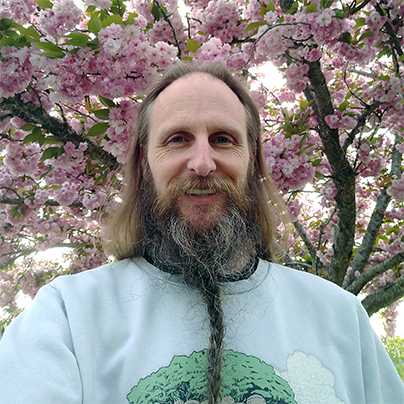
Stewart C Baker is an academic librarian and author of speculative fiction, poetry, and games, including The Butterfly Disjunct: And Other Stories, available now from Interstellar Flight Press. He was the lead writer for the Nebula-award winning game A Death in Hyperspace. Born in England, Stewart lives in Oregon.
About the Narrator
Kat Day