

PseudoPod 1018: The Polyamorous Heart of Death
Show Notes
The music track that inspired this particular story: HOLLAND, 1945
Which is from the album, In The Aeroplane Over The Sea
M. Lopes da Silva on Instagram: @authormlopesdasilva and on Bluesky: @mlopesdasilva.bsky.social
The Polyamorous Heart of Death
by M. Lopes Da Silva
You took her story like an organ removed in the night by a stranger she thought she knew. Victorian mummy unwrapping parties move in parallel to the kind of destruction you casually did. Your colonizing fingers made ghosts weep. Some of them are still weeping. You put roses in her eyes and plucked them out again. The petals fall on me every night as I hold him close. I blame you for that. I always will.
The painting was still unfinished: the underpainting vague with potential. Dark sepia shadows searched for a subject on the stretched canvas, hungry for meaning. Alex frowned the metaphors away. Squeezed the back of his own neck, hard. The point was that he needed a model, and Olivia was perfect for the job.
Yes, she was dead. It was unfortunate that she had died. He looked at her body, quiet underneath the hot key lights; a still life. He wondered vaguely if he should turn the lights off, but didn’t move. He kept looking at her. She had been alive a few minutes ago – her body still smelled like the cigarette she’d smoked out on the balcony.
Alex pinched sweat out of the fuzz of his mustache. He made a decision.
She’s not the only one I’ve ever loved; my heart has room for everyone. I have loved the unlovable, pulling even the cruelest people on this earth to my bosom. Murderers and sadists alike have succumbed to my seduction. To my smile. The eternally unforgiven have pressed their lips to the cold surface of my exposed teeth. To the zygomatic bone he referred to once as my “cheek.”
Yes, even you will know my love one day.
Acrylics are unforgiving—their polymer hearts yearn for firmness the minute they’re exposed to air—but oils are lush with patience. They wait for the tempo of inspiration, as slow or quick as it might come. Alex studied the oils creaming on his palette. The afternoon glowed ochre. On the other side of the horizontal blinds an ice cream truck played “Turkey in the Straw.” Racist shit, but inextricably entangled with nostalgia for city kids. Alex salivated at the memory of freezer burn on his tongue. He picked up a dull-edged palette knife and blended a mound of alizarin crimson and titanium white together.
He reasoned that it wasn’t like he’d murdered her. Surely people would understand; he was an artist. He’d merely seized upon the opportunity that reality had presented him with. He stared at the ruddy pink he’d made. No one would expect him to deny himself access to a paint color. Olivia was a distinct hue, an experience.
There was a faint smell of shit in the studio; her bowels had loosened. The fabric she was draped in wasn’t stained, but he left the area on the canvas between her legs shadowy, ready for the addition of a stain. He was already thinking about the story he would tell.
You’re the one that buried her alive. In declaring her rebirth you undid her sacrifice, casually. Unruddered from history he floats, adrift in me. He is just another collection of verbs and nouns, his context forgotten.
He mourns the fact that he was not allowed to tell his own story. That his optic nerves are forever intertwined with thorns.
People loved a romance.
Alex hadn’t known Olivia well enough to love her, but that didn’t matter now that she was dead. Her corpse was easier to love than her living body anyway; no unpleasant emotions or demands to negotiate. No threats of rejection to his advances. He placed a lone finger against her forearm and pressed down; first lightly, then with more force. Her flesh was pliant now, soft and quicker to bend to Alex’s directions than it had ever been in life. He found himself aroused by the vulnerable position that death had placed her in and blushed. He adjusted one of her hands, gently, and was surprised that she wasn’t very cold. Then he remembered the lights and felt foolish. Everything was hot underneath the lights.
Romance had always seemed implausible, an abstract concept lurking in the back of Alex’s mind. He understood the basics: dates and sex and poetry, maybe, if you could tumble the locks of a person’s defenses. He’d largely avoided the venture. Stuck to things he could grasp concretely like color, form, and texture. Constructing a love story now between him and Olivia was, perhaps, an ill-suited task for Alex, but people were in love with love; you didn’t need to say much for someone to fill in their own details. Happily ever after was different for everyone. Joy the elusive punctuation mark ending the sentence of every romance.
Alex squeezed out a turd of lemon yellow to rest alongside his pink blob.
Olivia was sort of famous already—not internationally known or anything, but she had a healthy social media presence—with plenty of followers online. Fans who drew anime-eyed pictures of her and DM’d her dicks or heart-dotted poetry. The kind of person who generated interest. Not just pretty, but charismatic.
Even now Alex couldn’t deny her charisma: he was trying to paint her likeness. To fix in place the elusive thing already slipping away. Alex pressed his brush into the paint he’d mixed. Slack-lipped, her facial muscles slowly lapsed into the calm walls of her maxilla. A fly was in the room somewhere. Periodically Alex heard a buzz and saw a scribble of black in his peripheral vision. He was taking too long. He would have to work faster to capture her.
Transformations gave her hope like lighthouse lanterns in the fog, but your shiny bulbs were all long-burned away. The lamps she thought she’d seen were really moonlight on the quartz-skimmed cliffs: rocks for her to break upon. You gave her a gift and called her boyfriend. You gave him a gift and called him girlfriend.
Things she could have given himself.
You gave nothing. You took everything.
He wanted to paint the ambiguity of her. The fact of her death and the persistence of her continued presence: she was still Olivia. She was no longer Olivia. At least she was no longer Olivia enough to get in the way of Alex.
He dabbed more crimson onto a smear of pink. The oils yielded beneath his pressure; smooth, eager to bend. He thought about the word remains, and wondered how much of Olivia he could eliminate while still communicating her essence. What needed to remain? How much could he take away? What was he permitted to take?
He stared at her body, trying to determine which details were critical to an individual’s humanity. It was all questions, all puzzles. Was a human being their hair color? The shape of their nose? Alex had always felt it was something about a person’s eyes. Now he was beginning to believe that the tension of their muscles had something to do with it; the slackening body in front of him was already so different from the Olivia he’d known. This corpse was not tersely scrolling on her phone and ignoring Alex’s jokes about the pronunciation of Sepulveda Boulevard. She could not ignore him anymore. She had to witness. She had to understand his vision.
In inertia I love her the same way that I will love you. The way a winding sheet loves a corpse, I love him. Tightly, completely; I hold him close and hope he forgets everything that made him hurt. It’s funny that she still remembers you.
Yes, it was unfortunate that she had died, truly a tragedy; but wasn’t Alex transforming this tragedy into something bigger than both of them? Writing them both into art history forever? Wasn’t this mutually beneficial, even without Olivia’s consent?
Wouldn’t she want this? Who wouldn’t want this?
He shivered, a thrill of cold sneezing up his spine even though the lights were too hot for that. It was odd that she’d died so suddenly. He suspected a heart condition from malnourishment or something like that; it wasn’t like death was infectious. Being in her presence wouldn’t hurt him, even if the smell in the studio was progressively growing stronger, richer with her bodily waste and the musk of other more exotic biological processes.
Alex got up and turned off one of the lights. Deep blue shadows immediately puddled in the dimples of Olivia’s softly decaying flesh, changing everything. He frowned and turned the light back on again. Rummaged around and lit a candle that his last ex had left behind years ago. A label on it read, optimistically: New Love. Dust and a cobweb ringing the old wick crackled as the flame connected. A chemically-sweetened vanilla odor began to perfume the atmosphere, the fragrance so heavy he could almost feel its weight on his tongue.
Alex knew that the story of their love had to be part of the composition itself. How he depicted Olivia would be the thing the romantics clung to, it was crucial to the piece. For a long time he couldn’t decide what to do. The potential variables overwhelmed him. Then, inspiration struck: he would paint her as reborn, already inhabiting her reincarnated form.
And he would always love her; even when she became a boy.
Enticing, so enticing to hearts hungry for trans icons (secretly and irresponsibly they are truly hungry for trans iconography, but some hearts are willing to settle), but changing a person’s gender after death is so much easier than transitioning while alive.
The gift of your love was truly a burden after all.
Alex was excited as he painted. His paint brush moved with an energy that he hadn’t felt in months. Cis, white, and het, he was not trans or queer, perhaps, but he could add to the cultural lexicon. Alex could addendum. Anyone could, really—they just had to be loud enough about it. Why not Alex? Why not, indeed? His skill with a paintbrush was undeniable, a kind of alchemy with paint and light and the human condition. His instructors all commended him on his expressiveness, his ability to capture something very real on the canvas.
The trick was to hide the real thing inside of something else: Olivia’s death lay at the core of the romance Alex wrote with every brushstroke. Her corpse was a fact, immovable and serene. If he reached out a hand he could touch her, still warm and dead beneath the artificial lights.
I have heard so many stories, whispered or screamed or merely thought; I hear every story. I collect them. I am, in some ways, a kind of librarian. But remember that my skull is empty: I have so much capacity to listen, but nothing is retained. All that flows into me, flows out again. Within me, I offer the joy of forgetting. Of undoing. All beginnings are muddled into endings, all endings a fresh start.
How will you be forgotten? Quickly, or will her body keep you going a little longer? Will he be your kindling or the flame? Just remember, all fires burn out.
Alex’s brush moved faster and faster. His hands became muddles of color. His heart rate sped like a rat across a floor.
I’m usually willing to wait, but you were so enticing, your palette knife scraped away layers to reveal surprising streaks of cadmium red.
You were so surprised.
He trembled, trying to focus on the story, the—
The paintbrush fell from his hand.
The mask you put on for fun was made of nails and rusty iron. Why are you shocked that you’re bleeding? Why didn’t you expect the pain?
Alex gouged his fevered forehead with his fingertips. Every muscle in his body ached. Shadows converged on his vision. He thought he saw a hand reach out of the darkness, fleshless but somehow tender.
They tell stories about me, too:
Death is a slut—he comes for everyone.
Death is a plagiarist—he steals everyone’s life story.
Yes, even yours, my love.
Host Commentary
This story is a late addition to our 2025 Anthologies and Collections showcase, and as I said at the top, it was originally published in And One Day We Will Die: Strange Stories Inspired by the Music of Neutral Milk Hotel, edited by Patrick Barb, and this particular story was inspired by ‘HOLLAND, 1945’ on the album In The Aeroplane Over The Sea.
And when we came across this anthology in the pile, we thought, oh? A book of stories inspired by music? That seems like the sort of thing that an audio-format outlet ought to promote. Our listeners listen to music occasionally, probably! So, here we are, and there’s a link to ‘HOLLAND, 1945’ in the notes for this episode.
First, I’m going to read part of the foreword from And One Day We Will Die. This was written by Adam Clair, the author of Endless Endless: A Lo-Fi History of the Elephant 6 Mystery:
I wasn’t surprised when I learned of this anthology, because just about any emotional response is appropriate for Neutral Milk Hotel.
What has made Aeroplane such an affirming, uplifting album for me and lots of other folks connects to why it’s such a good launch point for horror stories and why it’s inspiring to so many people in so many other genres and mediums: it’s impressionistic and abstract in a way that invites individual interpretations (and projections), but it’s still so masterfully realized that anyone listening can forge a deep connection to it. It’s accessibly intense. You’re probably going to feel something, and you’re going to feel it a whole heck of a lot, while the record is spinning and long after. What Jeff Mangum is expressing, mostly on an extratextual level, is his deep-rooted belief in the power of art to change people on an individual and societal level. Because that’s expressed extratextually, the listener is invited to provide their own text.
And second, although I’m the host voice this week, when this story came up, I asked Associate Editor Christi Nogle for her thoughts, as I happen to know she’s a fan of Neutral Milk Hotel. Actually, I offered the hosting slot to her, but she said “no, thank you, Kat, I’ll let you do that bit.” Fair enough. But she did come back to me with some fantastic notes, which I’m going to blatantly use here – so thank you, Christi!
Christi begins her notes with some extracts from the story.
“He [. . .] wondered how much of Olivia he could eliminate while still communicating her essence. What needed to remain? How much could he take away? What was he permitted to take?
“Yes, it was unfortunate that she had died, truly a tragedy; but wasn’t Alex transforming this tragedy into something bigger than both of them? Writing them both into art history forever? Wasn’t this mutually beneficial, even without Olivia’s consent?”
“Wouldn’t she want this? Who wouldn’t want this?”
In the Aeroplane Over the Sea is focused on a variety of ideas all subject to interpretation—adolescence and the growing awareness of death, reincarnation, art itself, nostalgia and much more, but one of the most commonly cited inspirations was The Diary of Anne Frank, and in particular, an experience the band’s frontman Jeff Magnum had of reading the book and feeling overcome with love and compassion for the young Anne Frank. He fantasized of saving her, dreamed of her—it was a profound experience.
‘The Polyamorous Heart of Death’ is inspired by ‘HOLLAND, 1945’ one of the songs that most explicitly references Anne Frank. As such, it is a perfect choice for M. Lopes da Silva’s explorations into the ethics of that album. The story makes physical this process of inspiration and foregrounds the questions of whether and how to use another’s life to create art.
In an interview with Patrick Barb, M. Lopez da Silva has put it thus:
“I got excited when I realized that I could finally tackle something that’s always bothered me about one of my favorite albums of all time: the ethical responsibility of artists inspired by real-life tragedies that they aren’t immediately connected to. Could I write a piece that explained my position without further exploiting or fetishizing people who have experienced horrible trauma. I tried my best.”
And thirdly, for my part… the point of a good story is to create an emotional connection with the reader. If a message comes along with that, then so be it, but it should be secondary to that first goal, and it should be somewhat subtle. As Adam Clair said, extratextual. There’s a temptation with horror, perhaps more than with other genres… or perhaps I just see it more often due to the time I spend in the submissions pile, who knows… to start down a line of, “Look how awful this is. This is you, this is. This is what you’re doing.”
It becomes didactic.
I was going to say preachy, but I’m not sure that’s the right word because, for all that I’m not a particularly religious person, I’ve listened to my share of religious words, and my impression is that while horror tends to stare into the dark, most religious leaders tend towards the hopeful. They are usually looking for a light out there, and rightly so. Without hope, we are lost.
But back to horror: pieces which say, I have a message and godsdammit, I’m going to give it to you, tend to fall flat. They become lectures with story elements rather than stories.
It would have been all too easy, in a story ultimately inspired by Anne Frank, to lean into the obvious horror there. But instead, M. Lopez da Silva has created a new story reflecting, as Christi says, on growing awareness of death, reincarnation and art itself. A new story layered over the old.
Fresh paint on an old picture, perhaps…
And it succeeds beautifully, I think. It’s ended up…
… somehow tender.
About the Author
M. Lopes da Silva
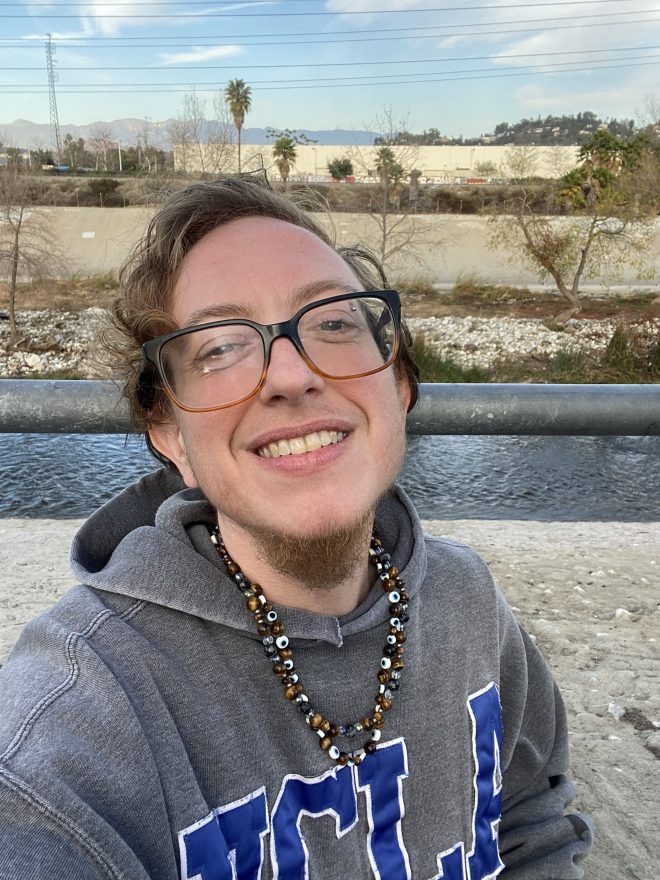
M. Lopes da Silva (he/they) is a non-binary trans masc author, poet, and artist from Los Angeles. His short fiction has been published within In Somnio: A Collection of Modern Gothic Horror Fiction, Stories of the Eye, and at Electric Literature. Weirdpunk Books released his collection of heartbreaking/exquisite trans and queer horror stories, Infinity Mathing at the Shore and Other Disruptions, in March of 2024. You can find him on Instagram @authormlopesdasilva and on BlueSky @mlopesdasilva.bsky.social.
About the Narrator
Jordan Kurella

Jordan Kurella is a queer and disabled author who has lived all over the world (including Cairo and Chicago). Their work can be found in Apex, Glitter + Ashes, and Strange Horizons.
