

PseudoPod 1009: Christmas Eve at Beach House
Christmas Eve In Beach House
By E Lynn Linton
It seemed as if the Mackenzies were under a spell, and that none of the men were ever destined to die in their beds. We sometimes see this strange law of persistent accident run through a family, and generation after generation fulfils what looks like the ordained decree, either of violent death or loss by fire, either of shipwreck or that mysterious and sudden disappearance when a person goes under like a stone in the water, and is never heard of again. I, who write this, know of a family where the law of “running away” has been in force for four generations; one or more lads of each brood having run away from home, school, or legal master as the case might be—some turning up again after a season of wild-oat-sowing, perhaps all the better for the process, but others gone forever, and their ultimate fate a mystery, never cleared up.
The law of the Mackenzies was, as I have said, a violent end. Old Zachary the grandfather, and Michael the father, of Captain Charles, had both died of their sins or, as the traditional phrase went, “died standing;” and Captain Charles himself had disappeared. He was a married man, but a wild one, according to the way of the Mackenzies; and ten years ago had been serving with his regiment in Cornwall, while his wife and two children left behind in London never knew more of him than that he was reported absent when he should have returned to his quarters at Truro after a week’s leave, and that from that time to this he was missing, and had left no trace behind. Every effort had been made to find him, but without success; and his family had by now almost given up the hope not only of seeing him again but of knowing what his end had been; though indeed his widow, poor soul, who loved him as certain women do love scampish men, handsome, affectionate, generous, and unfaithful, still clung to hope against hope, and refused to wear the conventional weeds, or do more than “provisionally” administer to his effects. Still, there the mystery of his fate remained, and it looked likely enough to remain a mystery to the end of time. Meanwhile the son grew up, and went out into the world; and now the daughter Alice had just married Walter Garwood, a young man of some means and roving habits, and so had begun life on her own account when this story opens.
Walter Garwood, an artist by temperament and a rentier by profession—which means of no profession at all—had one absorbing passion, namely, a love for the wild seacoast, which he must enjoy in the most absolute solitude if he would enjoy it at all. So he took Alice down for their honeymoon to Cornwall, a country which he knew by heart so far as its coastline went, though he was not a Cornish man by birth; and the fair delicate young London girl was soon initiated into the mysteries of loveliness to be found in rolling seas and weather-beaten crags, with a solitude almost as deep as death.
When he heard that Beach House was vacant—a lone place among rocks and cliffs, miles away from any town, and not within call of any other gentleman’s house, the nearest neighbours of which were half a dozen fishermen in a hamlet some two miles off—he resolved at once upon taking it, as a man who knows his own mind and who has found what he wants. It was in a dilapidated state enough. The garden, or what had once been the garden, was a tangled wilderness of weeds; the house wanted all sorts of repairs; but money and taste can do a great deal, and Alice was as yet too young a girl, and too fond a bride, to have a will of her own or to find a flaw in her husband’s. To be sure she was a little shocked when she saw the barren, deserted, God-forgotten ruin out of which Walter meant to build her a home that was to be the most beautiful thing in England; but if he said it would be beautiful she was sure it would be so, and in her simple faith began to take a profound interest in everything about the place, and to enjoy going over to superintend with her husband the alterations and improvements he was making. In time the work was done, though it had been a weary time; and just as October set in, the young people took possession, and began their home life in earnest.
It was indeed a wild and lonesome home that Walter had chosen for his wife. Sea-fowl screamed about it, and the angry waves beat up on the iron-bound coast, and every now and then a vessel, mastered by the wind, drifted close upon the rocks where lay the doom of many men; but the scene in general was of nothing but a wild waste of waters, with the bold headlands to the side running far out into the sea, and the sunset flooding the sky with gold or bathing it in blood.
The house itself was set on secondary height, overshadowed by a huge cliff which rose above, seeming to shut off all access to the upper world, and the wild rough shore below was no pathway to civilization. The only road that led to or from the house was a steep, little-used winding way. Indeed, it had been totally unused by all wheeled vehicles for the last six or seven years, during which time the place had been empty and had become overgrown with weeds, rutted and channelled with winter rains, in parts as unsafe as it was unsightly.
Truth to tell, Beach House had always been a difficult property to let. It had got a bad name among the fishermen of the little hamlet, and he would have been a bold man who would have denied the report that it was haunted—the fishermen said with ghosts, and the landsmen added with smugglers.
Be that as it may, both fishermen and landsmen were shy of passing it any time after sundown; and more than one belated sinner had been scared into sobriety and religion for the rest of his life by the nameless horror of what he had seen or heard at Beach House, somewhere about midnight.
But the Thing haunting the place was not always equally terrible. It was only about Christmas-time that the worst and most deadly things happened—though indeed when you came to inquire closely, and probe deep, as to what those things were, you could find nothing more definite than, “I was skeared,” and “I dunno what it were, but there was a summit;” and “I heerd a grane and a sigh, and a patter patter of feet, and I rin.”
The only man who was not afraid was Jem Penreath; and he had volunteered to take charge of the place while it was empty, and had therefore made it his home, and had always kept about it. When asked if he had ever heard or seen anything, he would laugh unpleasantly and say, “Nay, nay, the ghosts knows me, and I know un, and they know better nor to trouble me with their nonsense, that do un!”
We may be very sure that nothing of all this was told to the newcomer, Walter Garwood; and when he bought and took possession he was as innocent as a child that the place had a bad name, or that it was supposed to be haunted with ghosts or with smugglers, with the disembodied or the embodied.
This Jem Penreath was a man whose character fitted in with the house he chose to guard, and whose appearance fitted in with his character. He was handsome in a way: a tall, brawny, broad-shouldered man, with a reddish-brown beard; long, thick, tangled locks, reddish-brown, dark, deep-set, fiery eyes and an expression of lawless daring that, taken in connection with his tremendous strength, made one shudder. He was known as the most reckless and defying savage of the whole district, and the strongest. Smuggling, drinking, wrecking, or work that would knock up any other man—all came alike to him. He did not seem to value his life more than a rat’s or a crow’s, and no one’s else more than his own.
Everyone was afraid of him; everyone fought shy of him; yet no one knew anything definite against him. Or if they did, they kept it to themselves. Folks said he had been much worse in these latter times, since Mary Mainfote so strangely disappeared some ten years ago. He had loved Mary all his life, but she had never said the word, and often told her friends she never would. She did not favour Jem Penreath’s addresses, and used to say, tossing her fair head with its wealth of golden hair, that for her own part when she had a man at all she would have one she was not afraid of, and knew the life of.
“I do not take with dark ways,” she would add; and Jem Penreath’s ways were unquestionably dark.
Jem swore, many a time, that if she would not be his she should be no other man’s; for that he would, “scat the head on un,” if anyone dared to take what he desired. And this threat seemed to have frightened his mates; for though Mary was the prettiest girl of the fishing hamlet to which Jem belonged by birth, no man had yet made her his wife, and she was past twenty when she disappeared.
The last known or seen of her was on Christmas Eve—a wild one—after she had returned from Truro, where she had been staying with an aunt. Old man David—he was dead now—said he saw her walking down the rough road which led to Beach House, with a stranger and a gentleman. He was not one of them, he said, nor one he had ever seen before, nor a working man in his Sunday best. No, he was a gentleman, with black beard and curly hair, and he stood very upright, and they were walking down the road and talking—leastways he was talking to her—as if he had summut to say very pressing and as they got on he put his arm round her waist, and she didn’t seem to say him nay.
No one else had seen them; at least no one who told anything; but there had been a pair of eyes watching them as well as old David’s, only he who saw them coming down that steep rough road said less than David, and kept his own counsel.
David’s tale was accepted as final; and after Mary’s disappearance it was set down as a fact that she had gone off with the strange gentleman who was not known in these parts, and had come to no good, poor lass! But ever since her loss, Jem Penreath, savage as he always was, had become more savage still, more reckless, more Godless, more dangerous every way; till more than once the elders of the hamlet spoke about him among themselves, and said he would do hisself or some on un a mischief afore he was under grass.
For his strength was something almost terrifying; and he knew, as well as any of them, that he was master of them all when he chose to exert his authority and put out his power.
He was terribly annoyed when Beach House was sold to young Walter Garwood. It was turning him out of his home, he said, with many a bitter oath; and he prophesied but a short term of ownership for the newcomer.
“The ghostes would do for un,” he said, with a short laugh. “Them and me bin old friends, but they do take on against new folk. Iss, sure enough the ghostes will do for un!”
But though the Garwoods had been in possession from October until now, near Christmastime, their home had as yet been very quiet, and they had heard nothing of either ghosts or smugglers. To be sure there were odd noises every now and again in the house, and queer things occurred about the place that could not be accounted for; but “rats” have broad shoulders, and bear heavy weights in country places.
Alice, in her secret heart, added smugglers; but she thought that even if they were in the immediate neighbourhood—in some cave, maybe, among the rocks nearby, of which she and Walter knew nothing—so long as she and her husband did not pry, and did not discover, they were safe, and perhaps more than safe. The very fact of their living there—two young, innocent people, who did not smuggle on their own account, who had no connection with smugglers, who would not know how to set about smuggling if they tried, or what to do with the things if they had them—being so much of a guarantee for the respectability of the immediate beach, would be a protection to their less reputable neighbours. Which was not bad reasoning on the part of that young and timid London girl.
There was one thing however that she did not like—the persistency with which Jem Penreath used to come about the place. From the first she had taken one of those strong, shuddering dislikes to him, not rare with a certain kind of nervous organization. She could not explain why, but his presence filled her with an infinite undefinable dread, and she could never meet his eyes.
But she did not say anything to her husband beyond her first expression of dislike, which had not touched Walter very deeply. And he, a born artist, cared more for the man’s picturesque magnificence of build and face than he cared for the evil spirit lurking behind those deep-set flaming eyes; and because he made a striking accessory to the scenes he was so fond of painting, encouraged him to come as often as he liked, and went into raptures over the tones of his grey jersey which the red rays of the setting sun turned to purple, or the value of his scarlet cap among the bleached old rocks, or against the slaty background of the sea.
Encouraged then as he was by the master, Jem had no cause to stay away, and every day he came to Beach House on one or other pretext. But as all, save Walter, saw for the main reason of keeping an eye on what was doing there—though neither maid nor man, still less the young mistress, who kept close to her own room when he was about, could divine what it was he wanted to watch. What it was he feared would be found out.
Surely something in the place did not agree with Alice. She had grown thin, and pale, and melancholy, and was quite unlike the fresh, if delicate, young bride who had come over in October to take possession of the new home. The change which had been wrought was painfully great and sudden, but Walter—dreamy and abstracted as he was, absorbed in his poetry or his art—had noticed little. And it was really a strong proof of love that he noticed anything at all, that he saw any change, short of death itself, in his wife.
It was about a fortnight before Christmas, when the days were at their shortest and darkest. Alice was sitting in the bay of the window, gazing into the garden, and looking across the wide sea, where not a living thing was in sight save the wild birds that wheeled and circled in the waning light. There was neither colour nor savagery enough to make a picture or a poem—it was just a uniform cold grey throughout—and Walter, wearied with the book he had been reading alone in the study, threw it down on the table, and sauntered into the drawing-room where his young wife was sitting, also alone, in the deep bay-window looking over the wild sea.
“My darling! how pale and ill you are looking!” said Walter fondly, as the light fell on her upturned face. His eyes were suddenly opened, as is often the way with unobservant people; and for the first time he noticed what the very servants had seen and commented on for weeks. “Are you ill, Alice?” he continued, drawing her close to him. “What is the matter with you, darling?
“I don’t know, dear,” she answered, with a heavy sigh; “nothing, so far as I can tell; I only feel weak, and so stupidly nervous! I cannot tell you what a coward I have become, Wally; I could scream if a bird flies suddenly before me, and I am afraid of my own shadow. And then I have such dreadful dreams; or they are scarcely dreams. They are like visions more than dreams, for I seem to myself to be wide awake all the time.”
“What dreams, dear? You darling little coward! Why, I never imagined you were such a little faint-heart. I am afraid our lonely life is too much for you, dear. If you are going to have all these fancies, I don’t know what I must do with you; send you back to London, I think.”
He spoke tenderly for all the lightness of his words, smoothing her fair hair and kissing her forehead at every pause. Now, come, bring these dark things of yours into the light, darling, and tell me what your dreams are like. There is nothing like telling a thing of this kind to get rid of it. The mind falls into tricks just as the body does, and bad dreams and ghostly visions are its commonest tricks. What is it, my own?”
The girl shuddered and pressed a little closer to his bosom. Dreams of poor papa—” she half whispered. “I have such dreadful dreams or visions I don’t know what they are—about him, Wally. Night after night he seems to come to my bedside, so pale, and with all the blood streaming from his head. And he looks at me so sorrowfully; it is the sadness of his face that makes me so wretched, far more than the horror of even the blood about him. And sometimes I see what looks like a woman’s head, with a quantity of fair hair, near him, but I cannot see her face; and sometimes,” here she shivered, and drew her breath, as she sank her voice so low that Walter could hardly hear her. “I see a man like that Penreath, standing by them, with such a scowl, such a terrible expression on his face! Oh, Walter, dear,” she went on, weeping now, “you know that poor papa was lost in Cornwall when he was quartered at Truro. I do so fear that something bad happened to him—something worse than being drowned, or lost in an old mine, which I remember our friends used to tell poor mamma was the most likely thing. Oh, Walter, what shall I do? It is killing me!”
“Poor, sweet child! what can I do for you?” said her husband tenderly. “Shall I send you away for a while? No? Shall mamma, then, come and stay with you?”
“Yes, yes!” she cried. “I did not like to ask you, darling, for it looked as if I was discontented, but I should like to see mamma again. And, oh, I should like to have her here! She won’t mind the loneliness and wildness, I am sure, and I shall be so much happier when she is with us again. But, Walter,” and again that shiver passed over her, “she will not see anything, as I do, will she?”
“My dear!” he said, in a deprecating voice, “what would become of the world if we were all as sensitive and imaginative as you? No; I should think that mamma would sleep quietly enough, and not have the same bad dreams as her restless little daughter.”
“But why do I dream so much, and so continually the same thing?” persisted Alice. “Oh, Walter, if you could only see him—poor, dear, handsome papa—with that great wound in his head, and that sad, sad face! And he looks at me so pitifully! and then the woman’s yellow hair seems to fall across his breast, and that dreadful man’s face comes in, oh, so horrible, so fierce! Walter!” she cried, her passion rising and overmastering her caution, “I am sure he has had a hand in something bad! I am sure he has done something wrong to papa. Oh!” she shrieked, clinging to her husband nervously, as a heavy step ground on the gravel walk before the windows, and Jem Penreath, in a red cap and jersey, stood dark against the dusky sky, holding in his hand a batch of fish, which was his excuse for his evening’s visit to the house.
Walter dashed out, and for the first time spoke to him angrily, and ordered him out of the garden.
“What business had he,” said the young man haughtily, “to come before the drawing-room windows in that rude manner? Did he think the place was his own, that he had so little respect for any one in it?”
Jem made no answer. It would have been better, perhaps, if he had; for even Walter was startled, and for an instant almost terrified, at the sudden savageness, the fiendish fury that came into his face. He compressed his lips as if with an effort, then in a hoarse voice, but a quiet manner, said, “I brought un these fish, mayster. Fish do be scarce just now, and I thought as the young mistress ud like un.”
But Walter, though a trifle scared, was not to be “got over,” and went on berating him as young men will when they have a grievance, and the offender is beneath them in social circumstances.
To all of which Jem Penreath answered not a word, but stood with his eyes bent to the ground; once, and once only, lifting them, as he said, with a forced voice of patience, and a terrible look to belie it, “Then, may be, the young mistress do not want the fish, and I be losing my time, and yours, mayster?”
And when he had said this he turned away, and disappeared behind the rocks.
“Yes, Alice is right,” thought Walter, as he went back into the house. “That Penreath is a dangerous fellow. I wonder I never saw it before!”
Of course Mrs Mackenzie accepted the invitation to that wild Cornish home, where her darling daughter was, as she termed it, “buried alive;” and a few days saw her safely housed, too happy in her girl’s society to feel at first the full force of the wildness, the desolateness of the scene, and entering into all the small domestic details of household arrangements as only a mother can.
Among other things—it was only a trivial matter, perhaps—she urged on Alice to make a laundry of a certain outhouse not far from the kitchen, and which at present was a mere stick and lumber place. “The washing” was one of the grievances of the young wife’s life as it stood, and a good laundry would make this little hitch run smooth. So mamma proposed, and Alice requested, and Walter gave the order, that the outhouse should be cleared and set to rights, and made into a laundry with all despatch.
They sent over to the nearest town for the proper workmen to see to the copper, the flue, the ironing-board, and all fit appliances; but first the place had to be cleared, and some of the men in the fishing hamlet—times being bad, and neither fish nor wrecks on hand—volunteered to help the town workmen, and save their time and the master’s by clearing the place for them.
Since his fall-out with the master, Jem Penreath had been less than usual about the place, so that he did not quite know what was going on; and when he heard down in the village that the young master of Beach House was going to fit up a fine new wash-house out of the stack-house at the back, even his mates were astonished at the ferocity with which he swore he should not do it.
“A fool!” he said, with an oath; “a wandering, idle fool! Can he not let un alone ? If he can’t he must learn, and I be the one for to teach him!”
On saying which he strode out of the beer-shop where he was sitting, and darted off to Beach House as if life and death depended on his speed.
“Where’s the young master?” he asked, as he flung himself into the kitchen.
“Law, Jem, an’ you do skear me !” cried the servant, letting the jug she was carrying fall from her hands. “Master? He be out,” she answered after a pause, during which Jem’s roving bloodshot eyes seemed, as she said afterwards, “like swords.”
“And the young mistress?” asked Jem, in his hoarse harsh voice, that had almost the effect of an animal’s growl.
“She? She be in the drawing-room,” replied the girl.
And Jem Penreath, without another word, passed through the kitchen and shouldered his way to the drawing-room where Alice and her mother were sitting.
He knocked at the door, perhaps a little roughly, and a startled voice said, “Come in,” with an accent of terror that was almost a scream.
Jem opened the door, and came forward.
“Ye be a-thinking of that stack-house?” he said, touching his cap, which he kept on his head.
“We are clearing it out,” Alice answered with a visible shudder, as the man pressed forward.
“Ye do foolishly,” Jem said. “I know the place, and ye do know nothing of it. That stack-house, it will tumble down about your heads if ye do touch it. It is all rot-beam and rafter. Be warned by me, miss, and leave un alone.”
“I do not interfere in my husband’s arrangements,” Alice answered, with a fair amount of dignity. “If you have any advice to give about the house you had better give it to him.”
“But the boys are at work in it now, miss; and I must speak to you, because I do not know where the young master be; and you would be skeared, and more than skeared, if you heard the place abanging down like a cannon-ball about un’s head; and it will, I tell ye. Be warned, I do say to you again!”
In his eagerness, Jem pressed still nearer to the table by which the two ladies were sitting. In the middle was a large painted miniature of her husband, the handsome captain, which poor Mrs Mackenzie always carried about with her. It was her fancy to have this beloved face forever before her, and she had brought it with her to Beach House, where it stood on Alice’s table as she had remembered it, for more than ten years now, standing always on the table at home. It had been taken just before Captain Mackenzie had gone into Cornwall—that fatal sojourn from which he had never returned; and it was a wonderful likeness. It caught Jem Penreath’s eye, and Alice’s blood froze in her veins at the strange, only half-checked, groan, mingled with a curse, which the man uttered as his eyes fell
“Who’s he? ” he said abruptly, and he touched the picture with his hand.
The girl snatched it up and pressed it to her bosom, as if to protect it.
“My father!” she cried, standing up, white and trembling, but meeting Jem’s fierce look with the courage of desperation.
“My husband! broke out the poor widow, laying her hand on the man’s arm. “Did you know him? Can you tell me anything of him?”
“I didn’t know him, and I cannot tell you of him,” said Jem, speaking slowly and as if with difficulty; but by this time he had restrained himself, and had lowered his eyes to the ground.
Then he said no more, but still never raising his eyes, turned round and left the room, and they heard his heavy tread echo through the passage.
A sudden fear possessed Alice. “Where is Walter ?” she cried. “Mamma! come with me! that man will kill Walter! I saw it in his eyes; he means to kill him as he killed papa!”
“My child—Alice—you are raving, darling!” said her mother, soothingly, but she too was trembling.
The whole scene, strange, unintelligible, harrowing as it was, had shaken her nerves, and while trying to restrain, even to support, her daughter, she needed comfort for herself.
“I know what I am saying, mamma—come with me! come! ” Her voice had risen now to a shrill scream, as she caught her mother by the arm and dragged her with her through the passage to the kitchen, and so on to the stack-house which the men were clearing.
It was a wild dark evening, and the wind was sobbing round the house in fitful gusts that told of a rising storm for the morrow. Yet tomorrow would be Christmas Day—that day of joy to thousands, of peace, and love, and pleasant knitting-up of home-ties, of tender regrets for the past, though dead not buried nor yet forgotten, of loveliest hopes for the future—that day associated with all that is best in the heart and the life of England. The first Christmas Day that Alice had ever spent away from her mother’s home.
But what a Christmas Eve was this! Dread and nameless anguish within doors—without, gloom, desolation, and the awful signs of a coming storm. The wind was moaning across the tossing stretch of waters; the sea-birds wheeled low, and shrieked and screamed as if in pain; the wild waves dashed against the sounding beach, and tore down the shingles as they were sucked back into the vast world of seething waters; the heavy sky hung low and lowering-ah! it was, indeed, a threatening Christmas Eve on that wild Cornish coast, and even the hardy fishermen themselves felt the foreboding influences, and were saddened though they did not tremble.
Within the stack-house the men were working by the fitful light of a few lanterns set on the floor, and the candles which, miner-like, some carried in their caps. There were three sturdy fellows from the hamlet; the master workman from the neighbouring town, come to take measurements when the place should be cleared; and Jem Penreath, haggard, anxious, desperate-looking, facing Walter Garwood who stood with his hands in the pockets of his shooting-jacket looking on, every now and then pausing in his work to gaze full at the young master, with something in his face not pleasant to behold.
He had tried to persuade him to leave the work alone, but Walter would not, and all the more because the man was so strange and so persistent. It was noticed at the time, and spoken much of afterwards, how Jem stood doggedly to one side of the house where the heaviest stakes were: why did he look so often at Walter, balancing that heavy club across his palm, and with a kind of speculation in his eyes, a kind of preparatory spring in his feet? And how he wrought there, not so diligently as noisily, moving about the logs and stakes and brushwood piled up in that corner with a great show of exertion, but doing so little that the other men had turned out all the rest whilst his part was still unfinished. And it was noticed too, how fierce he looked towards the young master, and how, once or twice, still balancing that heavy stake across his palm, he had edged a step or two nearer.
And yet, what ill had the young man done? And what cause had they to be afraid that Jem would do him a mischief? But one of them, somehow or another, always managed to get between Walter and Penreath; and just as they came up to his side of the place, and began to clear away the rubbish thence, Alice, wild and white, stood in the doorway, and calling his name aloud, rushed forward to her husband.
He turned at the beat of her hurrying feet, at the sound of her frightened voice, and the turn saved him; for as he stepped aside, a heavy beam came down on the very spot where he had stood, and at the same moment a loud exclamation broke from one of the men. A loose board had rotted, and the heavy fall of the beam broke through the crumbling wood—broke through on to a battered mass of earth, which it stirred and scattered, showing the handle of something that looked like a cutlass, and a stiffened end of darkened cloth—some parts a lightish grey, others a blackened red.
“Why, what’s this?” said the master workman from the town, stooping down.
“Leave un alone,” hissed Jem, laying his broad hand on the man’s shoulder; “leave un alone, I say, or it may be the worse for ye!”
“Hey, man! what’s this ye say? It do look like knowing more about a dark job than ought to be,” answered the townsman, thrusting him back, while at the same time he pulled at the handle, and brought out a rusty cutlass, with one deep hack in the blade.
“There’s more where that came from,” he shouted; for he was excited, and the find was suggestive.
“Lower the lights, men, and work away!” cried Walter. “Mother, look to Alice,” he added, he too pressing forward with the rest.
But Alice was not to be kept back. Her eyes wild, her lips apart, her young face blanched, and strangely stiffened in all her limbs, she stood close by Jem Penreath, despite her horror of the man, holding her mother by the wrist, and forcing her to look too. Spadeful by spadeful they uncovered what was lying under the earth—slowly as it seemed to those who, excited, strained, half-maddened, according to their degree, waited for that which was to be revealed. And then they uncovered—what?
The crumbling bodies of a man with short, dark, curly locks, and of a woman down to whose waist fell a mass of golden hair. Across the man’s breast hung a thick gold chain of a peculiar pattern, to which was attached a locket that had been forced open, and the locket held the miniature likeness of Mrs Mackenzie, and on the fleshless hand glittered a diamond ring.
A piercing shriek burst from the poor widow. It needed no second glance to tell her who and what she saw. “My husband! Charles! Oh, Charles!” she sobbed, flinging herself on her knees by the terrible grave.
“And this is his murderer!” cried Alice, as she clutched Jem Penreath by the arm, and held him.
Strong man as he was—none stronger in all the country round—that slight girl’s touch held him. He stood for a moment paralysed and lost. His memory went back to this very day ten years ago—almost at this same hour—when he had stolen on the traces of Mary Mainfote and her gallant lover from Truro, as they took shelter in this deserted out-house from the storm, and ended both their lives together. There had been no struggle, no outcry, no pleading for life—only a woman’s hand had grasped his arm, scarcely knowing what it did in the terrible suspense of the moment.
Quietly, as they sat there in the deepening gloom, he had stolen upon them from the other side, and one blow had struck the life out of him who had gained what he had been refused, another had finished the work on her, and had avenged his denial in blood. The whole scene, so swift and bloody as it had been, wrought itself again before his eyes, so that he had not felt the tight hand which grasped his arm with fingers braced to slender bars of steel as hers had been.
But when the men came forward, his senses were aroused. The touch of the woman’s hand had been only a continuance, a part of the vision that had been conjured up again before him; and when the men’s rough grasp seized him, he woke back to himself, to his manhood, to his strength, and with a laugh of contempt he shook them off, and stood at bay.
“Ay, boys, it’s come at last!” he said, “and ye see it before ye. I swore it, she should never be living man’s if not mine; and I kept my oath; and I kept it well. She and him, they lie there where they courted, and where I watched them, boys, and went mad; but not so mad that I could not strike—that I could not end it all before the day came when she was to go with him—to her shame. Now, ye have it all; and do your worst!”
Swift steps pressed forward, sturdy hands were thrust out, but, swifter and stronger than any, Jem Penreath thrust them all aside, then sprang through the doorway, and was down the steep rocks before they could tell which way he had gone; and, search as they might, he never was seen in the place again, and never a sign, never a trace of him was found.
Days after, drifting with the current, washed up by the tide, a dreadful human corpse was flung on the shore of a lonely French village. It was buried in the small churchyard, and masses for the dead were said in its behalf; and some pitiful little maiden flung a crown of immortelles on the nameless sod; and kind souls sorrowed, thinking of the friends and lovers of the unknown—parents maybe, maybe children, wife, or lover—who would watch and wait through days and weeks of agony and hope deferred, till perhaps the poor burdened hearts could bear no more, but would break under their weight of misery.
So they made up tender and pathetic stories over the corpse that had floated to their shores; and none dreamt of that bloody scene which one Christmas Eve saw enacted, and another revealed.
Beach House was soon deserted again after this, and the Garwoods’ short occupancy seemed to be the end of its life as a dwelling-place. It fell into ruins, and got a worse name than ever, being said to be accursed, and to bring ill luck on anyone possessing or occupying it.
And when the news came down that way that the poor young lady had gone clean out of her mind since that awful night, and the doctors said she would never be herself again, Beach House was blamed for it all, and the curse was held undoubted.
But Alice was not in quite such a hopeless state as report made out. She did certainly for a time lose her reason, but she rallied again, and threw off her malady before it had struck too deeply. And by care, and the kindly agency of time, she lost the vividness of the horror that had overtaken her, and remembered that terrible evening only as one remembers a bad dream—a dream that may darken, shadow, sadden our day, but that does not destroy the years, nor extend into the future.
Host Commentary
I looked up E Lynn Linton as I was thinking about my hosting notes for this episode, and I came across the comment that her writing took an anti-feminist slant. I haven’t read nearly enough of her work to argue with a scholar on this point, but, reading this particular story… I wonder. Did it? Or was she, to apply modern terminology, more… trolling?
In this story she’s made the husband especially obnoxious and the wife especially wet, and I’m not convinced we’re meant to take that at face value. The strong-willed Mary is an interesting character, if a dead one, and Linton tells her tale in such a way that the initially wishywashy Alice is forced to pull herself together, while her revoltingly patronising husband Walter is forced to admit that his wife is right all along, hah. And the violent, abusive and entitled Jim Penreath falls, or jumps, off a cliff. Good riddance.
The relationships here seem pretty realistic of the time, and in some ways, those times have not changed as much as we might like. There’s a certain kind of man that prefers younger women, not just for their looks, but because they’re easier to control. It’s all about being with someone who’ll look after your needs while not asking very much in return. Who will put up with things that older women are considerably less willing to tolerate.
The trouble with this, of course, is that young women have a terrible tendency to grow up into older women. To, we might say, throw off their maladies before they have a chance to strike too deeply.
And then, let’s talk about ghosts…
Ghosts don’t exist, except when they do. It started as a comment from Dr. Frizzle on Bluesky, and it’s since become almost a running joke. Like most jokes, there’s a hefty dose of truth inside it. I’m a scientist by training and, sure, ghosts and fairies and aliens and telepathy don’t really exist in real life. Except… my Dad will tell you he definitely saw a leprechaun jump through a wall once, and my Mum will swear she’s experienced ghosts. My Granddad had at least one story about a soldier who had a premonition of the future.
Don’t we all throw salt over our shoulders and blow on dice and say bless you when someone sneezes? Salute magpies and wince if shoes, even pristine new ones, are put on a table? Or if none of those, then other little bits of magical thinking. Lucky socks. Telling someone we’re thinking of them. Crossing our fingers. A sneaky look at our horoscope. Wishing on a shooting star or a birthday candle.
Of course, we don’t believe.
Except when we do.
Mystical phenomena don’t exist.
Except when they do.
And the ghosts in this story are definitely just rats running around in an old building. Right up until the moment they’re not.
Christmas, as this story tells us, is: “a day of joy to thousands, of peace, and love, and pleasant knitting-up of home-ties, of tender regrets for the past, though dead not buried nor yet forgotten, of loveliest hopes for the future.”
But that’s just it, isn’t it? It is a bleak time of year. The cold, dark heart of it, when light and food and warmth are scarce. We light lights and sing songs precisely because of that darkness. We tell ghost stories at Christmas, because we can’t help acknowledging this contrast. The land sits on an edge, and we can only hope for something brighter to come. We set lights in the sky and say happy new year in the hope that it… might be.
So, since it is the end of the year, I must say some thank yous!
About the Author
E. Lynn Linton
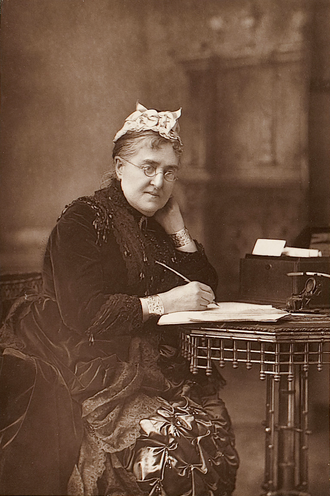
E Lynn Linton was the author of over 20 novels. She was born in Keswick, England, in 1822, the youngest of the twelve children, and was largely self-educated after the death of her mother when she was just five months old. In 1845, she left home to earn her living as a writer in London, promoted by Theodosia Monson, who was a champion of women’s rights. She finished her first novel, Azeth, the Egyptian, in 1846, and also began working as a journalist, joining the staff of the Morning Chronicle in 1849 – the first woman to be paid a salary as a journalist. She later moved to Paris where she became a correspondent for The Leader, and was a regular contributor to Charles Dickens’s Household Words, the Daily News, and other leading newspapers. She became one of the best-known women periodical contributors of her time.
About the Narrator
Lewis Davies

Lewis Davies – is an ex-actor turned history teacher and you can follow him @lewiskernow on twitter. He is always looking for opportunities to read aloud.
